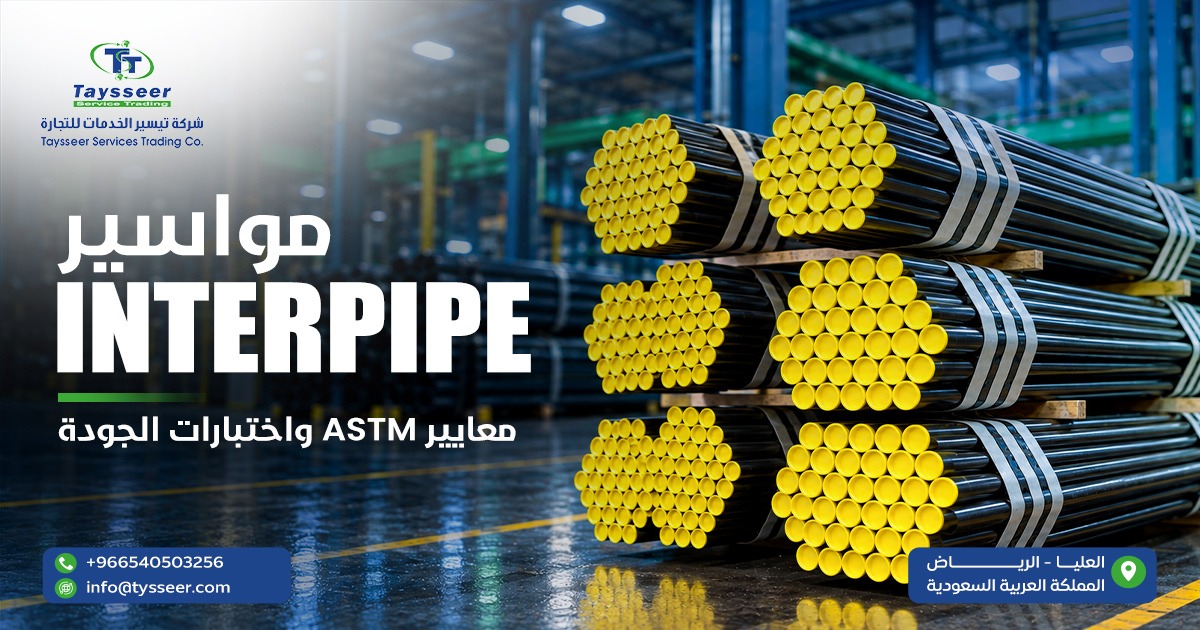
For contractors and procurement teams sourcing Interpipe Carbon Steel Pipes Saudi Arabia, brand selection is only the first step. Every pipe must strictly match approved project specifications, including size, Schedule, ASTM standards, manufacturing methods, and testing requirements.
We Tysseer Service Trading supplies carbon steel pipe products across Saudi Arabia, offering technical guidance, documentation, and quotation support. This comprehensive guide explains how to evaluate Interpipe products, review technical catalogues, distinguish seamless from welded pipes, and verify material compliance prior to procurement.
Interpipe Carbon Steel Pipes Saudi Arabia and Their Main Types
Interpipe is a Ukrainian industrial group with a tubular-products business covering a range of seamless and welded steel pipes. Its published product information includes pipe solutions for industrial, construction, water, heating and air-conditioning, structural, and pipeline-related applications.
For Saudi projects, the useful way to classify Interpipe carbon steel pipes is by the technical characteristics that affect procurement and installation rather than by the brand name alone.
- Seamless pipes for applications where seamless construction is specified.
- Welded pipes for systems where the applicable standard and project specification allow welded construction.
- ASTM and API specifications that define the applicable technical requirements.
- NPS, outside diameter, and wall thickness used to establish the required dimensions.
- Schedule used to identify the applicable wall-thickness series.
- Black or galvanized finish where the selected product and project specification require it.
The important point is that these classifications overlap. A pipe can be seamless, carbon steel, ASTM A106 Grade B, Schedule 40, and black at the same time. That is why a professional RFQ needs more detail than simply stating “Interpipe pipe.”
Interpipe Ukraine and the Manufacturer’s Product Range
Interpipe Ukraine is particularly relevant to buyers because the brand is associated with Ukrainian manufacturing. Tysseer‘s current Interpipe product page identifies Ukraine as the country of origin, while the manufacturer’s own site provides product information and technical resources for different pipe families.
Interpipe’s product documentation covers both seamless and welded pipes, with different standards and dimensional ranges depending on the intended application. Its official material for heating and air-conditioning systems, for example, lists seamless and welded products under different ASTM and EN standards.
This matters when reviewing an offer in Saudi Arabia. The correct approach is to identify the exact product line first, then confirm its standard, dimensions, manufacturing method, and documentation. The country of origin confirms where the product comes from, but it does not replace the technical specification.
Interpipe Catalogue and Technical Documents
Before preparing an RFQ or Material Submittal, technical buyers often need the Interpipe catalogue or a current product datasheet. The manufacturer’s website maintains a dedicated library of marketing materials and catalogues covering different applications and pipe product groups.
For a procurement team looking for an Interpipe Ukraine catalogue PDF, the most reliable reference is the current manufacturer documentation that clearly identifies the product family, applicable standards, dimensions, and revision or publication information.
The same principle applies when a project team needs an Interpipe seamless pipe catalogue or dimensional data for a particular size. A catalogue should be used to verify the product range, while the project specification and the final technical offer should determine the actual configuration being quoted.
This distinction becomes especially important with searches around Interpipe seamless pipe Schedule 40. Schedule 40 should not be treated as a complete product description. The quotation should also identify the nominal size, standard, grade where applicable, manufacturing method, finish, quantity, and required certificates.
Tysseer’s Interpipe page is designed around this same project-oriented approach, with technical specifications and documentation available for project requirements.
ASTM Standards for Interpipe Carbon Steel Pipes
ASTM requirements are often one of the first items engineers and procurement teams review when evaluating carbon steel pipe.
Among the standards associated with Interpipe products are ASTM A53 and ASTM A106. Interpipe’s certification resources include ASTM A53/A53M and ASTM A106/A106M certification records for Interpipe Niko Tube facilities.
ASTM A53
ASTM A53 covers specified types of welded and seamless steel pipe, including black and hot-dip zinc-coated pipe within the scope of the standard. The exact pipe type and applicable requirements must be confirmed from the standard and the project specification.
ASTM A106 Grade B
ASTM A106 Grade B is associated with seamless carbon steel pipe for high-temperature service. It should therefore be selected only where the service conditions and project requirements call for the applicable standard and grade.
For this reason, the correct Interpipe ASTM A53 or Interpipe ASTM A106 Grade B configuration cannot be selected from the brand name alone. The engineering requirement comes first.
| Item | What Should Be Confirmed |
|---|---|
| ASTM A53 | Pipe type, grade, dimensions, finish, and applicable tests |
| ASTM A106 Grade B | Seamless construction, grade, dimensions, service conditions, and documentation |
| API 5L | Applicable line-pipe requirements, grade, dimensions, and project specification |
Interpipe’s current certification database also includes API 5L certifications for applicable manufacturing facilities, which makes certificate scope an important part of technical verification.
Interpipe Seamless Pipes and Welded Pipes
One of the most important distinctions when selecting carbon steel pipe is the manufacturing method.
Interpipe Seamless Pipes
Interpipe seamless pipes are manufactured without a longitudinal welded seam along the pipe body. They are used across a range of applications where the applicable product specification requires or permits seamless construction.
Interpipe’s own technical materials list seamless products under standards such as ASTM A106/A53, ASTM A333, EN 10216 and other specifications depending on the product line.
For a project requiring carbon steel pipe seamless Interpipe, the procurement team should verify the required NPS, wall thickness or Schedule, standard, grade, length, finish, testing, and documentation before placing the order.
Interpipe Welded Pipes
ERW pipe Interpipe and other welded configurations should be evaluated according to the applicable manufacturing standard and project specification. Welded pipe is used in many industrial and construction applications, but the relevant acceptance criteria depend on the pipe standard and the service requirements.
Interpipe’s official technical information lists welded pipe products under ASTM A53/A53M, EN 10217 and other standards depending on the application.
The manufacturing method should therefore be treated as one part of the specification rather than as a simple quality ranking between seamless and welded pipe.
Interpipe Schedule 40 and Schedule 80
Schedule 40 and Schedule 80 identify wall-thickness series for a nominal pipe size. The NPS can remain the same while the wall thickness and weight change between Schedules.
That is why a purchase request for:
Carbon Steel Pipe – 4 Inch
is incomplete when the project requires a specific Schedule.
A more useful description would include information such as:
- NPS 4
- Schedule 40 or Schedule 80
- Applicable ASTM/API standard
- Grade where required
- Seamless or Welded
- Black or Galvanized finish where applicable
- Quantity and required length
Tysseer’s current carbon steel pipe category lists Interpipe with Schedule 40 and 80 (STD) among the available specifications, while the exact product and size should still be confirmed when preparing a project quotation.
How to Read Interpipe Pipe Dimensions
When reviewing Interpipe ASTM A53 Grade B pipe dimensions, the important information extends beyond the material grade. Engineers normally need to confirm the NPS, outside diameter, wall thickness, pipe length, and applicable dimensional standard.
Interpipe’s technical tables provide dimensions and wall-thickness ranges for its different pipe families. For example, its published heating and air-conditioning information lists separate dimensional ranges for seamless and welded products.
For procurement, the dimensional check should follow the product specification rather than a generic online table. This becomes particularly important where the project BOQ specifies both a nominal size and a Schedule.
Black and Galvanized Interpipe Carbon Steel Pipes
Black carbon steel pipes and galvanized pipes serve different finishing requirements.
Black Carbon Steel Pipes
Black pipe is supplied without a zinc galvanizing layer. It can be used in a wide range of mechanical and industrial systems where the project specification allows it.
Where corrosion protection is required, the project may specify a separate coating or protection system depending on the operating environment.
Galvanized Steel Pipes
Galvanized steel pipe has a zinc coating designed to provide surface protection against corrosion. Its suitability depends on the project environment, connection method, service requirements, and approved specification.
Tysseer’s current carbon steel pipe category identifies Interpipe products with both Black & Galvanized finishing options at the category level. The exact finish should be confirmed for the product configuration being quoted.
How to Inspect Interpipe Carbon Steel Pipes Before Delivery
Inspection should begin with the documents and continue through identification, dimensions, condition, and required testing.
When reviewing an Interpipe shipment, the project team can check:
- Manufacturer and product identification
- Pipe markings
- NPS and outside diameter
- Wall thickness or Schedule
- Pipe ends and overall condition
- Applicable ASTM/API standard
- Material grade
- Heat Number and traceability
- Required MTC or MTR
- Hydrostatic testing where specified
- Non-destructive testing where specified
- Any additional inspection required by the purchase order
This is the practical meaning behind how to inspect Interpipe: verify the physical pipe against the technical documents, rather than relying only on appearance, markings, or brand identification.
Interpipe’s certification and product documentation also show that inspection and certification requirements vary between product lines and manufacturing facilities.
How to Verify the Originality and Traceability of Interpipe Pipes
When buyers ask how to know whether an Interpipe pipe is original, the strongest approach is document traceability.
The Interpipe logo or pipe marking can be part of the identification process, but it should not be the only evidence. A proper check should connect the physical material to the supporting documents.
Review:
- Mill or manufacturer identification
- Product marking
- Heat Number
- Applicable standard
- Grade
- Dimensions
- Mill Test Certificate or Mill Test Report
- Certificate of Origin when required
- Traceability between the delivered material and the documentation
This is particularly important for projects where the material must pass a formal Material Submittal or inspection before installation.
Interpipe Mill Test Certificate and MTR
A Mill Test Certificate or Mill Test Report can provide the technical evidence needed to verify material compliance and traceability.
Depending on the applicable standard and purchase requirements, the documentation may include:
- Manufacturer name
- Product specification
- Material grade
- Heat Number
- Chemical composition
- Mechanical test results
- Dimensions
- Inspection and test results
For projects requiring an Interpipe seamless pipe mill test certificate, the document should correspond to the actual supplied material. The Heat Number is especially useful because it can connect the pipe to the relevant manufacturing and test records.
Interpipe’s official certificate database contains multiple certificates for Interpipe Niko Tube, including ASTM A53/A53M, ASTM A106/A106M, API 5L, ISO and other standards, depending on the facility and product scope.
Interpipe Approvals and Certifications
The term Interpipe approvals should always be linked to a specific product and certificate. There is no single approval that automatically applies to every Interpipe pipe, size, or application.
Interpipe’s published certificate records include different technical standards and application areas, including pipeline systems, construction, pressure equipment, energy and oil-related applications.
For example, a buyer researching whether a particular product is Interpipe UL Listed should check the exact certificate, manufacturing facility, product scope, and intended application rather than treating a certification held by one product as a blanket approval for the entire brand.
Where Are Interpipe Carbon Steel Pipes Used in Saudi Projects?
The selection of an Interpipe product depends on its standard and service conditions, but the manufacturer’s product portfolio covers applications that include construction, water, heating and air conditioning, structural systems, and pipeline-related services.
HVAC and MEP
Carbon steel pipe can form part of heating, cooling, and mechanical piping systems where the project specification allows the selected product. Interpipe itself lists pipe products for heating and air-conditioning systems under applicable ASTM and EN specifications.
Water and Utility Systems
Interpipe publishes general-purpose pipe products for water and related pipeline applications, with different standards and dimensions depending on the product line.
Industrial and Infrastructure Projects
Industrial and infrastructure projects usually require closer control of material standard, operating conditions, dimensions, inspection, and traceability. The BOQ and approved Material Specification should therefore be used as the starting point for selection.
For related project components, Tysseer also supplies Pipe Fittings, Valves, and Pipe Hangers and Supports that can be specified alongside a carbon steel piping system.
Interpipe Supplier in Saudi Arabia
For customers looking for an Interpipe supplier in Saudi Arabia, the most useful supplier is one that can work from the project’s actual technical requirement rather than simply quote a brand name.
Tysseer Service Trading has been active in the Saudi market since 2009 and supplies electromechanical and HVAC-related products to government and private projects. Its current Interpipe product page identifies the product as manufactured in Ukraine and lists applications including government, HVAC, MEP, and industrial projects.
For procurement teams, this means the RFQ can be built around the complete requirement: pipe type, NPS, Schedule, ASTM/API standard, grade, finish, quantity, documentation, and delivery location.
Why Source Interpipe Carbon Steel Pipes from Tysseer?
Tysseer approaches carbon steel pipe supply as part of a wider electromechanical procurement package. This is useful when the same project requires not only pipes, but also fittings, valves, supports, flanges, insulation, or other related products.
The company states that it has operated in the Saudi market since 2009 and works with Saudi, European, American, and Asian manufacturers and suppliers. Its English website also presents Tysseer as a supplier serving government, HVAC, firefighting, and electromechanical projects across the Kingdom.
For Interpipe projects, the practical advantage is having a supplier that can review the BOQ and technical specification before the quotation is issued and coordinate the related materials where required.
You can also review Tysseer’s Carbon Steel Pipes category to compare Interpipe with other available brands according to the project’s approved specification.
Related Carbon Steel Pipe Brands Available from Tysseer
Where a project allows more than one approved manufacturer, Tysseer can also provide other carbon steel pipe brands. These include:
- NKK Carbon Steel Pipes
- Jazeera Steel Carbon Steel Pipes
- PIETRAPIPE Carbon Steel Pipes
- UTPPIPE Carbon Steel Pipes
- HYUNDAI PIPE
The comparison should always be made on an equivalent technical basis. Brand, country of origin, pipe size, Schedule, standard, grade, finish, testing, certificates, quantity, and delivery requirements should be considered together.
How to Prepare an RFQ for Interpipe Carbon Steel Pipes in Saudi Arabia
A clear RFQ reduces the risk of receiving quotations for different pipe configurations that cannot be compared directly.
| RFQ Information | What to Specify |
|---|---|
| Brand | INTERPIPE |
| Pipe type | Seamless or Welded |
| Size | NPS |
| Schedule | Schedule 40, Schedule 80, or project requirement |
| Standard | ASTM A53, ASTM A106, API 5L, or other approved standard |
| Grade | Grade B or the grade specified by the project |
| Finish | Black or Galvanized where applicable |
| Quantity | Total quantity required |
| Length | Required pipe length |
| Project location | Delivery location in Saudi Arabia |
| Documentation | MTC, MTR, Certificate of Origin, datasheet, certificates |
| Project documents | BOQ, Material Specification, Material Submittal |
This level of detail allows the supplier to quote against the same technical basis used by the engineering and procurement teams.
Frequently Asked Questions About Interpipe Carbon Steel Pipes
What are three types of steel pipes?
Three common categories are seamless pipes, ERW welded pipes, and SAW welded pipes. Steel pipes can also be classified by material, standard, grade, Schedule, finish, and application.
What is seamless pipe manufacturing?
Seamless pipe manufacturing produces a pipe without a longitudinal welded seam, typically starting from a solid steel billet and using forming, piercing, rolling, sizing, finishing, and inspection processes suited to the product specification.
What is the difference between Interpipe seamless and welded pipes?
Seamless and welded pipes differ primarily in their manufacturing method. The right option depends on the applicable standard, service conditions, dimensions, testing requirements, and the project’s approved specification.
What is the difference between Schedule 40 and Schedule 80 Interpipe pipes?
The main difference is wall thickness for the same nominal pipe size. The selected Schedule should be based on the engineering design and project specification rather than assuming that the higher Schedule is automatically suitable.
What standards are available for Interpipe carbon steel pipes?
Interpipe products are manufactured under different standards depending on the product line. Published Interpipe resources include ASTM A53/A53M, ASTM A106/A106M, API 5L, EN standards, and other specifications.
Can I get an Interpipe catalogue or technical datasheet?
Yes. Interpipe maintains technical product literature and catalogues, while Tysseer can provide the relevant product information and supporting documents for a quotation or project submission, subject to the requested product and documentation scope.
What documents should be requested with Interpipe pipes?
Depending on the project, the required package may include a product datasheet, MTC or MTR, certificate of origin, applicable compliance certificates, dimensional information, and any additional documents specified in the Material Submittal or purchase order.
How can I request Interpipe carbon steel pipes in Saudi Arabia?
Send the BOQ, RFQ, Material Specification, or Material Submittal with the required pipe size, Schedule, standard, grade, finish, quantity, and delivery location. Tysseer can then review the requirement and prepare the quotation based on the requested configuration.
Request Interpipe Carbon Steel Pipes from Tysseer
Choosing the right Interpipe carbon steel pipes starts with the technical requirement, not the brand name alone. The NPS, Schedule, ASTM/API standard, grade, manufacturing method, finish, testing, and documentation all form part of the procurement decision.
Tysseer supplies Interpipe carbon steel pipe products for Saudi projects and can support contractors, procurement teams, and engineering companies with product information and quotation requests. The current Interpipe product page provides the starting point for reviewing the available specification and project documentation.
View Interpipe Carbon Steel Pipes
For a project quotation, you can also contact Tysseer in Saudi Arabia and send your BOQ, RFQ, or Material Submittal for review.
To explore the complete supplier range, visit the Tysseer homepage or browse the full Carbon Steel Pipes category.