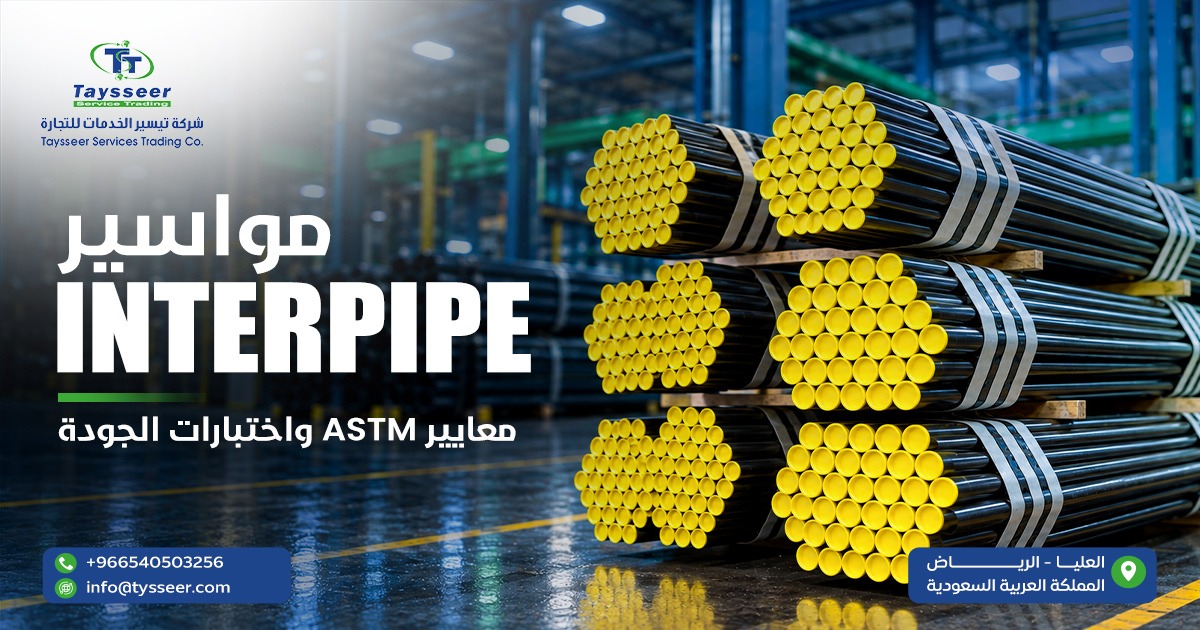
Pietra Pipe Specifications should be reviewed from a project perspective rather than by brand name alone. For contractors, MEP engineers, consultants, and procurement teams in Saudi Arabia, factors include the applicable standard, grade, pipe size, Schedule, manufacturing method, finish, service conditions, documentation, and project approval requirements.
We Tysseer presents PietraPipe as an Italian carbon steel pipe product for government, HVAC, MEP, electromechanical, and industrial applications. Before procurement, the configuration should be matched with the BOQ and Material Specification for the project.
What Are Pietra Pipe Specifications?
Pietra Pipe Specifications are the technical characteristics used to identify, evaluate, and approve a PietraPipe product for a particular project. These characteristics can include the applicable standard, material grade, manufacturing type, NPS, Schedule, wall thickness, finish, pipe end, testing requirements, and supporting documentation.
For a procurement team, this means that “PietraPipe” is not enough information to issue a technically complete purchase request. The project specification should define what configuration is required and the supplier should then confirm that the offered product matches it.
PietraPipe as an Italian Carbon Steel Pipe Product
Tysseer’s current PietraPipe page identifies the product as carbon steel pipe manufactured in Italy and lists ASTM A53 and EN 10217 under its technical standards
. Tysseer’s broader Carbon Steel Pipes category currently lists PIETRAPIPE with Italy as the origin, ASTM A53 / ASTM A106 Grade B, Schedule 40 and STD, Black and Galvanized finishes, and a listed size range of 1/2 inch to 12 inches.
There is an important qualification for procurement teams: the dedicated PietraPipe page and the broader category page do not display exactly the same technical summary.
The dedicated page currently lists ASTM A53 / EN 10217 and highlights a 1/2-inch to 4-inch summary range, while the category page lists ASTM A53 / ASTM A106 Grade B and 1/2 inch to 12 inches. Therefore, the exact configuration should be confirmed against the current datasheet and quotation before an order or Material Submittal is finalized.
Pietra Pipe Specifications at a Glance
| Specification Item | Current Tysseer Listing | Procurement Note |
|---|---|---|
| Product | PIETRAPIPE Carbon Steel Pipes | Confirm the exact product configuration required by the project |
| Origin | Italy | Confirm against the applicable product documentation when required |
| Standards | ASTM A53 / EN 10217 on the dedicated page | The broader category also lists ASTM A106 Grade B; verify the applicable standard for the quoted product |
| Schedule | 40 & STD on the general category page | Match the Schedule with the approved design and Material Specification |
| Finish | Black & Galvanized on the general category page | Select according to application and project requirements |
| Listed Size Range | 1/2″ to 12″ on the general category page | The dedicated page displays a narrower summary; confirm availability and configuration before ordering |
This distinction is important because a manufacturer’s overall product capability is not necessarily the same as a supplier’s current Saudi project offering. For that reason, procurement should rely on the product-specific documentation and the configuration confirmed in the quotation.
What Standards Are Associated With PietraPipe?
PietraPipe standards should be read together with the product type and project requirement rather than treated as a single universal specification. Tysseer’s current dedicated product page identifies ASTM A53 and EN 10217, while its broader carbon steel pipe category also lists ASTM A106 Grade B for PIETRAPIPE.
Pietra’s own current website describes its wider manufacturing portfolio as including seamless and welded line pipes and lists API 5L, ASTM, ASME, EN, and GOST among its standards and grades. That manufacturer-level information should not automatically be interpreted as meaning every PietraPipe configuration supplied by Tysseer is manufactured or certified to every one of those standards.
ASTM A53
ASTM A53/A53M covers seamless and welded steel pipe, including black and hot-dipped zinc-coated pipe within its scope. The applicable grade, type, dimensions, and other requirements must be checked against the actual purchase specification. :contentReference[oaicite:3]{index=3}
ASTM A106
ASTM A106/A106M covers seamless carbon steel pipe for high-temperature service. Where a project specifies A106, the grade and service conditions should be verified against the applicable material requirement rather than assuming that any carbon steel pipe is interchangeable with an A106 product. :contentReference[oaicite:4]{index=4}
EN 10217
EN 10217 belongs to the European standards framework for welded steel tubes intended for pressure purposes. When EN 10217 appears in a product specification, the exact part, grade, and delivery condition required by the project should be verified before approval.
Product Standards vs Dimensional Standards
It is useful to separate the standard defining the pipe material and manufacturing requirements from the standard used for dimensions. For example, ASME B36.10M is a dimensional reference for welded and seamless wrought steel pipe, whereas a material specification such as ASTM A53 or ASTM A106 addresses a different set of requirements.
This distinction matters during procurement because an RFQ can be dimensionally correct but still fail to define the required material specification.
What Sizes Are Available for PietraPipe?
PietraPipe sizes must be confirmed from the product documentation and the supplier’s current offering for the required configuration. Tysseer’s general Carbon Steel Pipes category currently lists PIETRAPIPE from 1/2 inch to 12 inches, while the dedicated PietraPipe page currently highlights a 1/2-inch to 4-inch summary.
At the manufacturer level, Pietra’s 2025 catalogue states a broader production range of NPS 1/2 inch to 24 inches for seamless/welded pipes and NPS 26 inches to 80 inches for welded pipes. That is a manufacturing range presented by the manufacturer and should not be interpreted as the current stock or Saudi supply range of Tysseer.
For this reason, the correct procurement approach is to specify the required NPS and then confirm the exact product, Schedule, manufacturing method, finish, and documentation offered for that size.
| Size Information | How It Should Be Used |
|---|---|
| NPS | Defines the nominal pipe size required by the project |
| DN | Provides the corresponding nominal metric designation where applicable |
| OD | Used when the actual outside dimension is required for design or compatibility |
| Wall Thickness | Must be considered together with NPS and Schedule |
What Schedule Options Are Available?
A pipe Schedule is a designation associated with wall thickness for a given nominal pipe size. Tysseer’s general carbon steel pipe category currently lists PIETRAPIPE in Schedule 40 and STD configurations.
The Schedule should not be selected simply because it is a common market option. It must match the approved design, operating and design conditions, applicable standard, and project requirements.
Schedule and Wall Thickness
Two pipes can have the same NPS while having different wall thicknesses because they are supplied under different Schedule designations. That change can affect pipe weight, internal diameter, fabrication considerations, and design calculations.
Accordingly, a purchase request should identify both the nominal size and the required Schedule or wall thickness rather than stating only “Pietra carbon steel pipe.”
Why Schedule Should Match the Project Design
Wall thickness is only one part of the engineering assessment. The final selection can depend on design pressure, temperature, material grade, corrosion allowance where applicable, loading conditions, and the governing design code.
What Are the Main Technical Properties to Review?
When reviewing PietraPipe technical specifications, the following information can be relevant depending on the project:
- Material standard
- Grade
- Manufacturing type
- NPS
- Schedule
- Wall thickness
- Outside diameter
- Finish
- Pipe end configuration
- Mechanical properties
- Chemical composition
- Testing requirements
- Traceability and documentation
Mechanical properties may include Tensile Strength, Yield Strength, and Elongation. These values should come from the applicable standard, product datasheet, or MTR rather than being copied from another grade or product configuration.
How Do Pressure and Temperature Affect Pipe Selection?
Pressure and temperature should be evaluated together when selecting a carbon steel pipe for a project. Design pressure, operating pressure, operating temperature, material grade, wall thickness, and the applicable design code can all influence the engineering assessment.
| Factor | Why It Matters |
|---|---|
| Operating Pressure | Describes the pressure expected during normal service |
| Design Pressure | Used as part of the design basis for selecting components and verifying the system |
| Temperature | Can affect material properties and allowable design conditions |
| Wall Thickness | Contributes to the pipe’s structural and pressure design assessment |
| Material Grade | Determines specified mechanical and chemical requirements |
| Corrosion Allowance | May be included in design where applicable |
The pressure information displayed on a supplier page should therefore not be treated automatically as a universal allowable operating pressure for every pipe size and service. The dedicated Tysseer PietraPipe page currently displays pressure classes of 150 / 300, but the engineering basis and applicable component configuration should be confirmed before using that information in design calculations.
What Are the Four Types of Steel Pipes?
If steel pipes are classified by manufacturing method, four commonly discussed types are Seamless, ERW, LSAW, and SSAW. This is one practical classification, not the only way to classify pipes.
| Pipe Type | Manufacturing Method | Typical Procurement Consideration |
|---|---|---|
| Seamless | Produced without a longitudinal weld seam | Selected according to standard, size, wall thickness, service, and project requirements |
| ERW | Electric Resistance Welded | Commonly evaluated where the project specifies welded pipe and the applicable size and standard permit it |
| LSAW | Longitudinal Submerged Arc Welded | Often considered for large-diameter applications subject to project requirements |
| SSAW | Spiral Submerged Arc Welded | Used in certain large-diameter applications according to project specifications |
Pietra’s own product information states that it manufactures both seamless and welded line pipes. :contentReference[oaicite:5]{index=5}
What Applications Can PietraPipe Be Used For?
PietraPipe applications should be determined from the actual product specification, service conditions, and project approval requirements. Tysseer currently associates PIETRAPIPE with HVAC, MEP, government, and industrial sectors in Saudi Arabia. :contentReference[oaicite:6]{index=6}
HVAC and MEP
For HVAC and MEP projects, carbon steel pipe selection is typically integrated with fittings, valves, supports, insulation, and connected equipment. The pipe should therefore be assessed as part of the complete mechanical system rather than as an isolated material.
When the project calls for compatible components, Tysseer currently lists pipe fittings, valves, and pipe supports and hangers within its wider product portfolio.
Industrial and Infrastructure Projects
Industrial and infrastructure applications can impose more detailed requirements for material grade, testing, traceability, pressure, temperature, and documentation. The product should therefore be evaluated against the project’s governing specification rather than selected solely because it is an Italian carbon steel pipe.
Water and Energy Applications
Pietra’s manufacturer information states that its products are used for conveying fluids under different pressure, temperature, and environmental conditions and in chemical and petrochemical processes. This is manufacturer-level portfolio information; the suitability of a specific PietraPipe configuration for a Saudi project still depends on the applicable specification and service requirements. :contentReference[oaicite:7]{index=7}
How Do You Match PietraPipe With a BOQ and Material Specification?
Match PietraPipe with a BOQ by comparing every technical field of the BOQ item with the proposed product and its supporting documentation.
- Read the complete BOQ description.
- Review the project’s Material Specification.
- Confirm the NPS.
- Confirm the required Schedule or wall thickness.
- Verify the applicable standard.
- Verify the material grade where specified.
- Check Seamless or Welded requirements.
- Confirm Black or Galvanized finish where applicable.
- Review required pipe ends and connection requirements.
- Check inspection and testing requirements.
- Review the required documentation.
- Submit the technical package for approval where required.
| BOQ / Specification Item | What to Verify |
|---|---|
| Brand | PietraPipe where a specific brand is required |
| Material | Carbon steel and applicable material specification |
| Standard | ASTM, EN, API or other specified standard |
| Grade | Required grade and associated documentation |
| Size | NPS and, where necessary, actual dimensions |
| Schedule | Required Schedule or wall thickness |
| Finish | Black, galvanized, or another specified condition |
| Documentation | MTR, compliance certificate, datasheet, origin documentation, and other project requirements |
What Documents May Be Required for PietraPipe?
The required documentation depends on the project and approval process. Tysseer’s current PietraPipe page lists the following documents as available on request:
- ASTM A53 / EN 10217 compliance certificate
- Mill Test Report (MTR)
- Certificate of Origin
- Product Datasheet and dimensional tables
- SASO import compliance documentation where applicable
These documents can support material verification, traceability, technical review, and project submission. However, availability of a document should not be confused with a statement that every project requires that document. :contentReference[oaicite:8]{index=8}
How to Prepare an RFQ for PietraPipe
A useful PietraPipe RFQ should identify the exact technical configuration required rather than simply requesting “carbon steel pipe.”
- Brand: PietraPipe, where specified.
- NPS and required size.
- Schedule or wall thickness.
- Applicable ASTM, EN, API, or other project standard.
- Grade.
- Seamless or Welded requirement.
- Black or Galvanized finish.
- Quantity.
- Required lengths.
- Pipe ends or connection requirements.
- Required documents.
- Project location and required delivery date.
- BOQ or Material Specification, when available.
Providing the BOQ or Material Specification can make the quotation process more precise because it allows the requested configuration to be checked against the project requirement.
How Does PietraPipe Compare With Other Steel Pipe Options?
There is no technically valid way to select a steel pipe simply by asking which brand has the strongest name. A project-specific comparison should consider:
| Comparison Factor | What to Evaluate |
|---|---|
| Standard | Does the offered pipe meet the required product standard? |
| Grade | Does the material grade match the project? |
| Size | Is the required NPS available in the needed configuration? |
| Schedule | Does the wall thickness designation match the design? |
| Manufacturing Type | Is Seamless or Welded required? |
| Finish | Does Black or Galvanized finish meet the application requirement? |
| Testing | Are the specified inspection and test requirements supported? |
| Documentation | Can the supplier provide the documentation required for approval? |
For that reason, PietraPipe can be evaluated alongside other carbon steel pipe options based on compliance with the actual project requirement rather than a general “best brand” assumption.
What Does Tysseer Supply for PietraPipe Projects?
Tysseer’s current product portfolio places PIETRAPIPE within its Carbon Steel Pipes category and provides related products that can form part of the same piping package. These include pipe fittings, flanges, insulation, pipe supports, and valves listed on the PietraPipe product page. :contentReference[oaicite:9]{index=9}
This can be useful for project procurement because the pipe is rarely purchased as an isolated component. The final system may also require compatible fittings, valves, supports, insulation, and other accessories according to the approved design.
For the latest product information, review the current PietraPipe product page and compare the listed configuration with your project’s Material Specification.
Request Pietra Pipe Specifications or a Quotation From Tysseer
At Tysseer, we can review the technical details required for a PietraPipe quotation, including the NPS, Schedule, standard, grade, finish, quantity, and documentation requirements.
For a more accurate quotation and technical review, share your BOQ, Material Specification, Material Submittal, or RFQ where available. This allows the requested PietraPipe configuration to be checked against the project’s actual requirements before procurement.
Submit your RFQ to Tysseer with the required pipe specifications and project information.
Frequently Asked Questions About PietraPipe
What are Pietra Pipe Specifications?
Pietra Pipe Specifications define the technical characteristics of the required PietraPipe product, including its standard, grade, size, Schedule, wall thickness, manufacturing type, finish, and documentation. The exact values should be confirmed from the product datasheet and project-approved Material Specification.
What sizes are available for PietraPipe?
Tysseer’s current Carbon Steel Pipes category lists PIETRAPIPE from 1/2 inch to 12 inches, while the dedicated PietraPipe page currently shows a 1/2-inch to 4-inch summary. Because these current Tysseer pages differ, the required size and configuration should be confirmed at quotation stage. The manufacturer’s broader catalogue describes a wider production capability, which should not be confused with Tysseer’s current Saudi offering. :contentReference[oaicite:10]{index=10}
What standards does PietraPipe meet?
Tysseer’s dedicated PietraPipe page currently lists ASTM A53 and EN 10217, while its general Carbon Steel Pipes category also lists ASTM A106 Grade B for PIETRAPIPE. The applicable standard should be confirmed against the exact product documentation and project requirement before approval. :contentReference[oaicite:11]{index=11}
What Schedule options are listed for PietraPipe?
Tysseer’s general Carbon Steel Pipes category currently lists Schedule 40 and STD for PIETRAPIPE. Schedule should be matched with NPS, design conditions, applicable standard, and the project’s approved Material Specification rather than selected independently. :contentReference[oaicite:12]{index=12}
Is PietraPipe suitable for HVAC and MEP projects?
Tysseer currently associates PIETRAPIPE with HVAC and MEP applications in Saudi Arabia. Suitability for a specific project depends on the approved specification, operating conditions, component compatibility, and required project approvals. :contentReference[oaicite:13]{index=13}
How do I match PietraPipe with a BOQ?
Match the brand, material standard, grade, NPS, Schedule, manufacturing type, finish, testing requirements, and documentation against the BOQ and Material Specification. Any discrepancy should be resolved before procurement or installation.
Who is the leading supplier of stainless steel seamless pipes in Saudi Arabia?
There is no single authoritative market-wide source establishing one supplier as the universally “leading” stainless steel seamless pipe supplier in Saudi Arabia. Supplier selection should instead consider the required stainless steel grade, standard, size, manufacturing method, documentation, approvals, project experience, and delivery requirements.
For clarity, the current Tysseer pages reviewed for this article document a carbon steel pipe portfolio rather than establishing a stainless steel seamless pipe offering. Therefore, Tysseer should not be described as the leading stainless steel seamless pipe supplier without separate evidence supporting that claim.
What are the four types of pipes?
When steel pipes are classified by manufacturing method, four commonly discussed types are Seamless, ERW, LSAW, and SSAW. Other classifications can be based on material, application, size, or joining method, so “four types” should not be treated as a universal classification for every pipe product.
Which company steel pipe is best?
There is no single steel pipe company or brand that is technically “best” for every project. The appropriate choice depends on the required standard, grade, size, Schedule, manufacturing method, finish, service conditions, documentation, and project approval requirements.
From a procurement perspective, PietraPipe should therefore be compared with other available steel pipe options against the actual project specification rather than through a general brand ranking.
What are some popular Italian pipe brands?
Examples of Italian steel pipe manufacturers or brands include Pietra S.p.A., Tenaris through its Dalmine operations, and Marcegaglia Carbon Steel. These are examples rather than a ranking. Pietra’s current website describes its seamless and welded pipe production and Italian manufacturing presence, while Tenaris identifies Dalmine as a major Italian seamless pipe manufacturing facility and Marcegaglia operates carbon steel pipe production facilities in Italy. :contentReference[oaicite:14]{index=14}
What documents may be required for PietraPipe?
Potential documents include a compliance certificate, Mill Test Report, Certificate of Origin, Product Datasheet, and dimensional tables. Tysseer also lists SASO import compliance documentation where applicable. The exact document package depends on project and procurement requirements. :contentReference[oaicite:15]{index=15}
How should I request a PietraPipe quotation?
Provide the NPS, Schedule, standard, grade, manufacturing type, finish, quantity, length, project location, required documents, and the relevant BOQ or Material Specification. Supplying the complete technical requirement helps reduce ambiguity during quotation and material approval.