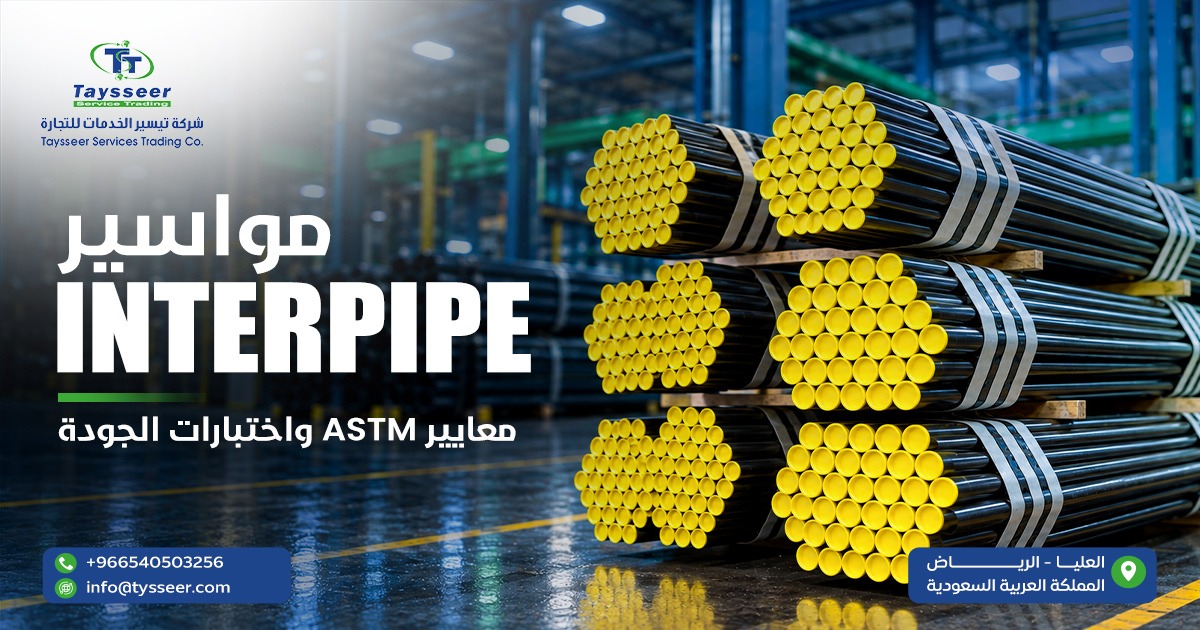
Carbon Steel Pipe Installation in industrial, MEP, and HVAC systems demands far more than placing pipe sections on site. A successful project requires thorough specification review, material inspection, precise alignment, proper joining techniques, support installation, and pressure testing prior to commissioning. For contractors across Saudi Arabia, material compliance with approved NPS, Schedule, and ASTM standards is vital.
We Tysseer supplies certified carbon steel pipes and essential piping components, supporting project teams with complete technical documentation, MTC certificates, and quotation assistance.
What Is Carbon Steel Pipe Installation?
Carbon Steel Pipe Installation is the process of preparing, positioning, joining, supporting, inspecting, and testing carbon steel pipe within a piping system according to approved drawings and project requirements.
The work can include route identification, material inspection, handling, cutting, end preparation, alignment, connection assembly, pipe supports, inspection, cleaning, testing, and completion of the required documentation. The exact sequence varies with the system and the applicable specification.
Installation should also be distinguished from Pipe Fabrication. Fabrication may involve cutting, fitting, end preparation, and assembling pipe spools before they are transported to the installation area. Installation then places those components in their final location and connects them into the completed system.
What Should Be Checked Before Carbon Steel Pipe Installation?
Before installation begins, the drawings, specifications, material requirements, and connection details should be reviewed together. This prevents a technically correct installation from being built around the wrong material or an incorrect pipe configuration.
| Item | What to Review | Why It Matters |
|---|---|---|
| Drawings | Route, pipe size, elevations, equipment connections, and service layout | Defines the intended installation arrangement |
| Material specification | ASTM/API designation, grade, manufacturing type, and finish where applicable | Confirms that the selected pipe matches the project requirement |
| Pipe size | NPS, DN, OD and related dimensions | Ensures compatibility with fittings and connected equipment |
| Schedule | Required wall thickness designation | Helps verify compliance with the specified pipe configuration |
| Connection method | Welded, threaded, flanged, or grooved connection | Determines preparation and installation requirements |
| Service conditions | Pressure, temperature, and conveyed medium | Connects the material and joining method to the application |
| Documentation | Material Submittal, MTR/MTC, Heat Number and other required records | Supports compliance and traceability where required |
For dimensional reference, ASME B36.10M covers the standardization of dimensions for welded and seamless wrought steel pipe, while the governing piping code depends on the type of system and service. :contentReference[oaicite:7]{index=7}
How Should Carbon Steel Pipes Be Prepared Before Installation?
Pipe preparation is intended to confirm that the material is suitable for the planned connection and that the pipe reaches the installation area without defects or contamination that could affect the work.
- Verify the material. Compare the delivered pipe with the purchase order, BOQ, approved material documentation, size, specification, grade, and quantity.
- Inspect the pipe visually. Check for damage, deformation, contamination, or other conditions that require attention before installation.
- Check identification markings. Confirm the information required for the project, such as size, specification, grade, and Heat Number where traceability is required.
- Measure and cut. Prepare pipe sections to the dimensions shown on the approved drawings or fabrication documents.
- Prepare the ends. The end configuration should match the selected connection. For example, welded systems may require appropriate beveling and fit-up preparation.
- Clean connection areas. Remove dirt, oil, and other contaminants from areas that will be joined.
- Pre-assemble where permitted. Pipe sections or spools may be assembled before final positioning when the project method allows it.
Cutting, modification, and end preparation should follow the approved project procedure. An unapproved modification can affect dimensions, connection quality, or material acceptance.
What Tools and Equipment Are Used for Carbon Steel Pipe Installation?
The tools required depend on pipe size, weight, installation location, and connection type. Typical equipment can include lifting and handling devices, pipe clamps, chain blocks or suitable lifting equipment, alignment and measurement tools, cutting equipment, welding equipment where required, and torque tools for connections with defined tightening procedures.
Selection of lifting equipment should be based on the load and site conditions. Similarly, welding and cutting equipment should be used according to the project’s approved procedures and applicable safety requirements.
What Are the Main Carbon Steel Pipe Connection Methods?
Carbon steel pipe connection methods are selected according to the system design, pipe size, pressure and temperature conditions, maintenance requirements, applicable specifications, and the type of components being connected.
Welded Connections
Welded connections are widely used in mechanical, industrial, and process piping where the project design specifies welding. The work typically involves alignment, fit-up, end preparation, welding under an approved procedure, and inspection according to the quality plan.
Where required, the project may involve a welding procedure specification for carbon steel pipe, supporting procedure qualification, welder qualification, and defined weld inspection or NDT requirements. These requirements should be taken from the applicable code, specification, and approved quality documentation rather than assumed to be identical for every project.
Threaded Connections
Threaded Connections can be used for applications and sizes where the project specification permits them. Proper thread condition, compatible components, correct assembly, and suitable sealing materials are important to achieve an acceptable joint.
Where a project uses carbon steel threaded pipe fittings, the fitting specification should be checked alongside the pipe requirements rather than treating the pipe and fitting as interchangeable items.
Flanged Connections
Flanged Connections use flanges, gaskets, and bolts to connect pipe sections or interface with equipment and valves. Correct alignment is important before tightening, and the bolting procedure should follow the applicable project requirements.
ASME B16.5 covers pipe flanges and flanged fittings within its defined scope, including pressure-temperature ratings, materials, dimensions, tolerances, marking, testing, bolting, and gaskets. :contentReference[oaicite:8]{index=8}
Grooved Connections
Grooved Connections use a prepared groove together with compatible couplings and fittings. They can be used where the piping design and applicable system specification permit mechanical grooved connections.
The groove profile, coupling, gasket, and pipe preparation must be compatible. Tysseer currently lists grooved pipe fittings and related piping components as part of its product range. :contentReference[oaicite:9]{index=9}
| Connection Method | Typical Context | Main Considerations |
|---|---|---|
| Welded | Mechanical, industrial, and process piping where specified | Fit-up, approved welding procedure, inspection, and applicable NDT |
| Threaded | Specific applications and sizes permitted by the design | Thread condition, compatibility, sealing, and assembly |
| Flanged | Equipment, valves, and accessible disconnection points | Alignment, gasket selection, bolting, and tightening procedure |
| Grooved | Systems designed for mechanical grooved joining | Groove preparation and component compatibility |
How Do You Choose the Right Pipe Joining Method?
The connection method should not be selected only because it appears easier to install. The decision should consider the piping system, pipe size, operating conditions, connection location, maintenance needs, applicable specification, and project code.
| Selection Factor | Effect on the Connection |
|---|---|
| Operating pressure | Influences the design and acceptance requirements of the connection |
| Operating temperature | Can affect materials, joining requirements, and service suitability |
| Pipe size | May limit the practical connection options |
| System type | Determines applicable technical and installation requirements |
| Installation space | Can affect access and the practicality of certain joining methods |
| Maintenance access | May make removable connections useful at equipment interfaces |
| Project code and specification | May define the permitted connection methods and inspection requirements |
What Are the Steps Involved in Installing a Pipe?
The basic steps involved in installing a carbon steel pipe are document review, work-area preparation, material inspection, support preparation, handling, positioning, alignment, connection, support completion, inspection, cleaning, testing, and final documentation.
- Review the drawings and specifications. Confirm the route, NPS, elevations, connection points, materials, and installation requirements.
- Prepare the work area. Confirm that access, lifting paths, supports, and installation locations are ready.
- Inspect materials. Match the pipe, fittings, valves, and other components against approved requirements.
- Prepare supports. Install the required hangers, guides, clamps, or anchors in accordance with the approved design.
- Handle and move the pipe. Transfer pipe sections safely using equipment appropriate for their size and weight.
- Position the pipe. Place the pipe along the intended route without forcing it into position.
- Check alignment. Confirm the route, elevation, orientation, and connection fit-up before joining.
- Complete the connection. Apply the specified welded, threaded, flanged, or grooved connection method.
- Complete the support system. Confirm that the installed supports keep the pipe stable and aligned.
- Inspect the installation. Check dimensions, connections, alignment, supports, and visible workmanship.
- Clean the line. Remove construction debris and foreign material as required by the project.
- Perform the required testing. Conduct the applicable pressure, leak, inspection, or NDT activities according to the approved procedure.
- Close out the installation. Resolve findings and complete the required project documentation.
This sequence provides a practical framework, but the final installation procedure should always follow the approved project method statement, drawings, inspection plan, and applicable code.
What Are the Safety Requirements During Pipe Installation?
Carbon steel pipe installation can involve lifting, handling, cutting, welding, electrical tools, work at height, and pressure testing. The work should therefore follow the project’s approved HSE plan and risk controls.
Lifting and Handling
- Inspect lifting equipment and accessories before use.
- Select handling equipment suitable for the pipe load and site conditions.
- Control the lifting area and prevent unauthorized access beneath suspended loads.
- Use appropriate methods to prevent unexpected movement of pipe sections.
Cutting and Welding
- Use the required personal protective equipment.
- Maintain suitable ventilation, particularly in enclosed work areas.
- Control hot-work areas and remove or protect combustible materials.
- Apply hot-work permits where required by the project.
- Inspect cutting and welding equipment before use.
Pressure Testing
- Define and secure the test area.
- Confirm that test equipment and isolation points are suitable for the approved procedure.
- Follow the specified test pressure, duration, and acceptance criteria.
- Do not loosen or modify a connection while the line is under test pressure.
Carbon Steel Pipe Installation for HVAC and MEP Systems
In HVAC and MEP systems, pipe installation is closely connected to equipment locations, valves, service routes, insulation requirements, and access for future maintenance. Carbon steel pipe may be used in certain water and mechanical services when permitted by the project specification.
Installation should allow adequate space for insulation, maintenance, valve operation, and connection to pumps or other equipment. Pipe alignment should also be controlled so that unwanted loads are not transferred to equipment nozzles or connection points.
From a procurement perspective, the required carbon steel pipe specifications should be established before installation begins. That normally includes the specified standard, grade, NPS, Schedule, manufacturing type, finish, quantity, and required documentation.
Carbon Steel Pipe Installation for Fire Protection Systems
Fire protection piping must be installed according to the approved system design, applicable code, project specification, and required component approvals. The pipe standard by itself does not determine whether an entire fire protection system is acceptable.
Depending on the system, the installation may involve grooved, flanged, welded, or other permitted connections. Supports, valves, fittings, pressure testing, and inspection must all be considered as part of the complete system rather than as separate components.
How Are Pipe Supports and Hangers Selected?
Pipe supports and hangers transfer pipe loads to the supporting structure while helping maintain the intended route and control movement. Their design depends on pipe size, pipe and fluid weight, insulation, operating conditions, and the supporting structure.
| Support Type | Typical Function |
|---|---|
| Hanger | Suspends the pipe from the supporting structure |
| Clamp | Restrains or supports the pipe at a defined location |
| Guide | Controls pipe movement in the directions permitted by the design |
| Anchor | Provides a fixed point within the support arrangement where required |
Tysseer’s current product range includes a dedicated pipe supports and hangers system, including TST support products. :contentReference[oaicite:10]{index=10}
What Are the Most Common Carbon Steel Pipe Installation Mistakes?
| Common Mistake | Potential Effect | Prevention |
|---|---|---|
| Installing the wrong material | Non-compliance and possible rework | Verify the material against the approved specification before installation |
| Poor alignment | Unwanted loads on connections or equipment | Check alignment before completing connections |
| Incorrect end preparation | Connection difficulties or quality issues | Follow the specified joining procedure |
| Inadequate support | Movement, sagging, or unwanted loads | Use the approved support arrangement |
| Incorrect flange tightening | Possible leakage or joint stress | Follow the specified bolting procedure |
| Failure to clean the line | Foreign material remaining inside the system | Complete the required cleaning before testing or commissioning |
| Skipping inspection or testing | Defects may be discovered later | Follow the approved inspection and test plan |
What Inspections and Tests Are Required After Installation?
Post-installation inspection normally combines visual, dimensional, alignment, connection, support, and documentation checks. Additional examination or testing depends on the project specification, applicable code, inspection plan, and service.
- Visual Inspection: General condition of the pipe, fittings, supports, and connections.
- Dimensional Inspection: Verification of dimensions, elevations, clearances, and installation geometry.
- Alignment Inspection: Confirmation that the pipe follows the intended route and interfaces correctly with connected components.
- Weld Inspection: Examination of welded joints according to project requirements.
- Flange Inspection: Review of flange faces, gasket installation, bolting, and alignment.
- Support Inspection: Verification that hangers, guides, clamps, and anchors match the approved arrangement.
- NDT: RT, UT, MT, PT, or another applicable method where required.
System testing may include a Hydrostatic Test, Pressure Test, Leak Test, Flushing, or Cleaning, depending on the system and approved procedure.
ASME B31.3, for example, addresses design, fabrication, assembly, erection, examination, inspection, and testing of process piping. It does not mean that every carbon steel piping system automatically falls under B31.3; the applicable code depends on the system and service. :contentReference[oaicite:11]{index=11}
How Do You Select the Right Carbon Steel Pipe Before Installation?
The installation outcome depends partly on selecting a pipe that matches the project’s approved material requirement. A basic procurement description such as “carbon steel pipe” is usually not enough to identify the exact product.
The specification should be checked for:
- NPS and required dimensions
- Schedule and wall thickness
- ASTM or API specification
- Grade
- Seamless or welded construction
- Black or galvanized finish where relevant
- Required length and quantity
- Connection type
- Inspection and testing requirements
- MTR/MTC and other required documentation
ASTM A53 and ASTM A106
ASTM A53 covers seamless and welded steel pipe, including black and hot-dipped zinc-coated pipe within its scope, while ASTM A106 covers seamless carbon steel pipe for high-temperature service. The appropriate specification depends on the project service and the approved material requirement. :contentReference[oaicite:12]{index=12}
Seamless and Welded Pipe
Carbon steel seamless pipe and carbon steel welded pipe are not interchangeable labels. The manufacturing type should be selected according to the applicable standard and project requirement.
Schedule and Wall Thickness
A carbon steel pipe schedule is a dimensional designation associated with pipe wall thickness. The required Schedule should come from the design and specification rather than being chosen simply because it is common in the market.
Black and Galvanized Pipe
Black carbon steel pipe and galvanized carbon steel pipe have different surface finishes. The selected finish should match the application and project specification rather than being treated as a purely cosmetic choice.
What Is the Difference Between Black Steel Pipe and Carbon Steel Pipe?
Carbon steel pipe describes the steel material category, while black steel pipe commonly refers to carbon steel pipe with a black, non-galvanized surface condition. Therefore, “black” and “carbon steel” do not describe the same characteristic.
The project specification should separately identify the material standard and the required finish.
What Is the ASTM Standard for Carbon Steel Fittings?
There is no single ASTM standard that covers every carbon steel fitting. For wrought carbon steel and alloy steel pipe fittings used for pressure piping at moderate and elevated temperatures, ASTM A234/A234M is a key material specification. The applicable dimensional and component standard can be a separate ASME or MSS standard depending on the fitting type. ASTM A234/A234M specifically covers wrought carbon steel and alloy steel fittings and references standards including ASME B16.9 and B16.11. :contentReference[oaicite:13]{index=13}
For example, ASME B16.9 covers factory-made wrought buttwelding fittings, while ASME B16.11 covers forged socket-welding and threaded fittings. The correct specification therefore depends on what type of fitting is being purchased and the service for which it is specified. :contentReference[oaicite:14]{index=14}
Tysseer currently lists pipe fitting products including Hitachi, BIS, Benkan, and Kofco. Product specifications should be checked against the approved project requirement rather than selected by brand name alone. :contentReference[oaicite:15]{index=15}
What Is the ASME Standard for Carbon Steel Pipe?
ASME does not have one universal standard that defines every aspect of carbon steel pipe. ASME B36.10M is the dimensional standard for welded and seamless wrought steel pipe, while an applicable ASME B31 piping code may govern the design, fabrication, erection, examination, inspection, and testing of the piping system, depending on its service. :contentReference[oaicite:16]{index=16}
For example, ASME B31.3 applies to process piping and addresses materials and components as well as design, fabrication, assembly, erection, examination, inspection, and testing. Other piping systems may be governed by different codes, so the project specification should always be checked before selecting the governing standard. :contentReference[oaicite:17]{index=17}
Carbon Steel Pipe Supply for Projects in Saudi Arabia
For Saudi projects, pipe selection should begin with the technical requirement rather than the brand name. Tysseer’s current carbon steel pipe category lists NKK Pipe, PIETRAPIPE, Jazeera Steel, UTPPIPE, and HYUNDAI PIPE. The listed product information includes standards, schedules, finishes, sizes, and other product details that should be checked against the approved project requirement before procurement. :contentReference[oaicite:18]{index=18}
For product-specific review, contractors and procurement teams can compare the relevant Tysseer pages for INTERPIPE carbon steel pipes, NKK Pipe, PIETRAPIPE, Jazeera Steel, UTPPIPE, and HYUNDAI PIPE.
These pages currently provide product-specific information and complementary products such as fittings, flanges, valves, and pipe supports. :contentReference[oaicite:19]{index=19}
How to Prepare an RFQ for Carbon Steel Pipe
A clear RFQ reduces the risk of receiving a quotation for a product that does not match the approved project requirement.
- Specify the required brand when the project calls for a specific manufacturer.
- State the NPS and required dimensions.
- State the Schedule or required wall thickness.
- Identify the ASTM/API specification and grade.
- State whether the pipe is seamless or welded.
- Specify the required finish, such as black or galvanized, where applicable.
- Provide quantity and required lengths.
- Identify the connection type where already defined.
- List the required documents and inspection requirements.
- Provide the delivery location and project timing.
- Attach the BOQ, Material Specification, or Material Submittal when available.
A request that contains only the words “carbon steel pipe” leaves too many technical variables undefined. From a procurement perspective, the more complete the technical description, the easier it is to compare quotations against the actual project requirement.
Request Carbon Steel Pipe Specifications or a Quotation from Tysseer
At Tysseer, project requirements can be reviewed against the applicable carbon steel pipe specifications before a quotation or supply arrangement is considered. Where available, sharing the BOQ, Material Specification, Material Submittal, or RFQ helps the supply team work from the project’s actual technical requirements.
For projects in Saudi Arabia, you can review the carbon steel pipe range at Tysseer and provide the required NPS, Schedule, ASTM/API specification, grade, manufacturing type, finish, quantity, and documentation requirements.
Contact Tysseer to discuss your project requirements or request a quotation based on your technical specification.
Frequently Asked Questions
What is a carbon steel pipe?
A carbon steel pipe is a steel pipe in which carbon is the principal alloying element used to define the material category. Its actual technical characteristics depend on the applicable specification, grade, dimensions, manufacturing method, and service requirements. Common specifications used for carbon steel pipe include ASTM A53, ASTM A106, and API 5L, depending on the intended application. :contentReference[oaicite:20]{index=20}
What are the steps involved in installing a pipe?
The main steps are reviewing the drawings, preparing the work area, inspecting materials, preparing supports, handling and positioning the pipe, checking alignment, completing the connection, inspecting the installation, cleaning the line, performing the required tests, and completing project documentation. The exact sequence depends on the piping system, connection method, applicable code, and approved installation procedure.
What is the ASTM standard for carbon steel fittings?
ASTM A234/A234M is a key specification for wrought carbon steel and alloy steel pipe fittings used in moderate- and high-temperature pressure piping, but it is not a universal standard for every fitting. Fitting geometry and connection type may be governed by separate standards such as ASME B16.9 or ASME B16.11. :contentReference[oaicite:21]{index=21}
What is the ASME standard for carbon steel pipe?
ASME B36.10M is the principal ASME dimensional standard for welded and seamless wrought steel pipe, while the applicable ASME B31 code depends on the piping system and service. For example, ASME B31.3 addresses process piping design, fabrication, assembly, erection, examination, inspection, and testing. :contentReference[oaicite:22]{index=22}
What are the main carbon steel pipe connection methods?
The main methods include welded, threaded, flanged, and grooved connections. The permitted method depends on pipe size, system design, service conditions, applicable standards, and project requirements.
How do I choose the right carbon steel pipe connection?
Choose the connection method according to the system specification, pipe size, pressure, temperature, installation location, maintenance requirements, and applicable code. Ease of installation alone should not determine the connection type.
What inspections are performed after carbon steel pipe installation?
Post-installation inspection may include visual, dimensional, alignment, weld, flange, and support inspections. Additional NDT or system testing is performed where required by the project specification, applicable code, inspection plan, or purchase requirements.
What information should be included in a carbon steel pipe RFQ?
An RFQ should normally identify the NPS, Schedule, ASTM/API specification, grade, manufacturing type, finish, quantity, length, connection type, required documentation, and delivery requirements. Providing the BOQ or Material Specification can further reduce ambiguity during quotation review.