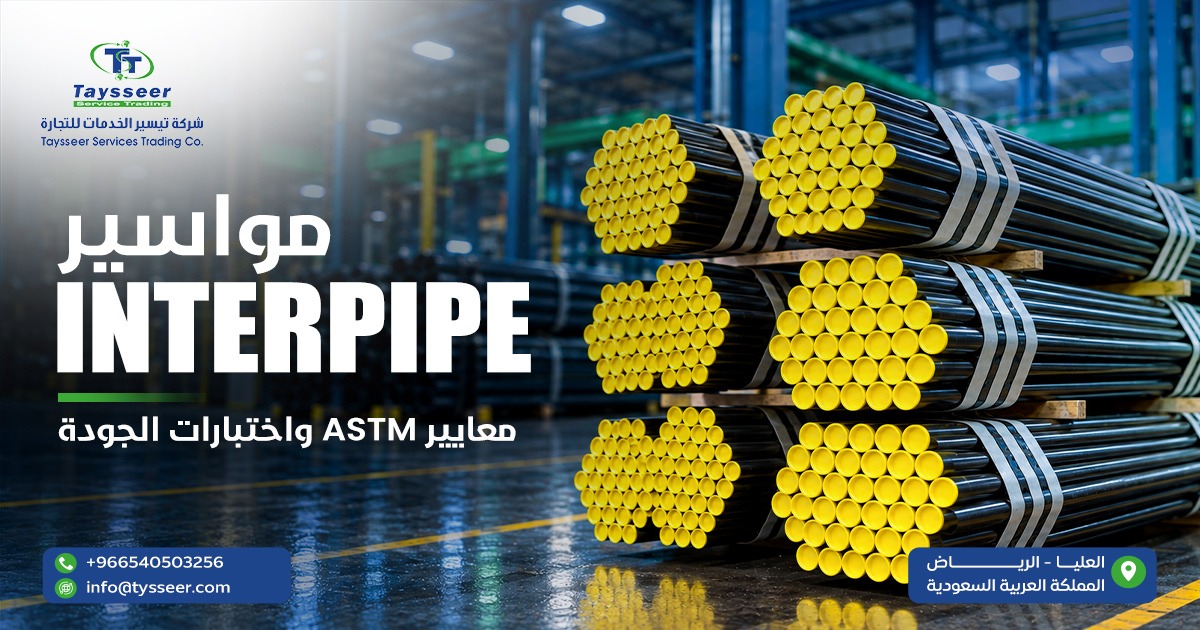
A carbon steel pipe thickness chart helps engineers and procurement teams match NPS, Schedule, wall thickness, inside diameter, and weight before material is specified. For projects in Saudi Arabia, understanding differences between SCH 40, SCH 80, SCH 160, and XXS is essential when reviewing drawings, BOQs, and piping material specifications.
This guide explains carbon steel pipe dimensions, compares common schedules, shows thickness and weight data, and outlines information needed to prepare an RFQ for industrial, construction, MEP, and infrastructure projects.
What Is Pipe Schedule in Carbon Steel Pipes?
Pipe Schedule is a standard designation used to identify the wall thickness associated with a given nominal pipe size. In a carbon steel pipe dimensions chart, the Schedule cannot be read as a direct thickness measurement in millimetres. Instead, the selected NPS and Schedule together point to a specific nominal wall thickness.
For example, 6″ SCH 40 means a pipe with a nominal pipe size of 6 inches manufactured to the Schedule 40 dimensional series. It does not mean the pipe wall is 40 mm thick.
The Schedule becomes useful because the outside diameter for a given NPS remains standardized while different Schedule selections change the wall thickness. As the wall becomes thicker, the inside diameter becomes smaller and the theoretical weight per metre increases.
For engineering and procurement work, the practical sequence is simple: identify the NPS, identify the required Schedule, then read the corresponding OD, wall thickness, ID, and weight from the applicable pipe schedule chart.
Carbon Steel Pipe Thickness Chart for SCH 40
Schedule 40 is one of the most commonly specified carbon steel pipe schedules. The actual wall thickness varies with NPS, which is why a carbon steel pipe thickness chart should always be read by matching the pipe size and Schedule.
| NPS | OD (mm) | SCH 40 Wall Thickness (mm) | ID (mm) | Theoretical Weight (kg/m) |
|---|---|---|---|---|
| 1/2″ | 21.34 | 2.77 | 15.80 | 1.27 |
| 1″ | 33.40 | 3.38 | 26.64 | 2.50 |
| 1-1/2″ | 48.26 | 3.68 | 40.90 | 4.05 |
| 2″ | 60.32 | 3.91 | 52.50 | 5.44 |
| 3″ | 88.90 | 5.49 | 77.92 | 11.29 |
| 4″ | 114.30 | 6.02 | 102.26 | 16.07 |
| 6″ | 168.28 | 7.11 | 154.06 | 28.26 |
| 8″ | 219.08 | 8.18 | 202.72 | 42.54 |
| 10″ | 273.05 | 9.27 | 254.51 | 60.30 |
| 12″ | 323.85 | 10.31 | 303.23 | 79.72 |
| 16″ | 406.40 | 12.70 | 381.00 | 123.30 |
| 20″ | 508.00 | 15.09 | 477.82 | 183.42 |
| 24″ | 609.60 | 17.48 | 574.64 | 255.24 |
The values above are nominal dimensional and theoretical weight references for common sizes. Actual delivered mass can vary according to manufacturing tolerances, length, pipe configuration, and the manufacturer’s certified data. The applicable dimensional standard and project specification should remain the controlling references.
Carbon Steel Pipe Thickness Chart for SCH 80
Schedule 80 provides a greater wall thickness than SCH 40 for the same NPS in the corresponding dimensional range. This reduces the inside diameter and increases the theoretical weight of the pipe.
| NPS | OD (mm) | SCH 80 Wall Thickness (mm) | ID (mm) | Theoretical Weight (kg/m) |
|---|---|---|---|---|
| 1/2″ | 21.34 | 3.73 | 13.88 | 1.62 |
| 1″ | 33.40 | 4.55 | 24.30 | 3.24 |
| 1-1/2″ | 48.26 | 5.08 | 38.10 | 5.41 |
| 2″ | 60.32 | 5.54 | 49.24 | 7.48 |
| 3″ | 88.90 | 7.62 | 73.66 | 15.27 |
| 4″ | 114.30 | 8.56 | 97.18 | 22.32 |
| 6″ | 168.28 | 10.97 | 146.34 | 42.56 |
| 8″ | 219.08 | 12.70 | 193.68 | 64.63 |
| 10″ | 273.05 | 15.09 | 242.87 | 95.99 |
| 12″ | 323.85 | 17.48 | 288.89 | 132.06 |
| 16″ | 406.40 | 21.44 | 363.52 | 203.53 |
| 20″ | 508.00 | 26.19 | 455.62 | 311.17 |
| 24″ | 609.60 | 30.96 | 547.68 | 441.78 |
A useful procurement point is that Schedule values should not be interpreted in isolation. A drawing or material requisition that states 8″ SCH 80 identifies the dimensional series, but the complete requirement may also need the pipe standard, material grade, manufacturing method, end preparation, finish, inspection requirements, and quantity.
Carbon Steel Pipe Thickness Chart for SCH 160
Schedule 160 is a heavier wall series used where the project specification or engineering design calls for a greater nominal wall thickness. As with other schedules, the actual wall thickness is determined by the NPS and the applicable dimensional table.
| NPS | OD (mm) | SCH 160 Wall Thickness (mm) | ID (mm) | Theoretical Weight (kg/m) |
|---|---|---|---|---|
| 1/2″ | 21.34 | 4.78 | 11.78 | 1.95 |
| 1″ | 33.40 | 6.35 | 20.70 | 4.24 |
| 1-1/2″ | 48.26 | 7.14 | 33.98 | 7.24 |
| 2″ | 60.32 | 8.74 | 42.84 | 11.12 |
| 3″ | 88.90 | 11.13 | 66.64 | 21.35 |
| 4″ | 114.30 | 13.49 | 87.32 | 33.54 |
| 6″ | 168.28 | 18.26 | 131.76 | 67.55 |
| 8″ | 219.08 | 23.01 | 173.06 | 111.26 |
| 10″ | 273.05 | 28.58 | 215.89 | 172.30 |
| 12″ | 323.85 | 33.32 | 257.21 | 238.72 |
| 16″ | 406.40 | 40.49 | 325.42 | 365.36 |
| 20″ | 508.00 | 50.01 | 407.98 | 564.81 |
| 24″ | 609.60 | 59.54 | 490.52 | 807.63 |
The difference becomes significant at larger NPS sizes. For example, a 24-inch pipe retains the same standardized OD while moving from SCH 40 to SCH 160 changes the nominal wall thickness from 17.48 mm to 59.54 mm. The resulting ID and theoretical weight are therefore substantially different.
NPS vs OD vs ID vs Wall Thickness
Understanding the basic pipe dimensions is essential before using a carbon steel pipe size chart. These terms describe different characteristics and should not be treated as interchangeable.
| Term | Full Name | Meaning | Why It Matters |
|---|---|---|---|
| NPS | Nominal Pipe Size | A standardized nominal designation for pipe size | Identifies the pipe size used in drawings, specifications, and schedules |
| OD | Outside Diameter | The standardized outside diameter of the pipe | Important for fittings, supports, couplings, and dimensional compatibility |
| ID | Inside Diameter | The internal bore of the pipe | Important for flow calculations and internal clearance |
| Wall Thickness | Pipe Wall Thickness | The thickness of the pipe wall | Affects internal diameter, weight, and design considerations |
| Schedule | Pipe Schedule | A dimensional designation linked to NPS and wall thickness | Used to identify the required wall thickness series |
NPS is particularly important because its numerical designation should not be mistaken for the actual OD or ID. For instance, a 6-inch NPS carbon steel pipe has a standardized OD of approximately 168.3 mm rather than an OD of exactly 152.4 mm.
XXS Pipe Dimensions and Wall Thickness
XXS means Double Extra Strong. It is a traditional designation used for heavy-wall pipe dimensions rather than a numeric Schedule designation.
XXS should always be checked by size rather than treated as a universal equivalent of SCH 160. In some NPS ranges, XXS and SCH 160 are different wall thicknesses, while XXS is not defined across all larger sizes in the same way.
| NPS | OD (mm) | XXS Wall Thickness (mm) | ID (mm) | Theoretical Weight (kg/m) |
|---|---|---|---|---|
| 1/2″ | 21.34 | 7.47 | 6.40 | 2.55 |
| 1″ | 33.40 | 9.09 | 15.22 | 5.45 |
| 1-1/2″ | 48.26 | 10.15 | 27.96 | 9.54 |
| 2″ | 60.32 | 11.07 | 38.18 | 13.44 |
| 3″ | 88.90 | 15.24 | 58.42 | 27.68 |
| 4″ | 114.30 | 17.12 | 80.06 | 41.03 |
| 6″ | 168.28 | 21.95 | 124.38 | 79.21 |
| 8″ | 219.08 | 22.23 | 174.62 | 107.91 |
| 10″ | 273.05 | 25.40 | 222.25 | 155.12 |
| 12″ | 323.85 | 25.40 | 273.05 | 186.94 |
| 16″ | 406.40 | — | — | — |
| 20″ | 508.00 | — | — | — |
| 24″ | 609.60 | — | — | — |
The dash in the table indicates that a corresponding XXS value is not listed in the dimensional series used for those larger NPS sizes. The absence of a value should not be replaced with an assumed Schedule equivalent.
Carbon Steel Pipe Size Chart for SCH 40, SCH 80, SCH 160 and XXS
For quick comparison, the following carbon steel pipe size chart shows how wall thickness changes at several common NPS sizes.
| NPS | OD (mm) | SCH 40 (mm) | SCH 80 (mm) | SCH 160 (mm) | XXS (mm) |
|---|---|---|---|---|---|
| 2″ | 60.32 | 3.91 | 5.54 | 8.74 | 11.07 |
| 4″ | 114.30 | 6.02 | 8.56 | 13.49 | 17.12 |
| 6″ | 168.28 | 7.11 | 10.97 | 18.26 | 21.95 |
| 8″ | 219.08 | 8.18 | 12.70 | 23.01 | 22.23 |
| 10″ | 273.05 | 9.27 | 15.09 | 28.58 | 25.40 |
| 12″ | 323.85 | 10.31 | 17.48 | 33.32 | 25.40 |
This comparison illustrates why Schedule terminology should always be tied to NPS. It also shows why the traditional XS and XXS designations should not be converted automatically into SCH 80 or SCH 160 without checking the actual dimensions.
What Is the Difference Between XS and SCH 80?
XS stands for Extra Strong, while SCH 80 is a numerical Schedule designation. They can correspond for specific pipe sizes, but they should not be treated as identical for every NPS.
| Designation | Meaning | Type | Procurement Note |
|---|---|---|---|
| SCH 40 | Schedule 40 | Schedule designation | Wall thickness depends on NPS |
| SCH 80 | Schedule 80 | Schedule designation | May correspond with XS in certain sizes |
| XS | Extra Strong | Traditional designation | Do not assume universal equivalence with SCH 80 |
| XXS | Double Extra Strong | Traditional designation | Do not assume universal equivalence with SCH 160 |
For procurement, the safest practice is to state the exact Schedule or nominal wall thickness required by the project instead of relying on an informal conversion between traditional and Schedule designations.
What Is the Difference Between XXS and SCH 160?
XXS and SCH 160 are not universally identical. Their wall thicknesses must be checked for the specific NPS being specified.
For example, at NPS 8, the reference values are approximately 23.01 mm for SCH 160 and 22.23 mm for XXS. At NPS 10, SCH 160 is approximately 28.58 mm while XXS is 25.40 mm. These differences demonstrate why an RFQ should not replace one designation with the other without dimensional verification.
Does the Outside Diameter Change When the Schedule Changes?
For a given NPS in the standard dimensional series, the outside diameter remains the same while changing the Schedule changes the wall thickness. The additional wall extends inward, reducing the bore.
| NPS | OD (mm) | SCH 40 (mm) | SCH 80 (mm) | SCH 160 (mm) |
|---|---|---|---|---|
| 2″ | 60.32 | 3.91 | 5.54 | 8.74 |
| 4″ | 114.30 | 6.02 | 8.56 | 13.49 |
| 6″ | 168.28 | 7.11 | 10.97 | 18.26 |
| 8″ | 219.08 | 8.18 | 12.70 | 23.01 |
| 12″ | 323.85 | 10.31 | 17.48 | 33.32 |
How Does Wall Thickness Affect Inside Diameter?
The relationship can be expressed in a simplified form as:
ID ≈ OD − 2 × Wall Thickness
This relationship is useful for understanding why a heavier Schedule reduces the bore. For example, increasing the wall thickness while keeping the same NPS and OD leaves less internal space for fluid flow.
However, pipe selection should not be reduced to ID alone. Hydraulic calculations, allowable pressure, temperature, material properties, corrosion allowance, design code requirements, and the service conditions all have to be considered by the responsible engineering team.
How to Calculate Carbon Steel Pipe Weight per Meter
A commonly used approximation for theoretical steel pipe mass is:
Weight (kg/m) ≈ 0.02466 × (OD − t) × t
Where:
- OD is the outside diameter in millimetres.
- t is the wall thickness in millimetres.
- Weight is the approximate theoretical mass per metre.
For a 6-inch SCH 40 pipe:
- OD = 168.28 mm
- Wall thickness = 7.11 mm
- Weight ≈ 0.02466 × (168.28 − 7.11) × 7.11
- Theoretical weight ≈ 28.26 kg/m
Theoretical weight is useful for material takeoff, logistics, shipping estimates, and preliminary quantity calculations. For a purchase order or contractual documentation, the manufacturer’s certified dimensional and mass data should take precedence.
Does a Higher Pipe Schedule Mean a Higher Pressure Rating?
A higher Schedule means a greater nominal wall thickness for the specified NPS; it does not provide a universal pressure rating by itself.
Pressure capability depends on several engineering variables, including:
- Pipe material and Grade.
- Design temperature.
- Design pressure.
- Outside diameter and wall thickness.
- Allowable material stress.
- Applicable piping code.
- Corrosion or erosion allowance where applicable.
- Service conditions and project-specific requirements.
For this reason, a statement such as “SCH 80 is suitable for a specific pressure” should not be made without the relevant engineering calculation and governing code.
Schedule vs Material Grade vs Pipe Standard
These terms describe different parts of a carbon steel pipe specification. Confusing them is a common source of procurement errors.
| Item | What It Defines | Example |
|---|---|---|
| Schedule | Wall thickness designation associated with NPS | SCH 40 |
| Material Grade | Material chemistry and mechanical requirements | ASTM A106 Grade B |
| Pipe Standard | Product requirements covering manufacturing, testing, dimensions, or other requirements as applicable | ASTM A53 or API 5L |
| Manufacturing Method | How the pipe is produced | Seamless or ERW |
| Pipe End | End preparation or connection type | Plain End or Beveled End |
This is why 6″ SCH 40 is normally not a complete procurement description. Depending on the project, the buyer may also need the applicable standard, Grade, manufacturing method, end preparation, finish, inspection requirements, and quantity.
ASTM A53 vs ASTM A106 vs API 5L
These specifications should not be treated as interchangeable because they address different product requirements and applications.
| Specification | General Scope | Typical Procurement Consideration |
|---|---|---|
| ASTM A53/A53M | Steel pipe available in welded and seamless forms, including black and hot-dipped galvanized pipe within the specification scope | Commonly specified for mechanical and pressure applications and utility services |
| ASTM A106/A106M | Seamless carbon steel pipe for high-temperature service | Frequently considered where high-temperature service requirements apply |
| API 5L | Seamless and welded steel line pipe for pipeline systems in the petroleum and natural gas industries | Selected according to pipeline, material, inspection, PSL, and project requirements |
ASTM A53 covers both seamless and welded pipe, while ASTM A106 is specifically a seamless carbon steel pipe specification for high-temperature service. API 5L addresses line pipe and includes requirements covering manufacturing, inspection, testing, marking, and traceability. The governing project specification must determine which standard applies.
Seamless vs ERW Carbon Steel Pipe
Seamless and ERW describe manufacturing methods rather than pipe Schedules.
An ERW pipe is produced by forming steel and joining it using an electric-resistance welding process. A seamless pipe is manufactured without a longitudinal welded seam. The appropriate selection depends on the product specification, service, design requirements, applicable code, and project approval criteria.
For procurement in Saudi Arabia, the buyer should therefore specify the required manufacturing method instead of assuming that Schedule alone defines whether the pipe should be seamless or ERW.
How to Choose the Correct Schedule for a Project
The correct Schedule should come from the approved design and project specification rather than a general rule such as “higher Schedule is always better.” A practical workflow is:
- Determine the NPS. Start with the nominal pipe size required by the system.
- Review the design conditions. Check pressure, temperature, service, and other relevant parameters.
- Review the Piping Material Specification. Confirm the project-specific material class and dimensional requirements.
- Confirm the Material Grade. Examples may include ASTM A53 Grade B or ASTM A106 Grade B where specified.
- Confirm the applicable standard. ASTM, API, or another standard may govern the product depending on the service.
- Select the specified Schedule. Use the project requirement or engineering calculation.
- Confirm manufacturing method. Verify whether Seamless or ERW is required.
- Confirm Pipe End. Check Plain End, Beveled End, Threaded End, or another preparation.
- Review inspection requirements. Confirm MTR/MTC, testing, marking, traceability, and project documentation requirements.
- Confirm quantity and delivery details. Include length, quantity, project location, and required delivery schedule.
How to Read a Carbon Steel Pipe Dimensions Chart
A carbon steel pipe dimensions chart can be read in a consistent sequence:
- Find the required NPS.
- Confirm the standardized OD.
- Locate the specified Schedule.
- Read the corresponding Wall Thickness.
- Calculate or verify the ID.
- Check the theoretical Weight kg/m.
- Confirm that the table corresponds to the applicable standard and pipe type.
This process is useful when checking a BOQ, reviewing a drawing, comparing a supplier quotation, or preparing a material submittal.
How to Use a Carbon Steel Pipe Weight Chart for Quantity Takeoff
A carbon steel pipe weight chart is useful for estimating the total mass of pipe required for a project.
For example, assume a project requires 100 metres of 6-inch SCH 40 pipe:
| Item | Value |
|---|---|
| NPS | 6″ |
| Schedule | SCH 40 |
| Theoretical Weight | 28.26 kg/m |
| Total Length | 100 m |
| Estimated Pipe Weight | 2,826 kg |
The same method can be applied to different pipe sizes and Schedules. The calculated result is a theoretical estimate. Fittings, flanges, valves, supports, insulation, coatings, and transported fluid should be considered separately when calculating complete system or shipping loads.
What Information Should Be Included in a Carbon Steel Pipe RFQ?
A clear RFQ helps the supplier understand exactly what the project requires and reduces the possibility of receiving quotations for different products that cannot be compared on the same technical basis.
| Requirement | Example |
|---|---|
| Pipe Type | Carbon Steel Pipe |
| NPS | 6″ |
| Schedule | SCH 40 |
| Standard | ASTM A53 / ASTM A106 / API 5L, as specified |
| Grade | Grade B, where specified |
| Manufacturing | Seamless or ERW |
| Pipe End | Plain End / Beveled End / Threaded End |
| Finish | Black or Galvanized, where required |
| Length | As specified in the project |
| Quantity | As required by BOQ |
| Documentation | MTR/MTC and other specified certificates |
Carbon Steel Pipe Requirements for Projects in Saudi Arabia
Carbon steel pipes are specified across a broad range of Saudi projects, including industrial facilities, infrastructure, HVAC and MEP systems, construction projects, utilities, and other engineering applications. For procurement teams, the key issue is not simply finding a pipe with the correct nominal size. The material must also match the project specification, Schedule, Grade, standard, manufacturing method, finish, and documentation requirements.
This is particularly relevant when different suppliers quote the same NPS but offer different pipe standards or manufacturing methods. A technically complete comparison should therefore be based on the full specification rather than the size alone.
In current Saudi-market product information, Tysseer lists carbon steel pipe products in seamless and ERW configurations, with brands including INTERPIPE, NKK PIPE, PIETRAPIPE, Jazeera Steel, UTPPIPE, and HYUNDAI PIPE. Published specifications vary by product, including standards, Schedule range, finish, and size range.
For the broader product range, see carbon steel pipes available through Tysseer.
Carbon Steel Pipe Procurement for Saudi Engineering Projects
For engineers and procurement teams, the most useful approach is to build the RFQ directly from the approved project documents. A supplier should be able to identify the pipe from the NPS, Schedule, standard, Grade, manufacturing method, end preparation, finish, quantity, and documentation requirements.
If a project specification requires supporting materials or related piping components, it can also be useful to review pipe fittings and other connection components at the same stage rather than treating each item as an isolated purchase.
For pipe preparation requirements, Tysseer’s workshop lists services including Threading, Grooving, Cutting, and Galvanizing, allowing procurement requirements to be connected with project installation requirements where applicable.
What Should You Check Before Ordering Carbon Steel Pipe?
- NPS: Confirm the nominal pipe size.
- Schedule: Verify SCH 40, SCH 80, SCH 160, XXS, or the specified wall thickness.
- Standard: Confirm the governing ASTM, API, or other project standard.
- Grade: Verify the required material grade.
- Manufacturing: Confirm Seamless, ERW, or another specified method.
- Pipe End: Confirm Plain End, Beveled End, Threaded End, or other preparation.
- Finish: Confirm Black, Galvanized, or another specified finish.
- Documentation: Confirm MTR/MTC, inspection certificates, traceability, and other project documents.
- Quantity: Confirm the total required length and number of pipe lengths.
- Delivery: Include the project location and requested delivery schedule.
CTA: Request a Carbon Steel Pipe Quotation
If your project requires a quotation for carbon steel pipe, prepare the NPS, Schedule or wall thickness, standard, Grade, manufacturing method, pipe end, finish, quantity, and project requirements before submitting the RFQ. Tysseer Service Trading provides carbon steel pipe products for Saudi engineering and procurement requirements, with current product information covering multiple international brands and specifications.
To discuss a specific requirement, visit Tysseer’s contact page or review the available carbon steel pipe range.
Conclusion
A carbon steel pipe thickness chart is most useful when it is read together with NPS, OD, ID, Schedule, and the applicable pipe standard. SCH 40, SCH 80, SCH 160, and XXS represent different wall-thickness requirements, and the actual value changes with the nominal pipe size.
The practical rule is to verify the exact dimensional requirement instead of assuming that a Schedule number represents a fixed thickness or that XS and XXS automatically correspond to SCH 80 and SCH 160. For procurement, Schedule is only one part of the specification; Grade, standard, manufacturing method, Pipe End, finish, quantity, and documentation may also be required.
For Saudi projects, using the correct carbon steel pipe dimensions and a verified pipe schedule chart helps engineers and procurement teams compare quotations, review BOQs, prepare RFQs, and reduce dimensional or specification mismatches before ordering.
Frequently Asked Questions About Carbon Steel Pipe Thickness Charts
What is a carbon steel pipe thickness chart?
A carbon steel pipe thickness chart shows the relationship between NPS, Schedule, OD, wall thickness, ID, and sometimes theoretical pipe weight for standardized carbon steel pipe dimensions.
What is the wall thickness of SCH 40 carbon steel pipe?
The wall thickness of SCH 40 depends on the NPS. For example, 6-inch SCH 40 has a nominal wall thickness of approximately 7.11 mm, while 2-inch SCH 40 is approximately 3.91 mm.
What is the difference between SCH 40 and SCH 80?
SCH 80 generally has a thicker wall than SCH 40 for the same NPS, which reduces the inside diameter and increases theoretical weight.
What is the difference between SCH 80 and SCH 160?
SCH 160 provides a greater nominal wall thickness than SCH 80 for the corresponding NPS, resulting in a smaller ID and higher theoretical weight.
Is XXS the same as SCH 160?
No. XXS and SCH 160 should be compared by NPS because their wall thicknesses are not universally identical.
Is XS the same as SCH 80?
XS may correspond to SCH 80 for certain NPS sizes, but it should not be treated as a universal equivalent for every pipe size.
How do I find the thickness of a 6-inch carbon steel pipe?
First identify the required Schedule, then check the corresponding row for NPS 6 in the applicable carbon steel pipe dimensions chart. For example, 6-inch SCH 40 is approximately 7.11 mm and SCH 80 is approximately 10.97 mm.
How do I calculate carbon steel pipe weight per meter?
Use the applicable weight table or the approximate formula 0.02466 × (OD − t) × t, with OD and wall thickness measured in millimetres.
Does changing the pipe Schedule change the outside diameter?
For the same NPS in the standard dimensional series, the OD remains standardized while changing the Schedule changes the wall thickness and therefore the ID.
What is the difference between NPS and OD?
NPS is the nominal pipe size designation, while OD is the standardized actual outside diameter associated with that NPS.
Is Schedule enough when ordering carbon steel pipe?
No. A complete specification may also need the pipe standard, material Grade, manufacturing method, Pipe End, finish, quantity, and project documentation requirements.
What is the difference between ASTM A53 and ASTM A106?
ASTM A53 covers welded and seamless steel pipe within its scope, while ASTM A106 covers seamless carbon steel pipe for high-temperature service.
What is API 5L carbon steel pipe?
API 5L is a line pipe specification covering seamless and welded steel pipe for pipeline systems, with requirements for manufacturing, testing, inspection, marking, and traceability.
What information should I include in a carbon steel pipe RFQ?
Include NPS, Schedule or wall thickness, standard, Grade, Seamless or ERW manufacturing method, Pipe End, finish, quantity, documentation requirements, and the project or delivery location.
Where can I review carbon steel pipe options for Saudi projects?
You can review the carbon steel pipe range from Tysseer, including current product information for INTERPIPE, NKK PIPE, PIETRAPIPE, Jazeera Steel, UTPPIPE, and HYUNDAI PIPE.