Every HVAC or piping system is only as reliable as the supports holding it up. A wrongly selected hanger causes pipe sag, alignment failure, vibration noise, and – in insulated systems – moisture ingress that shortens service life by years.
This guide covers 11 pipe hanger and support types used in HVAC, plumbing, and fire protection projects. For each type, you’ll find what it does, where it belongs, and what goes wrong when it’s misused. The final section gives you a selection checklist built around Saudi climate conditions.
What Are Pipe Hangers and Supports?
Pipe hangers and supports are structural components that hold piping systems in position along their intended route – whether horizontal, vertical, or at slope. They transfer the weight of the pipe, its contents, and its insulation into the building structure above or below.
Hangers vs. supports – the practical difference:
- Hangers suspend a pipe from above (ceiling, beam, slab). The pipe hangs.
- Supports bear the pipe from below (floor, rack, baseplate). The pipe sits.
Both categories include rigid and flexible variants, and both must account for thermal movement, vibration, and the pipe’s operating load – not just its dead weight.
Three functional categories:
- Fixed/rigid – hold the pipe in a defined position with no planned movement
- Sliding/guided – allow axial movement while controlling direction
- Spring-loaded – absorb vertical movement caused by thermal expansion or system vibration
Complete List of 11 Pipe Hanger and Support Types
1. Clevis Hanger
The clevis hanger is the standard workhorse for horizontal piping. A U-shaped bracket – the clevis – wraps under the pipe, and a threaded rod connects the assembly to the overhead structure.
Where it’s used: Chilled water lines, hot water lines, HVAC supply and return mains – anywhere a rigid horizontal suspension is needed.
Sizing note: Clevis hangers are sized to the pipe’s outer diameter, including insulation where applicable. Using a clevis sized to bare pipe on an insulated line crushes the insulation and creates a thermal bridge.
Saudi market consideration: For chilled water systems running at 6–12°C in ambient temperatures above 40°C, the clevis must clear the insulation completely. Specify coated or stainless steel clevis hangers in areas exposed to humidity or HVAC condensate drip zones.
2. Riser Clamp
Riser clamps support vertical pipe runs – risers. The clamp wraps around the pipe and rests on a structural element (floor, beam, sleeve). The pipe’s weight transfers through the clamp into the building at that point.
Where it’s used: Vertical plumbing stacks, fire riser mains, chilled water vertical distribution.
Critical installation rule: Every vertical riser needs a clamp at defined intervals – typically every floor or per manufacturer specification. Missing a clamp means the pipe’s full weight is transferred to the connection at the top, which is a failure point in large-diameter risers.
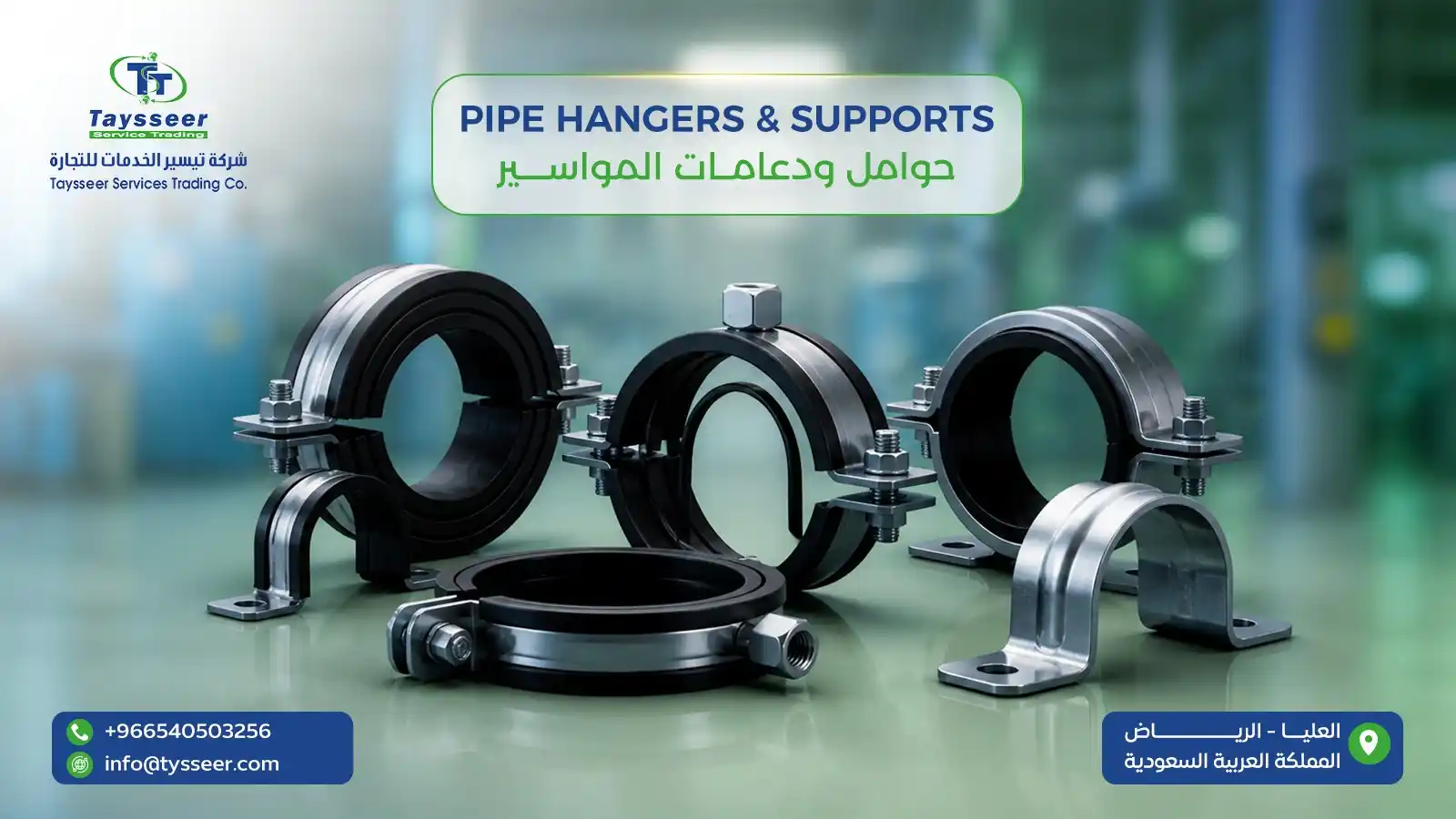
3. Split Ring Hanger
A two-piece ring that closes around the pipe, connected to a hanger rod above. Easier to install on existing runs since the ring splits to wrap around the pipe without threading it through.
Where it’s used: Light-duty horizontal runs, plumbing branch lines, copper tube systems.
Limitation: Not suitable for heavy loads. Split ring hangers work well on copper or small-diameter steel pipe; they are not rated for large-bore chilled water or fire mains.
4. Spring Hanger / Spring Support
Spring hangers absorb vertical pipe movement caused by thermal expansion, pressure surges, or vibration. They maintain a constant or variable load on the pipe regardless of its position.
Two sub-types:
Variable spring hangers – load changes as the spring compresses or extends. Used where movement is small and load variation is acceptable.
Constant spring hangers – engineered to deliver a consistent supporting force through the entire range of movement. Used on critical piping (steam mains, high-temperature hot water) where load variation would stress joints or equipment nozzles.
Where it’s used: Steam lines, high-temperature hot water systems, any piping connected to sensitive rotating equipment (pumps, chillers) where vibration isolation is required.
5. Band Hanger / Heavy-Duty Strap Hanger
A steel strap or band that wraps around the pipe and connects to a support above. Simpler than a clevis and faster to install. Rated for medium loads.
Where it’s used: Lightweight HVAC piping, refrigerant lines, condenser water runs in accessible ceilings.
Limitation: Band hangers do not provide a load-rated saddle seat under the pipe. For insulated piping, always use with a protection shield to prevent band edges from cutting through insulation.
6. J-Hanger
A J-shaped hook that the pipe rests in. Minimal contact with the pipe – easy to install and remove.
Where it’s used: Light residential or small commercial runs – copper domestic water, small-bore drain lines. Not a primary choice for large HVAC mains.
Limitation: No positive locking – pipe can shift laterally under vibration or thermal movement. Avoid on any system subject to water hammer or high flow velocity.
7. Sliding Saddle / Roller Hanger
Allows controlled axial movement of the pipe as it expands and contracts thermally. The pipe rests in a saddle or rides on a roller that moves along a guide plate.
Where it’s used: Long runs of hot water, steam, or chilled water piping where thermal expansion must be directed – not restrained.
Saudi application: Rooftop chilled water distribution lines exposed to ambient temperature swings from 15°C (night) to 48°C+ (day) will expand significantly. A 100-meter run of carbon steel pipe expands approximately 57mm across that range. Without sliding supports at defined intervals, that movement concentrates at fittings and equipment connections.
8. Trapeze Hanger
Two or more hanger rods support a horizontal strut (unistrut / channel) from which multiple pipes are hung. Effectively a frame for a group of parallel pipes.
Where it’s used: Mechanical rooms, plantrooms, ceiling-mounted multi-service routes carrying chilled water, hot water, condenser water, and fire mains in parallel.
Advantage: Reduces the number of anchor points into the structure, simplifies coordination between trades, and allows clean organized multi-pipe routing.
9. Strap Hanger (Perforated Strap)
A flat perforated steel strap looped around the pipe and fastened to structure above. The lowest-cost option for light-duty applications.
Where it’s used: Small-diameter copper or PVC runs in residential or light commercial. Not suitable for HVAC mechanical systems.
Do not use: On insulated piping, near high temperatures, or on pipe runs subject to vibration. The perforated edges cut through pipe wrapping over time.
10. Rod Hanger (Threaded Rod Support
Not a hanger in itself, but the vertical load-carrying element connecting any hanger assembly to the overhead structure. Sized and threaded to rated load.
Selection rule: Rod diameter is determined by the total supported load – pipe weight + fluid weight + insulation weight + any dynamic load from vibration or water hammer. Always apply the manufacturer’s safe working load, not the breaking load.
Saudi market note: Specify hot-dipped galvanized or stainless steel rods in areas subject to condensation or external exposure. Untreated mild steel rod in a chilled water ceiling corrodes within 2–3 years.
11. Pipe Saddle Support (Pipe Shoe / Cradle Support)
A steel saddle or cradle that supports the pipe from below, typically welded or bolted to a structural steel rack or concrete pad. Used when the pipe must be elevated above a surface without hanging from above.
Where it’s used: Rooftop pipe racks, plant room steel frames, pipe bridges, and any application where overhead support is not available or not practical.
For insulated pipes: The saddle must be sized to the outer insulation diameter, and a load-bearing insulation insert (pipe shoe) must be included to prevent the saddle from compressing the insulation and creating a cold bridge.
Quick Comparison Table – All 11 Types
| Hanger Type | Orientation | Load Capacity | Thermal Movement | Primary Use |
| Clevis Hanger | Horizontal | Medium–High | Rigid | HVAC mains, chilled water |
| Riser Clamp | Vertical | High | Rigid | Riser stacks |
| Split Ring Hanger | Horizontal | Low–Medium | Rigid | Copper, small-bore pipe |
| Spring Hanger | H or V | Variable | Absorbs movement | Steam, hot water, vibrating systems |
| Band Hanger | Horizontal | Medium | Rigid | Light HVAC, refrigerant |
| J-Hanger | Horizontal | Low | None | Light residential |
| Sliding Saddle / Roller | Horizontal | Medium–High | Allows axial movement | Long hot/cold mains |
| Trapeze Hanger | Horizontal | High (multi-pipe) | Rigid | Multi-service routes |
| Strap Hanger | Horizontal | Low | None | Light residential / PVC |
| Rod Hanger | Vertical | Sized to load | N/A | Structural element for all hangers |
| Pipe Saddle / Shoe | Horizontal | High | Rigid or sliding | Rooftop racks, plant rooms |
How to Choose the Right Pipe Hanger: 7 Factors
1. Load Requirements
Calculate the total load before selecting any hanger: pipe dead weight + maximum fluid weight + insulation weight + a safety factor (typically 1.5–2×). For spring hangers, also calculate the cold and hot load separately – they differ on thermal systems.
2. Pipe Orientation (Horizontal vs. Vertical)
Horizontal pipes need hangers with saddle seats or clevis assemblies. Vertical pipes need riser clamps at structural levels. Do not use horizontal hangers on vertical runs – they will not retain the pipe under thermal cycling.
3. Thermal Expansion and Movement
Any pipe operating above ambient temperature expands on heat-up and contracts on cool-down. Calculate expansion using the pipe material’s coefficient of thermal expansion:
- Carbon steel: ~12 × 10⁻⁶ per °C
- Copper: ~17 × 10⁻⁶ per °C
- CPVC: ~54 × 10⁻⁶ per °C
Long runs need expansion loops, expansion joints, or sliding supports – not rigid hangers at every point. Where sliding supports are used, anchor points must be defined to control the direction of movement.
4. Vibration and Noise Control
Mechanical equipment (pumps, chillers, fans) generates vibration that travels through pipe into structure. Specify spring hangers or hangers with elastomeric inserts within 1–3 meters of equipment connections. This is frequently overlooked on HVAC projects and becomes a call-back issue within the first operating season.
5. Pipe Material and Insulation
- Steel pipe: Standard clevis, riser clamp, trapeze – all compatible
- Copper tube: Use copper-compatible or coated hangers to prevent galvanic corrosion at contact points
- CPVC fire pipe: Use hangers rated for CPVC; avoid point loading that concentrates stress
- Insulated pipe: Always size hanger to outer insulation diameter; use protection shields at contact points
6. Corrosion and Environmental Conditions
Saudi Arabia’s combination of high humidity in coastal areas (Jeddah, Dammam), condensation on chilled water systems, and external exposure on rooftop installations makes corrosion a primary failure mode. Specify:
- Hot-dipped galvanized steel for most interior mechanical work
- Stainless steel (316) for coastal projects, external exposure, or food/pharma applications
- Epoxy-coated hangers for chilled water ceiling zones where condensate is present
Plain mild steel hangers on chilled water systems in Saudi Arabia typically fail within 3–5 years. This is a specification issue, not a product quality issue.
7. Spacing and Code Requirements
Hanger spacing depends on pipe material, diameter, and whether the pipe is insulated. General reference values for steel pipe (uninsulated):
| Pipe Diameter | Maximum Hanger Spacing |
| 15–20mm (½”–¾”) | 1.8m |
| 25–40mm (1″–1½”) | 2.4m |
| 50mm (2″) | 3.0m |
| 80–100mm (3″– 4″) | 3.7m |
| 150mm (6″) | 4.6m |
Always verify against the applicable Saudi Building Code requirements and the system engineer’s specification. For fire protection systems, NFPA 13 spacing rules govern.
Common Installation Mistakes to Avoid
Over-tightening clevis rods on insulated pipe. The rod should be snug, not compressed into the insulation. Crushed insulation is a thermal bridge and moisture trap.
Using the wrong material in the environment. Plain steel hangers in a chilled water mechanical ceiling are a maintenance liability. Galvanize or specify stainless from the start – retrofitting is three times the cost.
No pipe shoes on insulated saddle supports. A metal saddle bearing directly on insulation crushes it within months under the pipe’s weight. The cold bridge creates condensation and corrosion on the pipe exterior.
Ignoring hanger spacing on CPVC. CPVC for fire suppression has different (closer) spacing requirements than steel. Exceeding CPVC hanger spacing allows sag that causes stress concentration at fittings – a cracking failure over time.
Skipping vibration isolation near equipment. Rigid connections from pumps or chillers directly to structure through pipe hangers transmit noise into occupied spaces. This is a commissioning issue that is expensive to correct after ceiling finishes are installed.
Frequently Asked Questions
What is the difference between a pipe hanger and a pipe support?
A hanger suspends the pipe from above using a rod or bracket attached to the overhead structure. A support bears the pipe from below, resting on floor, rack, or structural steel. Both serve the same function – controlling pipe position and transferring load – but their structural connections go in opposite directions.
Which pipe hanger is best for chilled water systems in Saudi Arabia?
For horizontal runs: hot-dipped galvanized clevis hangers, sized to the outer insulation diameter, with protection shields at the clevis seat. For long horizontal runs (30 meters+), alternate clevis with sliding saddles at expansion anchor intervals. Specify stainless rod and fittings in coastal areas or high-humidity mechanical rooms.
When do you need spring hangers?
Spring hangers are required wherever the pipe must move vertically during operation – typically on steam systems, high-temperature hot water, and any piping directly connected to rotating equipment subject to vibration. They are also specified by the structural engineer on piping attached to seismically sensitive structures.
What is the maximum spacing between pipe hangers?
Spacing depends on pipe material, diameter, and insulation. For standard carbon steel HVAC piping, spacing typically ranges from 1.8m for small-bore up to 4.6m for 150mm pipe. Always verify against the project specification and applicable code – fire suppression piping under NFPA 13 has its own spacing requirements that differ from plumbing or HVAC standards.
Can I use the same hanger for insulated and uninsulated pipe?
The hanger type may be the same, but the size must change. An insulated 50mm pipe may have an outer diameter of 100mm or more depending on insulation thickness. Using a clevis sized to 50mm on this pipe crushes the insulation and creates a moisture problem. Always size to the outer insulated diameter.
Sourcing Pipe Supports for HVAC Projects in Saudi Arabia
Tysseer stocks a full range of pipe hangers and supports – clevis hangers, riser clamps, threaded rod, trapeze channel, and pipe saddle assemblies – available for fast delivery to project sites across the Kingdom.
Our technical team can assist with hanger selection based on your system specifications, pipe sizes, and insulation requirements. We supply to MEP contractors, government projects, and industrial facilities with full documentation and material traceability.
Request a quotation: Contact Tysseer | info@tysseer.com