If you’re specifying pipe joining methods for an HVAC, fire protection, or chilled water system in Saudi Arabia, you’ll face this choice on almost every project: grooved mechanical couplings or welded joints.
Both work. Both are code-compliant in the right application. But they are not interchangeable – and choosing the wrong method for your project type, schedule, or building environment costs money that doesn’t come back.
This guide breaks down the real differences: installation speed, long-term maintenance access, pressure and temperature limits, total cost, and the project conditions where each method earns its place.
What Is a Grooved Pipe Connection?
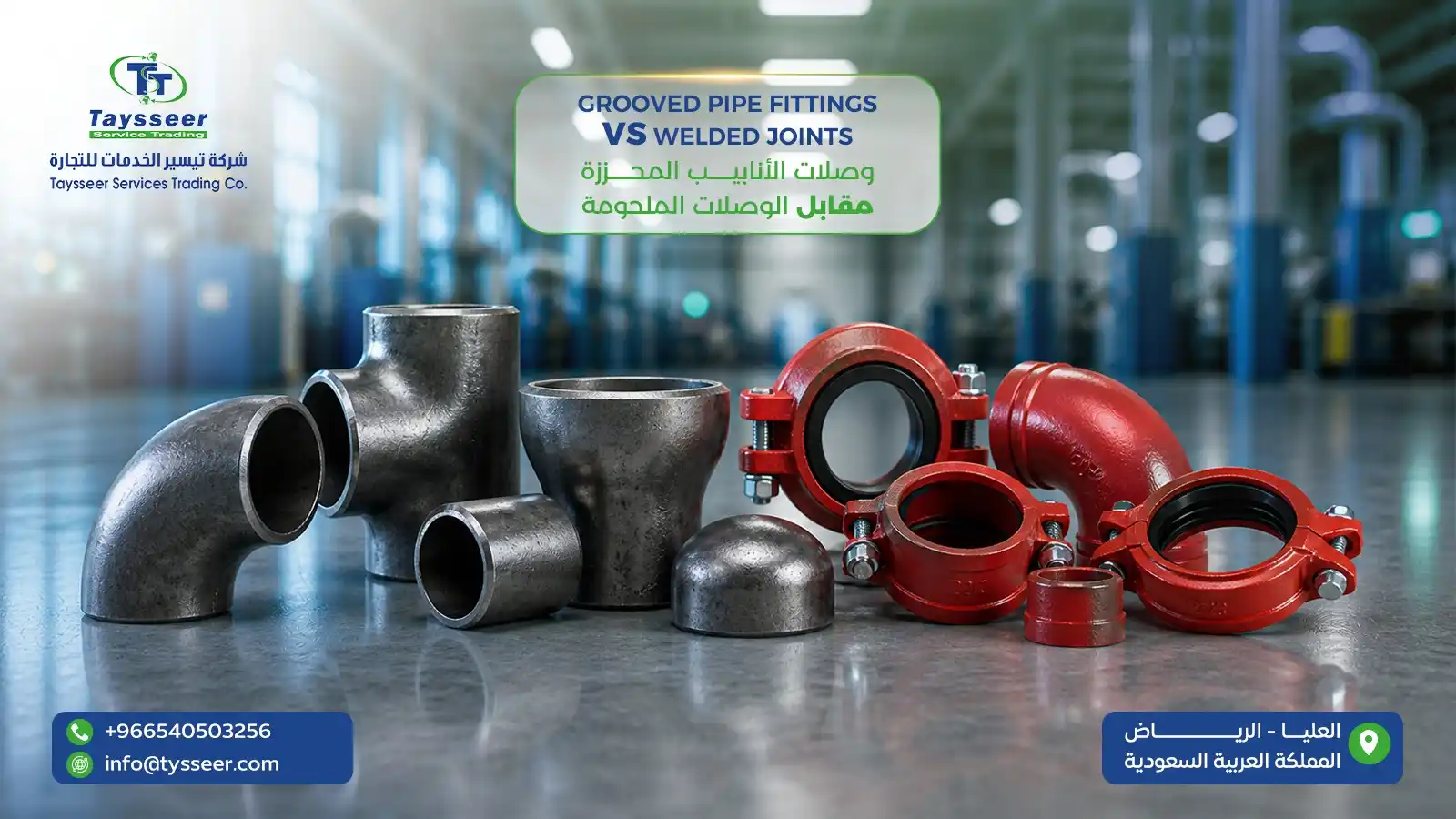
A grooved joint connects two pipe ends using a mechanical coupling – no welding, no threading for large diameters, no open flame required on site.
The process: a groove is cut or roll-formed into the pipe end at a defined depth and width (to AWWA C606 or equivalent standard). A rubber gasket sits over the pipe ends, a two-part housing clamps around both ends and seats into the grooves, and bolts are tightened to compress the gasket and lock the coupling in place.
The assembly has three components:
- Groove – cut into the pipe end, dimensioned to standard
- Gasket – elastomeric seal, compound selected for the fluid and temperature
- Coupling housing – ductile iron or carbon steel, rigid or flexible design
The coupling is the joint. No filler metal, no heat, no post-weld inspection required.
What Is a Welded Joint?
Welded pipe jointing fuses two pipe ends using heat and filler metal. The weld becomes structurally continuous with the pipe wall – one homogenous assembly.
Common weld types in HVAC and mechanical piping:
- Butt weld – pipe ends beveled and fused end-to-end; used on larger-diameter schedule pipe
- Socket weld – pipe end inserted into a fitting socket and fillet-welded; used on smaller bore (typically ≤50mm)
- Fillet weld – used for branch connections, flanges, and structural attachments
A qualified welder, controlled environment (wind, moisture), pre- and post-weld inspection, and in some cases radiographic or ultrasonic testing are all part of a welded joint’s quality assurance chain.
Head-to-Head: 7 Factors That Determine the Right Choice
1. Installation Speed
This is where grooved systems deliver the clearest advantage on large projects.
A trained technician can complete a grooved coupling joint in under five minutes once the groove is cut. The groove itself takes two to four minutes on a roll groover for standard wall pipe. No preheating, no purging, no cool-down time, no weld inspection waiting period.
A welded butt joint on 150mm pipe requires beveling, fit-up, tack welding, full-pass welding, and cooling before the line moves – typically 30 to 60 minutes per joint for a qualified welder, depending on pipe schedule and weld specification.
Practical impact on Saudi projects: A 10,000m² district cooling distribution loop with 400 field joints represents roughly 400 welder-hours vs. approximately 55–70 hours with grooved couplings. That gap directly affects program and preliminaries cost.
2. Hot Work Requirements and Fire Risk
Welding requires hot work permits on every construction site in Saudi Arabia – and in occupied or partially occupied buildings, hot work clearance can take 24 to 72 hours and requires a fire watch.
In hospital expansions, data centers, hotel refurbishments, or any retrofit project where the building is live, this is a genuine operational constraint. Hot work restrictions can halt pipe installation entirely in certain zones.
Grooved systems require no hot work permits. No flame, no spark, no heat. This is not a minor convenience – on sensitive projects it’s the deciding factor.
3. Pressure and Temperature Limits
This is where grooved connections are sometimes misunderstood.
Grooved systems are rated to higher pressures than most HVAC applications require. Victaulic, Tyco, and equivalent manufacturers certify grooved couplings to 1,200 kPa (175 psi) and above for standard rigid couplings. Flexible couplings are typically rated to 1,000–1,200 kPa depending on size and gasket type. Purpose-designed high-pressure couplings go significantly higher for fire protection and industrial applications.
Temperature limits are governed by gasket compound:
| Gasket Compound | Fluid Temperature Range | Typical Application |
| EPDM | -34°C to +110°C | Chilled water, cold water, HVAC |
| Nitrile (Buna-N) | -29°C to +82°C | Petroleum-based fluids |
| Silicone | -40°C to +177°C | High-temperature hot water |
| Halogenated (Fluorocarbon) | -29°C to +177°C | Chemical service |
For Saudi HVAC applications – chilled water (6–12°C), condenser water (30–35°C), and hot water (60–80°C) – EPDM grooved couplings comfortably cover the operating envelope.
Welded joints have no inherent temperature or pressure limitation from the joint itself – limits come from the pipe and fitting material. This makes welding the standard choice for steam systems above 110°C and for any system where a coupling’s gasket would be a liability.
4. Vibration and Seismic Performance
Flexible grooved couplings are engineered to absorb movement. They allow angular deflection (typically 1°–3° per coupling depending on size) and linear end-pull. This means:
- Vibration from pumps and chillers is attenuated before it travels through the pipe network
- Seismic movement is distributed across multiple couplings rather than concentrated at rigid joints or anchors
- Thermal expansion is partially accommodated without dedicated expansion loops on some systems
For HVAC pump sets, cooling towers, and chillers where vibration transmission into occupied space is a concern, locating flexible grooved couplings at the equipment connections is a standard detail in well-designed systems.
Welded systems are rigid. All movement must be handled by dedicated expansion joints, loops, or anchors – which adds system length, design complexity, and cost.
5. Maintenance Access and System Modification
A grooved coupling can be removed in under ten minutes with basic hand tools. The pipe section comes out without cutting, grinding, or re-welding.
This matters in three situations:
Inspection and repair: Any coupling can be unbolted, the gasket inspected or replaced, and the coupling reinstalled – without taking the pipe section out of service for grinding or re-welding.
System modifications: Adding a branch, relocating a riser, or reconfiguring distribution on a grooved system requires no hot work. Cut the pipe, roll a groove, install a tee or coupling.
Tenant fit-out changes: In commercial buildings where HVAC distribution evolves with tenant changes, grooved systems significantly reduce the cost and disruption of each modification cycle.
Welded systems are permanent by design. Any modification requires cutting out the weld, re-beveling, re-welding, and – on painted or fire-rated systems – making good the surface finish afterward.
6. Cost Comparison: Installation vs. Lifecycle
Initial installation cost: Grooved systems typically have a higher material cost per joint than field-welded connections, partly offset by reduced labor hours and no hot work permit overhead. For large-diameter pipe (≥100mm), the labor saving frequently outweighs the material premium.
Equipment cost: A roll groover for site use is a capital or rental item. On a large project this is insignificant. On a small project with few joints, it changes the equation.
Lifecycle cost: Welded joints, correctly executed, are maintenance-free for the pipe’s service life. Grooved couplings require periodic gasket inspection – typically at 5-year service intervals on clean systems, more frequently on systems with water treatment challenges. Gasket replacement is inexpensive and requires no specialist trades.
Rework cost: When a welded joint fails quality inspection, the cost is re-cutting, re-beveling, re-welding, and re-testing. When a grooved coupling is incorrect (wrong gasket, missed groove spec), the correction is a bolt change and reinstallation – minutes, not hours.
7. Quality Assurance and Inspection
Welded joints require welder qualification certificates, weld procedure specifications, and – on critical systems – non-destructive testing (radiography, ultrasonic). For Saudi government and ARAMCO projects, weld inspection documentation is a contractual requirement.
Grooved couplings are inspected visually at installation: groove dimensions checked against a gauge, gasket seated correctly, bolt torque verified. No specialist NDT required. This simplifies quality records management on large projects significantly.
When to Choose Grooved Fittings
Grooved mechanical joining is the better choice when:
- The project timeline is fixed or compressed – installation speed is 4–6× faster per joint than welding on large-diameter pipe
- Hot work restrictions apply – hospitals, data centers, hotels under operation, any site with hot work permit constraints
- The system requires future flexibility – tenant fit-out, phased commissioning, systems that will be extended or reconfigured
- Vibration isolation from equipment is required – flexible couplings at pump and chiller connections without separate vibration compensators
- The building is seismically considered – flexible couplings distribute movement; Saudi building codes are increasingly requiring seismic consideration in high-occupancy structures
- Chilled water, condenser water, hot water, and fire protection systems – the standard applications where grooved systems perform exactly as designed
When to Choose Welded Joints
Welded jointing is the better choice when:
- Steam or very high-temperature systems – above the gasket temperature limit for the required service life
- High-pressure gas or process piping – applications where any possibility of gasket degradation is unacceptable
- Buried or inaccessible piping – where long-term access for coupling inspection is not practical
- ARAMCO, Saudi Aramco, or Sabic project specifications – many hydrocarbon and petrochemical project specifications mandate welded joints with NDT on process piping as a contractual requirement regardless of pressure
- Large-diameter water mains – where groove dimensions become impractical or where the pipe wall is too thin for groove rolling
- Systems requiring no mechanical joints per project specification – some fire protection engineers specify all-welded systems above a certain pressure class
Grooved Fittings in Saudi HVAC Projects: What the Market Looks Like
The Saudi HVAC market has shifted noticeably toward grooved mechanical joining over the past decade on commercial and institutional projects. Several factors drive this:
Labor availability: Skilled welders for clean HVAC piping (as opposed to structural welding) are a constrained resource on large Saudi projects. Grooved installation can be performed by pipefitters with a shorter qualification curve.
Project delivery timelines: With Vision 2030 infrastructure programs accelerating delivery schedules across the Kingdom, the time difference between welded and grooved on a large district cooling or chilled water project is a material schedule risk item.
District cooling expansion: Riyadh and Jeddah district cooling networks – both utility-scale and building-level – use grooved systems extensively for their distribution headers and riser connections.
Maintenance infrastructure: As large commercial and mixed-use developments move from construction to long-term facility management, owners are recognizing the maintenance access benefit of grooved systems in occupied buildings.
Grooved Fitting Categories
Understanding the product range helps specification:
Rigid couplings – allow no angular or linear movement. Used where the pipe must behave as a continuous rigid run. Installed in pairs with flexible couplings at equipment.
Flexible couplings – allow angular deflection and limited linear movement. Standard coupling for most HVAC applications.
Grooved elbows and tees – directional fittings with grooved ends; eliminate the need for field welds at changes of direction.
Grooved reducers – concentric and eccentric, for diameter transitions without threading or flanging.
Grooved flange adapters – transition between grooved and flanged equipment connections.
Grooved valves – butterfly and ball valves with grooved end connections; remove without pipe cutting when replacement is needed.
Key Specifications to Verify Before Ordering
Before placing a purchase order for grooved fittings on a Saudi project, confirm:
- Groove standard – AWWA C606 is the most common; confirm the coupling and pipe groove specification match
- Pipe schedule compatibility – groove dimensions vary with pipe wall thickness; thin-wall pipe requires roll groove; schedule 40 and heavier can be cut grooved
- Coupling pressure rating vs. system design pressure – with safety factor applied
- Gasket compound – specify EPDM for chilled and condenser water; confirm with design engineer for other fluids
- Housing material – ductile iron is standard; stainless steel available for corrosive environments
- Coating – hot-dipped galvanized standard for most HVAC; orange paint is not a corrosion coating
- Standards compliance – UL Listed / FM Approved for fire protection systems (mandatory for NFPA 13 compliance)
Frequently Asked Questions
Can grooved pipe connections handle the pressures in Saudi HVAC systems?
Yes. Standard rigid grooved couplings are rated to 1,200 kPa (175 psi) or higher, which exceeds the working pressure of virtually all commercial chilled water, condenser water, and hot water systems. Fire protection systems up to 175 psi are also covered. For higher-pressure industrial applications, purpose-designed high-pressure couplings extend the range further.
Are grooved fittings acceptable under Saudi building codes and NFPA 13?
Yes. UL Listed and FM Approved grooved couplings comply with NFPA 13 for fire protection systems. For HVAC and plumbing, grooved mechanical joining is accepted under Saudi Building Code provisions aligned with ASME B31.9 (Building Services Piping). Confirm with the project authority having jurisdiction (AHJ) on government and institutional projects.
Which is more expensive – grooved or welded?
The honest answer is: it depends on project scale and pipe diameter. Grooved coupling material costs more per joint than field welding consumables. But when you include welder labor hours, hot work permit administration, weld inspection, and NDT costs, grooved systems are frequently lower in total installed cost on projects with 200+ joints of 100mm pipe and above. On small projects with few joints, welding is often cheaper overall.
Do grooved couplings require special maintenance?
Grooved couplings on clean HVAC systems (treated chilled water, condenser water) are inspected at periodic service intervals – typically every 5 years – and gaskets replaced as needed. This is a simple, low-cost maintenance task. Welded joints require no periodic maintenance but cannot be inspected internally without cutting.
Can I mix grooved and welded on the same system?
Yes – and this is common practice. Many projects weld the main distribution headers (which are buried in structure or otherwise inaccessible) and use grooved connections at riser takeoffs, equipment connections, and accessible ceiling distribution. The key is ensuring the transition points are properly detailed and the groove standard matches throughout the grooved sections.
What grooved pipe fittings does Tysseer supply?
Tysseer stocks grooved couplings (rigid and flexible), grooved elbows, tees, reducers, and grooved butterfly valves from qualified manufacturers. We supply to MEP contractors across Saudi Arabia with full documentation, including material test reports and manufacturer compliance certificates. Contact our technical team for product selection based on your pipe schedule, system pressure, and fluid type.
Summary: Grooved vs. Welded – Decision Framework
| Factor | Grooved Wins | Welded Wins |
| Installation speed | 4–6× faster per joint | – |
| Hot work restrictions | No flame required | – |
| High-temperature steam | – | No gasket limitation |
| Buried/inaccessible piping | – | No periodic inspection |
| Vibration isolation | Flexible coupling built-in | – |
| Seismic performance | Angular deflection capacity | – |
| Future system modification | No cutting or re-welding | – |
| ARAMCO/process spec compliance | – | Standard requirement |
| Quality records simplicity | No NDT required | – |
| Chilled water & fire systems | Standard method | – |
For most commercial and institutional HVAC projects in Saudi Arabia – chilled water, condenser water, hot water, and fire protection – grooved mechanical joining is the faster, lower-risk, and more maintenance-friendly choice. Welding remains the correct specification for steam, high-pressure process, and projects where the contract mandates it.
Source Grooved Pipe Fittings for Your Saudi Project
Tysseer Services Trading Company supplies grooved pipe fittings and couplings to MEP contractors and project teams across Saudi Arabia. Our technical team can assist with product selection, groove specification confirmation, and project documentation.
Request a quotation: Contact Tysseer | info@tysseer.com | +966 54 050 3256