A rubber expansion joint looks like a minor component on a drawing. On site, it is often one of the last items specified and the first to cause problems when it is wrong.
In Saudi Arabia’s HVAC market – where chilled water systems run at 6–12°C against ambient temperatures above 45°C, where district cooling distribution lines span hundreds of meters on rooftops, and where mechanical equipment vibration is a persistent complaint in occupied buildings – selecting the right rubber expansion joint is a specification decision, not a purchasing decision.
This guide covers the types available, the five movement parameters that determine what you actually need, the environmental factors specific to Saudi installations, and the pre-order checklist that prevents the most common misspecification mistakes on site.
What Is a Rubber Expansion Joint and What Does It Actually Do?
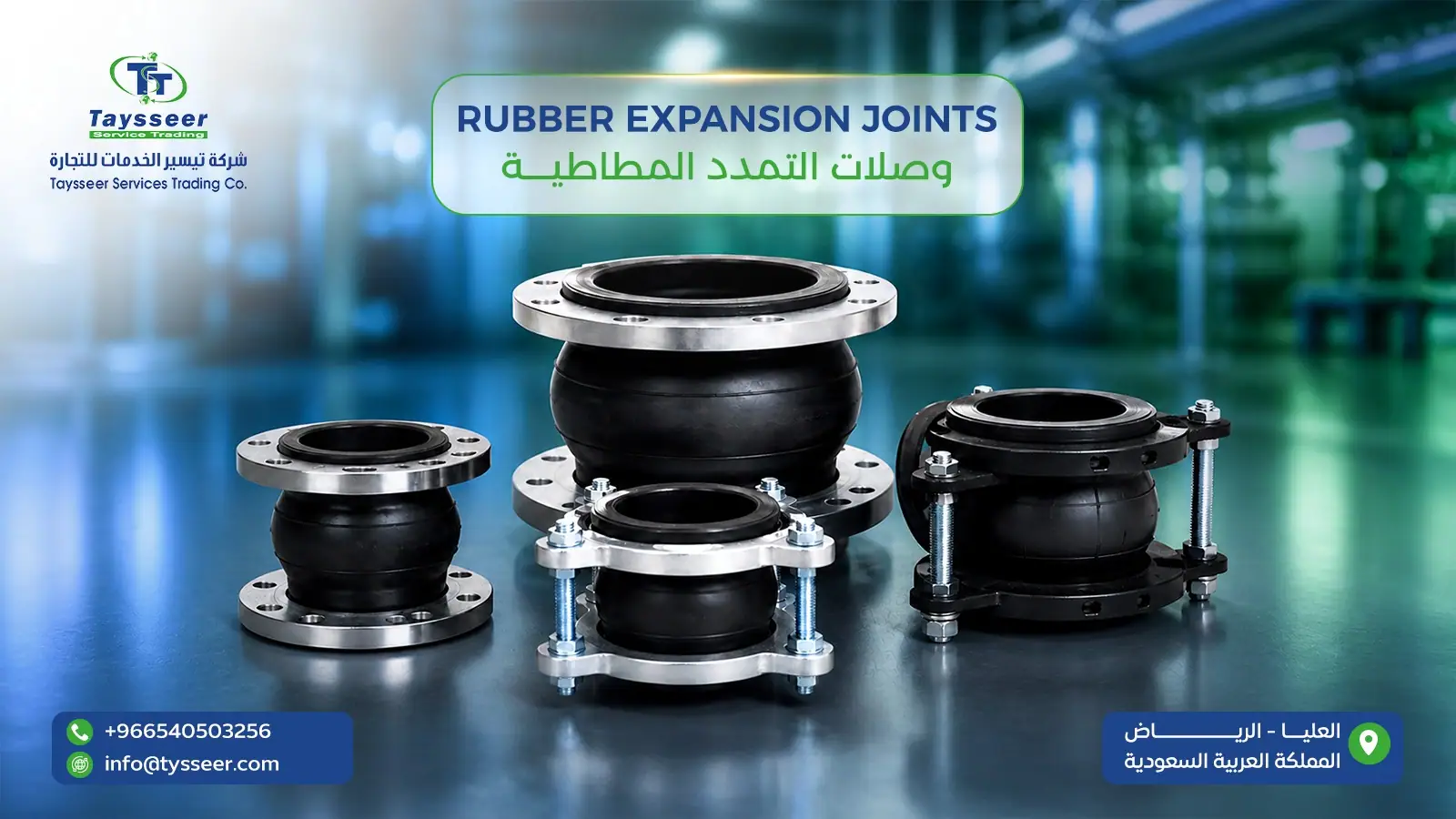
A rubber expansion joint – also called a flexible connector, rubber bellows, or flexible pipe coupling – is an engineered component installed in a piping system to absorb movement, isolate vibration, and relieve stress that would otherwise concentrate at equipment connections, pipe anchors, or rigid joints.
It is not a solution to poor pipe design. It is a precisely rated component selected to absorb a defined amount of movement in a defined direction.
The three problems it solves:
- Thermal expansion and contraction – pipe changes length as fluid temperature changes; if that movement is not absorbed, stress concentrates at flanges, equipment nozzles, and fittings
- Mechanical vibration – pumps, chillers, and cooling towers generate vibration that travels through rigid pipe into the building structure, producing noise and accelerating joint fatigue
- Misalignment – minor parallel or angular misalignment between pipe and equipment that cannot be corrected without damage during assembly
In Saudi chilled water systems, all three occur simultaneously. A flexible connector near a chiller connection is doing vibration isolation, thermal movement absorption, and misalignment compensation at once.
The Five Movement Types: What You Must Specify Before Selecting
This is where most misspecification happens. A rubber expansion joint is not selected by size alone – it is selected by the movements it must accommodate. Every catalog sheet shows rated movement values; your selection must match or fall within those values for all five axes.
1. Axial Compression
The joint shortens along its centerline – pipe pushes inward. This is the movement most people think of first.
Saudi application: Chilled water supply at 7°C in a roof-level distribution line that started installation at 35°C ambient contracts when the system is commissioned. Axial compression absorbs that shortening at defined anchor intervals.
2. Axial Extension
The joint elongates along its centerline – pipe pulls outward. Less common in compression-dominant systems but occurs in systems that cycle between hot and cold service or during system drainage.
3. Lateral (Shear) Movement
Perpendicular movement across the pipe centerline – one flange moves sideways relative to the other. This is the dominant movement at pump connections where thermal growth of the pump casing shifts the nozzle laterally relative to the pipe connection.
Critical note: Lateral movement rating is significantly less than axial rating for the same joint. A single arch connector rated ±25mm axial may only accommodate ±10mm lateral. Check both values separately against your system requirements.
4. Angular Deflection
Bending of the centerline – one flange tilts relative to the other. Relevant at expansion loops, directional changes, and installations where the connected equipment tilts under load or thermal growth.
5. Torsional Rotation
Twisting about the centerline. Rubber expansion joints have very limited torsion resistance – this movement type should not be induced into the joint. If torsion is present in the system, it must be addressed by system design (anchors, guides), not absorbed by the flexible connector.
The rule: Never select a rubber expansion joint by size and pressure rating alone. Define your required movement in all relevant axes first, then select a joint rated to handle those movements with a margin.
Types of Rubber Expansion Joints – and Where Each Belongs
Single Arch (Single Sphere)
The most common type in HVAC mechanical work. One arch (or sphere) of reinforced rubber between two flanged ends. Absorbs moderate axial, lateral, and angular movement simultaneously.
Where it belongs: Pump connections (chilled water, condenser water, hot water), chiller nozzle connections, cooling tower basin connections, and any location where a single flexible element is adequate for the system’s movement and vibration requirements.
Pressure range: Typically 10–16 bar working pressure for standard HVAC grades.
Saudi market note: The single arch is the most commonly misapplied joint. Engineers specify it for large-displacement applications (long unanchored pipe runs) where it is not rated for the required movement. On long runs, calculate the movement first.
Double Arch
Two arches in series between the flanges. Rated for greater movement in all directions than a single arch of the same bore.
Where it belongs: Applications requiring higher lateral offset capacity than a single arch provides – long pipe runs between fixed anchors, connections to equipment with larger thermal growth, installations where single arch ratings are marginal.
Trade-off: Longer face-to-face dimension – ensure the installation space accommodates it. On tight mechanical room installations, double arch connectors sometimes cannot fit between the equipment nozzle and the first pipe support.
Wide Arch
A single arch with a larger arch profile than standard, giving increased movement capacity in a shorter overall face-to-face length than a double arch.
Where it belongs: Installations where movement capacity of a standard single arch is insufficient but face-to-face space is limited.
Twin Sphere / Double Sphere
Two spherical elements connected by an intermediate spool. Provides high lateral offset and angular capacity.
Where it belongs: Pump connections where both vibration isolation and significant lateral offset must be accommodated – common on large centrifugal chillers and primary chilled water pumps where equipment thermal growth is significant.
Floating Flange Type
The joint’s flanges are not bonded to the rubber body – they are free to rotate, which simplifies alignment during installation and allows the rubber body to center itself under load.
Where it belongs: Installations where flange bolt-hole alignment during assembly is difficult, or where future removal for maintenance must be simple. Floating flange joints are faster to install and remove than fixed-flange equivalents.
Eccentric Reducer Type
A rubber expansion joint with unequal inlet and outlet diameters – functions as both a flexible connector and a reducer in one component.
Where it belongs: Pump suction connections where the suction pipe and pump nozzle diameters differ, or any location where a reducer and flexible connector would otherwise be installed in series. Eliminates one flange pair and reduces installation length.
Rectangular / Ducting Type
Rectangular cross-section rubber expansion joints for air handling ductwork connections – not pipe connections.
Where it belongs: AHU discharge connections to ductwork, fan connections, any duct-to-equipment transition where vibration and thermal movement must be absorbed. This is a separate product category from pipe-bore expansion joints but is commonly overlooked in HVAC specifications.
Flange-to-Groove / Flange-to-Threaded End Types
One flanged end connects to the piping system; the other end connects via grooved or threaded connection rather than flange. Reduces the number of bolted flange connections on systems using grooved pipe joining throughout.
Where it belongs: Grooved piping systems where a transition from grooved to flanged is needed at equipment connections with flanged nozzles.
Rubber Compound Selection: The Factor Most Specifications Get Wrong
The arch profile and pressure rating get specified correctly on most projects. The rubber compound is frequently left to the manufacturer’s standard – which may not be correct for the service fluid, temperature, or environment.
EPDM (Ethylene Propylene Diene Monomer)
Temperature range: -40°C to +120°C
Fluid compatibility: Chilled water, hot water, condenser water, steam (low pressure), dilute acids and alkalis, potable water
UV and ozone resistance: Excellent – suitable for external exposure on rooftop installations
Not suitable for: Petroleum-based fluids, oils, solvents
Saudi HVAC verdict: EPDM is the correct compound for chilled water, condenser water, and domestic hot water systems. Specify it explicitly – do not accept “standard compound” without confirmation.
Nitrile (Buna-N / NBR)
Temperature range: -30°C to +100°C
Fluid compatibility: Petroleum oils, fuels, hydraulic fluids, diesel
Not suitable for: Hot water above 80°C, ozone-rich environments, weathering exposure
Saudi HVAC verdict: Correct for fuel oil service, diesel generator connections, and hydraulic systems. Not appropriate for chilled or hot water HVAC service despite being widely available.
Neoprene (CR)
Temperature range: -30°C to +100°C
Fluid compatibility: Water, dilute acids, refrigerants (some), weathering
UV and ozone resistance: Good
Not suitable for: Aromatic or chlorinated solvents, strong oxidizers
Saudi HVAC verdict: Acceptable for water service and moderate temperature applications. EPDM typically preferred for chilled water due to superior low-temperature flexibility in outdoor installations.
Silicone
Temperature range: -60°C to +200°C
Fluid compatibility: Hot water, steam, high-temperature air
Not suitable for: Petroleum fluids, acids
Saudi HVAC verdict: Correct compound for high-temperature hot water systems (80–120°C) and steam service within its pressure rating. Higher cost than EPDM; specify only where the temperature requires it.
Chlorobutyl (CIIR)
Temperature range: -30°C to +120°C
Fluid compatibility: Hot water, dilute acids, chemicals, steam
Good resistance to: Heat aging, oxidation, ozone
Saudi HVAC verdict: Used where higher chemical resistance is needed than EPDM provides – water treatment chemical dosing connections, chemical plant utility systems.
Compound Quick-Reference Table
| Compound | Temp Range | Chilled Water | Hot Water | Fuel Oil | UV/Outdoor |
| EPDM | -40°C to +120°C | Best choice | Up to 120°C | Not suitable | Excellent |
| Nitrile (NBR) | -30°C to +100°C | Acceptable | Up to 80°C | Best choice | Poor |
| Neoprene | -30°C to +100°C | Acceptable | Up to 100°C | Not suitable | Good |
| Silicone | -60°C to +200°C | Overkill | Best >120°C | Not suitable | Good |
| Chlorobutyl | -30°C to +120°C | Acceptable | Up to 120°C | Not suitable | Good |
Saudi Arabia-Specific Selection Considerations
Chilled Water System Temperature Differential
Saudi chilled water systems operate at supply temperatures of 6–7°C in ambient conditions that reach 47–50°C on exposed rooftops. This is one of the most demanding thermal environments for rubber expansion joints in any HVAC application globally.
The implication: The rubber compound must maintain flexibility and seal integrity across a temperature range from approximately 5°C (minimum fluid temperature) to 50°C+ (maximum ambient on an uninsulated section). EPDM handles this range without issue. Natural rubber compounds or standard neoprene may harden and crack in prolonged low-temperature service on chilled water lines.
UV and Ozone Exposure on Rooftop Installations
Saudi Arabia’s solar radiation intensity accelerates rubber degradation. Rooftop expansion joints – at cooling tower connections, district cooling distribution headers, and exposed condenser water lines – require compounds with verified UV and ozone resistance.
Specification requirement: EPDM or neoprene with UV stabilizers for all external or rooftop-located expansion joints. Specify protective covers for joints in direct sun exposure – this extends service life by 5–8 years on exposed installations.
District Cooling Distribution Systems
Riyadh and Jeddah district cooling networks involve large-bore chilled water distribution (200mm to 600mm+ pipe diameter). Expansion joints in these applications must be:
- Rated for continuous operating pressure (typically 10–16 bar)
- Sized for the pipe’s thermal expansion over the anchor span length
- Specified with control rods (tie rods) where the joint will experience vacuum or surge conditions
- Accessible for periodic inspection – these joints are long-term assets on 30-year infrastructure
Seawater Cooling – Coastal Projects
Projects on the Red Sea coast (Jeddah, NEOM, Red Sea Project) or the Arabian Gulf coast may use seawater or brackish water in cooling circuits. Standard carbon steel control rod assemblies corrode rapidly in seawater service.
Specification requirement: Stainless steel control rods, stainless steel flange hardware, and EPDM rubber body for seawater-cooled systems. Confirm material specifications before ordering.
Control Rods (Tie Rods): When They Are Required
Control rods are steel rods that span the expansion joint flanges, limiting the maximum extension the joint can reach under internal pressure and fluid weight.
When to specify control rods:
- Large-diameter joints (typically 200mm+) where internal pressure would otherwise push the flanges apart beyond the joint’s axial extension rating
- Vertical installations where gravity places continuous axial extension load on the joint
- Systems subject to hydraulic surge or water hammer
- Pump discharge connections where pressure pulses occur at startup
When control rods are not required:
- Small-bore connections (≤100mm) in standard pump suction service
- Applications where the joint is fully supported by pipe guides and anchors that prevent extension beyond the rated limit
Misuse warning: Control rods must not be used as a substitute for pipe anchors and guides. They are a safety limit device, not a movement control device.
Pre-Order Specification Checklist
Before ordering rubber expansion joints for a Saudi HVAC project, confirm these eight parameters in writing:
- Pipe bore – nominal diameter and pipe schedule; OD must match flange bore
- Flange standard – ANSI 150, ANSI 300, DIN PN10, DIN PN16, or other; bolt circle and hole pattern must match the connected flanges
- Design pressure – system working pressure plus surge allowance; specify in bar or kPa
- Design temperature – minimum and maximum fluid temperature, not just operating temperature
- Required movements – axial compression, axial extension, lateral offset, and angular deflection in mm/degrees; confirm each against the joint’s rated values
- Rubber compound – specify EPDM for water service; do not accept “standard” without written confirmation of compound type
- Control rods – required or not required; if required, specify stainless steel hardware for coastal or corrosive environments
- End connection type – flanged both ends, floating flange, groove-to-flange, or threaded; specify flange face type (flat face or raised face)
Installation Requirements That Affect Service Life
Pipe alignment before installation. The joint must not be used to pull misaligned flanges into position. Forcing flanges into alignment through bolt tension overstresses the rubber body immediately. Align the pipe first; install the joint second.
Control rod torque. Control rod nuts are tightened to snug, not to a structural torque value. Over-torquing locks the joint into a fixed position – it functions as a rigid spacer and absorbs nothing.
Minimum installation length. Do not compress the joint below its minimum face-to-face dimension during installation. The rubber must be in its neutral or slightly extended position to absorb both compression and extension during operation.
Pipe guides and anchors. The expansion joint must be flanked by properly designed pipe anchors and guides. Without guides, lateral movement beyond the joint’s lateral rating will be applied – destroying the joint in a single thermal cycle.
Insulation. Do not insulate the rubber body of a chilled water expansion joint. The rubber must be inspectable – any leak will be invisible under insulation until it causes damage. Insulate the connected pipe up to the joint flanges; leave the body exposed.
Frequently Asked Questions
What is the difference between a rubber expansion joint and a metal expansion bellows?
Both absorb pipe movement, but differently. Rubber expansion joints absorb larger lateral and angular movements with lower spring rates – they are more forgiving of misalignment and better at vibration isolation. Metal bellows handle higher temperatures and pressures (steam, high-pressure gas) but are less tolerant of lateral misalignment and absorb vibration less effectively. For HVAC chilled water, hot water, and condenser water systems, rubber is the standard choice. Metal bellows are specified for steam and high-temperature or high-pressure process applications.
How long does a rubber expansion joint last in a Saudi chilled water system?
A correctly specified and properly installed EPDM rubber expansion joint on a treated chilled water system in a mechanical room environment should last 15–20 years. External rooftop installations in direct sun may see 10–15 years before degradation requires replacement. Annual visual inspection is the minimum; biannual inspection including manual flexing to check for surface cracking is recommended.
Can rubber expansion joints be used on fire protection systems?
Yes, where specifically rated and listed for that service. Fire protection expansion joints must be UL Listed and FM Approved for the system’s working pressure. Verify the listing before specifying – not all rubber expansion joints carry fire protection approvals, and substituting an unlisted joint on a fire system violates NFPA 13 compliance.
What causes rubber expansion joints to fail prematurely?
The most common causes in Saudi HVAC installations are: (1) wrong rubber compound for the fluid or temperature; (2) pipe installed without proper anchors and guides, placing lateral loads beyond the joint’s rating; (3) direct sun exposure without UV-resistant compound or protective cover; (4) installation in compression beyond the joint’s minimum face-to-face dimension; and (5) untreated system water causing rubber body swelling or chemical degradation.
What rubber compound should I specify for a Saudi chilled water system?
Specify EPDM explicitly. EPDM provides the correct fluid compatibility, low-temperature flexibility for 6°C supply water, and UV/ozone resistance for external sections. Confirm in writing with the supplier before placing the order.
Are rubber expansion joints reusable after removal?
Yes, if they are removed carefully and inspected before reinstallation. A joint that shows no surface cracking, no delamination of the rubber body, and no corrosion of the metal flanges or control rods can be reinstalled. Gaskets at the flange faces should be replaced. Any joint that has experienced movement beyond its rated limits should be replaced regardless of visual condition.
Summary: Selection Framework for Saudi HVAC Applications
| Application | Joint Type | Compound | Control Rods | Special Requirement |
| Chilled water pump connection | Single or Twin Sphere | EPDM | Usually not | Size flanges to pump nozzle standard |
| Chiller nozzle connection | Twin Sphere / Double Arch | EPDM | May be required | Check lateral offset against chiller thermal growth |
| Condenser water pump | Single Arch | EPDM | Usually not | – |
| Cooling tower basin connection | Single Arch | EPDM | Check | UV cover if exposed |
| Rooftop distribution header | Wide Arch or Double Arch | EPDM | Required (large bore) | Stainless hardware, UV protection |
| District cooling large bore (200mm+) | Double Arch or Twin Sphere | EPDM | Required | Full anchor/guide system required |
| Hot water (60–80°C) | Single Arch | EPDM or Silicone | Check | Confirm compound temperature rating |
| High-temp hot water (>100°C) | Single Arch | Silicone or CIIR | Required | Verify working pressure rating |
| Fuel oil / diesel service | Single Arch | Nitrile (NBR) | Check | – |
| AHU duct connection | Rectangular Duct Type | EPDM or Neoprene | N/A | Match duct dimensions exactly |
| Seawater cooling – coastal projects | Twin Sphere | EPDM | Stainless steel | Full stainless hardware specification |
Source Rubber Expansion Joints for Your Saudi Project
Tysseer Services Trading Company supplies rubber expansion joints and flexible pipe connectors to MEP contractors and project teams across Saudi Arabia. We stock single arch, double arch, and twin sphere connectors in standard HVAC sizes, with EPDM compound for water service and Nitrile for petroleum applications.
Our technical team can assist with joint selection based on your pipe schedule, system pressure, required movements, and rubber compound requirements – and provide full material documentation for project quality records.
Request a quotation: Contact Tysseer | info@tysseer.com | +966 54 050 3256