A practical guide for engineers and contractors working on fire-compliance HVAC projects in Saudi Arabia
The Problem You’re Facing
You’re halfway through a project specification when your fire safety consultant flags it: “You need fire-rated ductwork gaskets throughout the plenum.” You’ve heard the term before, but now you need to actually specify it. You search “Flamebar fire rated duct gasket” and come up empty with technical details. Worse, you’re not entirely sure what the difference is between a standard gasket and a fire-rated one – or whether your current duct design actually requires one.
This confusion costs time. It creates RFIs with contractors. It can delay approvals if the wrong gasket ends up in the spec.
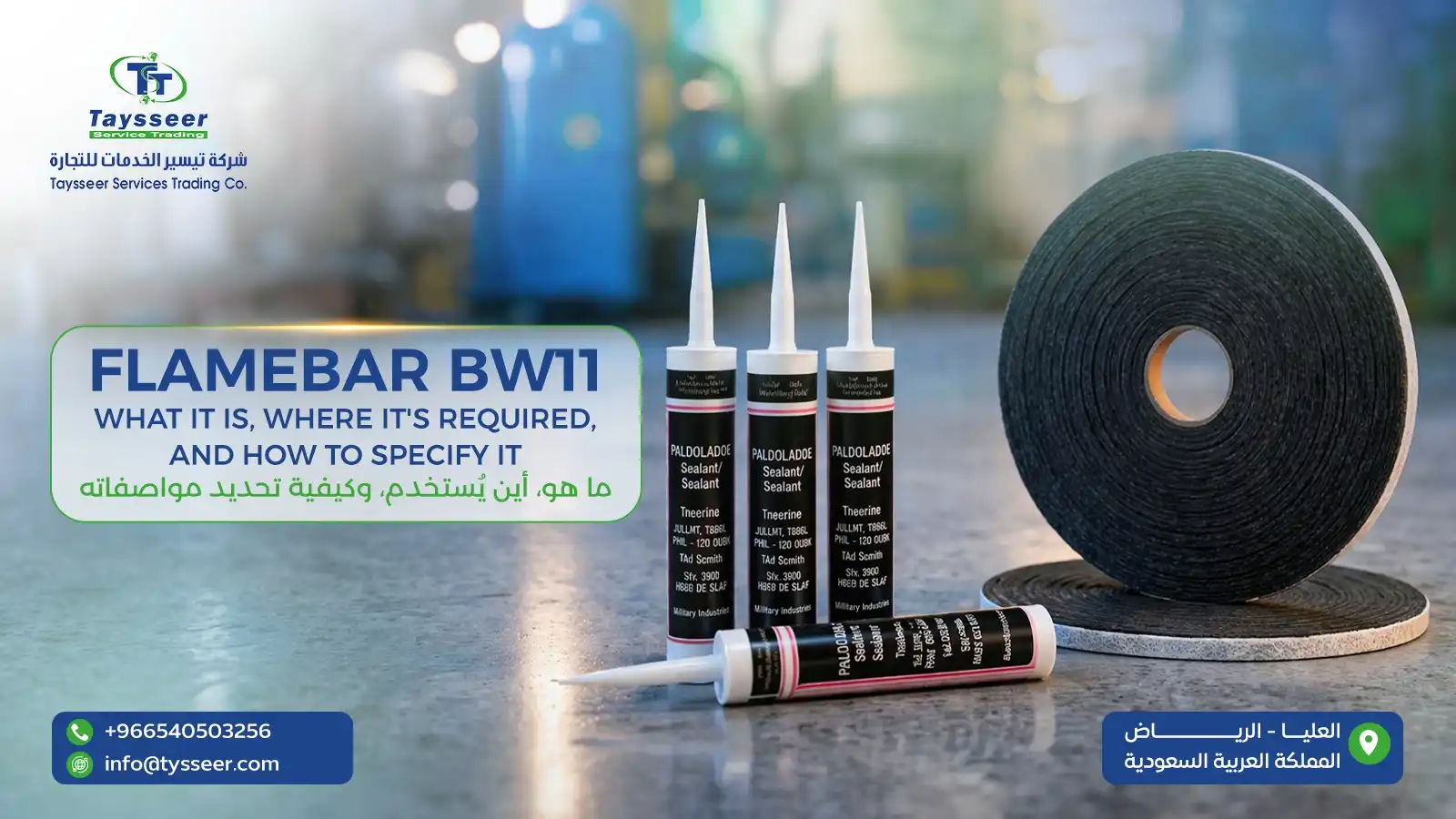
Flamebar BW11 is the answer to this specific problem. It’s a fire-rated gasket designed for HVAC ductwork in Saudi projects – and it’s required more often than most engineers realize.
Here’s what you need to know.
What Is Flamebar BW11?
Flamebar BW11 is a fire-rated, intumescent gasket manufactured by Flamebar (a German specialist in fire-safety products) and distributed in Saudi Arabia by Tysseer Trading Company.
The Technical Definition
A gasket is simply a seal that prevents air leakage between two metal surfaces – in this case, between duct sections. Most gaskets are made from rubber or foam.
But BW11 is different. It’s an intumescent gasket, meaning:
- Under normal conditions, it looks and behaves like a standard gasket – flexible, compressible, non-conductive.
- Exposed to fire (temperatures above 120°C), the gasket expands and hardens. This expansion creates a seal that prevents flames and smoke from traveling through the duct joint. This is called the “intumescent effect.”
The result: A duct joint that remains sealed during a fire, which prevents:
- Flames from spreading through the HVAC system
- Smoke from spreading to adjacent compartments
- Structural integrity loss in duct connections
Key Material Properties
| Property | Standard Gasket | Flamebar BW11 |
|---|---|---|
| Composition | Rubber or closed-cell foam | Intumescent rubber compound |
| Temperature rating (normal) | Up to 80°C | Up to 120°C continuous |
| Fire exposure rating | Not rated | Up to 1000°C (fire test verified) |
| Smoke development | N/A | ASTM E84 Class A |
| Flammability | Variable | Passes EN 13823 |
| Cost | Baseline (1x) | +15–25% vs. standard |
| Installation | Same as standard | Identical |
Where BW11 Is Required: Saudi Building Codes
You need to understand when BW11 becomes required versus when it’s recommended.
Regulatory Requirement: SASO 2662
Saudi Arabia’s primary building code reference is SASO 2662 (Building Code), which aligns with international standards for fire safety in HVAC systems.
BW11 is required in:
- Fire-rated air transfer openings
Any duct that penetrates a fire-rated wall or floor partition (typically 1-hour or 2-hour rated) must have fire-rated sealing at all joints and connections. - Return air plenums in commercial buildings
If your plenum is used as a return air path and the building is more than 4 stories, all duct seams must be fire-rated. - Hospital, hotel, and high-occupancy buildings
Projects with elevated life-safety requirements (MOH, Ministry of Interior, major hospitality) typically mandate fire-rated ductwork gaskets throughout. - High-rise government buildings (> 12 stories)
Any government office or institutional building taller than 12 floors requires fire-rated gaskets on all HVAC penetrations and return plenums. - ARAMCO and Saudi Basic Industries (SABIC) projects
Industrial and refinery work almost always requires fire-rated ductwork due to hazardous material handling.
How to Know If Your Project Requires It
Ask yourself these questions:
Question 1: Does your duct system penetrate any fire-rated wall or floor?
→ If yes: BW11 is required at that penetration.
Question 2: Is the building a hospital, government facility, or high-rise (> 12 floors)?
→ If yes: Consult SASO 2662 and your fire safety consultant. Most likely required throughout.
Question 3: Does the project have specific ARAMCO or MOH requirements?
→ If yes: Fire-rated gaskets are almost certainly required.
Question 4: Is the return air plenum serving more than 4 floors?
→ If yes: BW11 required at all plenum seams.
Real-World Example: A Government Office in Riyadh
To make this concrete, here’s how BW11 comes into play in an actual project.
Project: 15-story MOH (Ministry of Health) office building, Riyadh
HVAC Design:
- Rooftop air handler serving 3 zones
- Return air plenum on floors 5–15 (above suspended ceiling)
- Ductwork penetrates fire-rated walls at floors 7, 10, and 12
Specification Decision:
The engineer is tempted to use standard gaskets (cheaper, faster to install). But the fire safety plan specifies:
- All ductwork penetrating fire-rated walls must have fire-rated sealing
- Return plenum above floor 4 must have fire-rated gaskets at all seams
The Solution:
- Standard gaskets on all non-fire-rated ductwork (rooftop, non-critical sections)
- Flamebar BW11 gaskets on:
- All duct sections that penetrate fire-rated walls (floors 7, 10, 12)
- All seams in the return air plenum (floors 5–15)
Cost Impact:
- Standard gasket: SAR 8 per duct joint
- BW11 gasket: SAR 10–12 per duct joint
- Difference: ~SAR 500–800 for the entire project
But the value: The project passes fire safety approval on the first round, no RFIs, no delays.
How to Specify Flamebar BW11 Correctly
If you’ve determined that BW11 is required, here’s how to specify it in your documentation.
Step 1: Identify Locations
In your drawings or specification document, create a fire-rated ductwork schedule. Example:
| Location | Duct Size | Reason | Gasket Type |
|---|---|---|---|
| Wall penetration, Floor 7 | 600×400 | Fire-rated wall | Flamebar BW11 |
| Wall penetration, Floor 10 | 800×600 | Fire-rated wall | Flamebar BW11 |
| Return plenum seams, Floors 5–15 | Various | Return plenum > 4 floors | Flamebar BW11 |
| Rooftop ductwork | 1200×1000 | Non-rated | Standard gasket |
Step 2: Write the Spec Section
Add this language to your HVAC specification document (CSI Division 23):
23 31 13 – Duct and Casings (excerpt)
Fire-Rated Ductwork Sealing:
Flamebar BW11 intumescent gaskets shall be used at all duct joints and seams in the following locations:
- All ductwork penetrating fire-rated walls or floors
- All seams in return air plenums serving more than 4 floors
- All ductwork in fire-rated air transfer openings
Flamebar BW11 shall:
- Be factory-manufactured intumescent gasket material, per EN 13823
- Have a continuous operating temperature rating of 120°C
- Achieve EN 13823 Class A smoke development when exposed to flame
- Be installed at the same pressure as standard gaskets (no special installation required)
- Include a certificate of fire performance test results
Contractor shall provide:
- Cut gasket material to length for each duct joint
- Install gasket before bolting or riveting duct sections
- Maintain gasket continuity throughout all seams in fire-rated sections
- Submit fire test certificates for approval before installation
Step 3: Procurement
Once your spec is approved, you (or the contractor) need to source the gasket. Here’s where Tysseer comes in.
Why Tysseer for Flamebar BW11:
- Direct distribution: Tysseer is the authorized Flamebar distributor in Saudi Arabia. No middlemen, no delays.
- Technical support: Tysseer’s engineers can verify your application and confirm the right gasket material for your project.
- Delivery: Stock available in Riyadh. Can ship within 48 hours for urgent projects.
- Documentation: Includes fire test certificates and compliance documentation for your project file.
Common Mistakes (And How to Avoid Them)
Mistake #1: Installing Standard Gaskets in Fire-Rated Locations
The Problem:
You’re cost-cutting or trying to simplify the supply chain, so you use standard rubber gaskets everywhere. The building inspector catches it during commissioning.
The Fix:
Don’t try to save a few SAR per joint. If your project specs require fire-rated gaskets, use them. The cost difference is negligible (SAR 2–4 per joint), but the consequence of non-compliance is project delay.
Mistake #2: Over-Specifying BW11 Everywhere
The Problem:
You specify Flamebar BW11 for every single duct joint in the building “just to be safe.” You waste money and confuse the contractor.
The Fix:
Only specify BW11 where your building code or fire safety plan actually requires it. Create a clear schedule (like the table above) that shows exactly which locations need it and why.
Mistake #3: Forgetting Ductwork Inside Fire-Rated Walls
The Problem:
You specify fire-rated gaskets for ductwork entering a fire-rated wall, but forget the ductwork inside the wall. This is a common oversight.
The Fix:
When a duct penetrates a fire-rated wall, the entire duct section within that wall (and any branch ducts within it) should have fire-rated sealing at all joints.
Mistake #4: Not Ordering Early Enough
The Problem:
Your project is 2 weeks from installation, and you discover you need fire-rated gaskets. The supplier doesn’t have stock, and you face a 3-week lead time.
The Fix:
Confirm gasket requirements during the design phase, not during construction documents. Order a sample from Tysseer early so you have it in hand before the contractor needs it.
Technical Comparison: BW11 vs. Alternatives
If you’re evaluating fire-rated gasket options, here’s how BW11 stacks up:
Flamebar BW11
- Intumescent (expands under heat)
- German engineering, EN 13823 certified
- Easy installation (same as standard gasket)
- Available in Saudi Arabia via Tysseer
- Good cost-to-performance ratio
- Specialty product (not every supplier has it)
Promat Fire-Rated Gaskets
- Alternative brand, also intumescent
- Similar performance to BW11
- Longer lead time (imported from Belgium)
- More expensive (+30–40% vs. BW11)
Silicone-Based Fire Sealant (Poor Choice)
- Applied after duct installation (labor-intensive)
- Difficult to remove if duct needs repair
- Not suitable for moving duct connections
- Higher total cost when labor is considered
Bottom line: For most Saudi HVAC projects, Flamebar BW11 is the best balance of performance, cost, and availability.
Installation & Handling
Good news: Installing Flamebar BW11 is exactly the same as installing a standard gasket.
Installation Steps
- Cut the gasket material to length for each duct seam
- Apply the gasket to one duct flange (same process as standard gasket)
- Bolt or rivet the connection (same pressure as standard gasket – no special clamping required)
- Maintain gasket continuity throughout the seam
Storage & Handling
- Keep gasket rolls sealed until use (prevents compression)
- Store at room temperature (avoid extreme heat or cold)
- Do not stretch or overcompress the gasket before installation
- Discard any damaged sections and use fresh material
Compliance Documentation for Your Project File
When you specify Flamebar BW11, you should include the following documentation with your project:
- Fire Test Certificate
- EN 13823 test results showing ASTM smoke development rating
- Temperature rating confirmation (120°C continuous)
- Product Data Sheet
- Composition and dimensions
- Installation instructions
- Performance specifications
- Certification of Compliance
- Confirmation that the gasket meets SASO 2662 requirements
- Batch number and manufacture date (for traceability)
Tysseer provides all of these documents with every order. When you request a quote for Flamebar BW11, ask for the complete documentation package. Include it in your project RFI to the contractor, and keep it in your project file for inspection and commissioning.
When to Call Tysseer’s Technical Team
You should reach out to Tysseer’s engineers if:
- You’re unsure whether your project requires fire-rated gaskets
→ They can review your building code requirements and advise - You need clarification on the difference between gasket types
→ They can explain intumescent vs. standard, and help you choose correctly - You’re writing specs and want to verify the correct language
→ They’ve written specs for hundreds of Saudi projects and can provide a template - You need a sample for your contractor to review before ordering
→ Tysseer can send a sample roll for testing and approval - You’re on a tight timeline and need to confirm delivery
→ They maintain stock in Riyadh and can guarantee 48-hour delivery
Contact Tysseer:
- Email: info@tysseer.com
- Phone: +966 54 050 3256
- Request: Free technical consultation on fire-rated ductwork sealing
The Bottom Line
Flamebar BW11 isn’t just another gasket. It’s a critical fire-safety component that prevents flames and smoke from spreading through your HVAC system during an emergency.
If your project requires it, specifying BW11 correctly ensures:
- Compliance with SASO 2662
- Faster approval from building inspectors
- No RFIs or change orders related to sealing
- Peace of mind that the system is genuinely fire-rated
If you’re unsure whether you need it, the answer is simple: Ask your fire safety consultant or building code authority. They’ll tell you exactly where BW11 is required.
For sourcing and technical support, Tysseer is your single point of contact in Saudi Arabia. They stock it, spec it, and support it — so you don’t have to hunt across suppliers.
Next Steps
If you’re currently specifying a project:
- Confirm requirement: Ask your fire safety consultant: “Does this project require fire-rated ductwork gaskets?”
- Create a schedule: If yes, make a list of exactly which locations require BW11 (use the template in this article).
- Write the spec: Use the language provided above and customize it for your project.
- Get a sample: Contact Tysseer and request a sample roll of Flamebar BW11 – test it with your contractor to confirm compatibility.
- Confirm delivery: Place your order with Tysseer 3–4 weeks before installation starts.
Free Consultation
Not sure if your project needs BW11?
Tysseer’s engineers offer free technical consultations for specification and compliance questions. They can review your project drawings, confirm requirements against SASO 2662, and recommend the exact gasket type you need.
[Request a Free Engineering Consultation] 15 minutes to confirm your fire-rated ductwork requirements
About Tysseer Trading Company
Tysseer has been supplying HVAC and electromechanical equipment to government and private sector projects across Saudi Arabia since 2009. We work with Flamebar and 8+ other international manufacturers to provide the exact products your projects require — including technical support, compliance documentation, and fast delivery to Riyadh.
For Flamebar BW11 or other fire-rated ductwork components, Tysseer is your trusted partner.Have questions about Flamebar BW11 or fire-rated ductwork? Email us at info@tysseer.com or call +966 54 050 3256