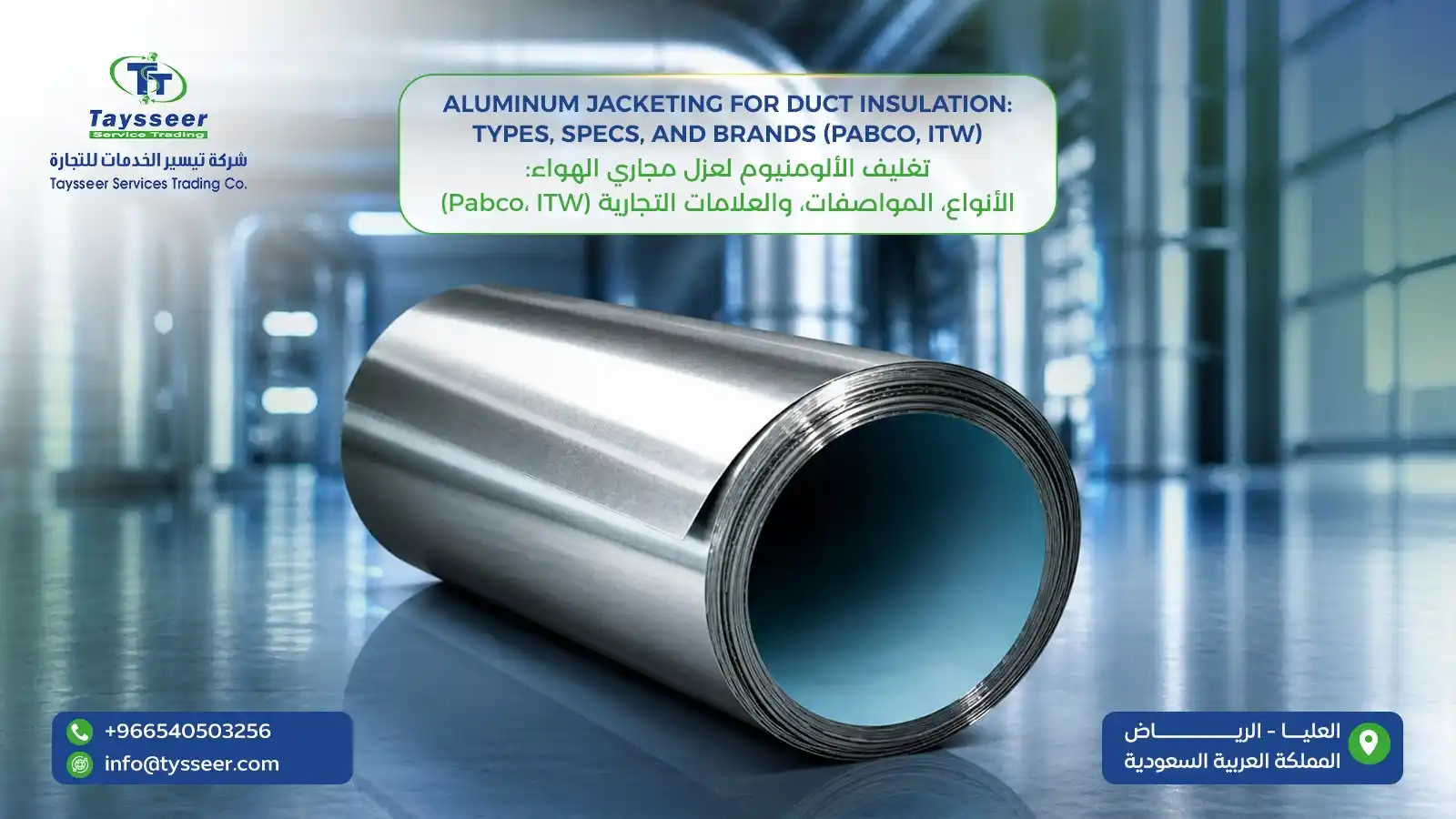
Aluminum jacketing is one of those materials that rarely appears in project specifications with much detail – just “aluminum cladding, 0.5mm” – yet getting it wrong causes persistent problems: corrosion under insulation, mechanical damage from wind vibration, water ingress at seams, and costly re-work during commissioning.
This guide covers the main jacketing types used on duct insulation in Saudi Arabia, the specifications that actually matter in Gulf climate conditions, and a practical look at the two brands most commonly specified on government and large commercial projects: Pabco and ITW.
Why Aluminum Jacketing Matters on Saudi Projects
In Saudi Arabia, duct insulation systems face two distinct threat environments depending on location.
Indoors (mechanical rooms, ceiling voids): The primary risk is mechanical damage during maintenance and the buildup of dust and moisture in insulation that is left unprotected. Jacketing here is about durability and appearance as much as performance.
Outdoors and semi-outdoors (rooftop plant areas, external risers): UV degradation, thermal cycling between 10°C at night and 55°C midday, wind-driven sand abrasion, and seasonal humidity spikes from the Gulf all attack unprotected insulation. Without proper jacketing, even premium duct insulation like Armaflex or Kimmco fiber glass will degrade within two to three seasons.
Aluminum jacketing solves both problems when correctly specified and installed.
Types of Aluminum Jacketing
Smooth Aluminum Jacketing
The standard product for most HVAC duct applications. A flat sheet of aluminum alloy, typically 1xxx or 3xxx series, with no surface treatment beyond the mill finish or a polycoat moisture barrier on the interior face.
Used for: straight duct runs, flat surfaces, indoor and outdoor applications where aesthetics are not a primary concern.
Alloy selection note: 1100 series aluminum is the softest and easiest to work but offers less corrosion resistance. 3003 series (alloyed with manganese) is the standard choice for outdoor Saudi applications – better corrosion resistance and higher tensile strength without a significant cost premium.
Corrugated (Embossed) Aluminum Jacketing
The surface is mechanically embossed with a repeating pattern – stucco emboss is the most common, sometimes called “orange peel” texture on site. The embossing increases stiffness significantly without adding material thickness, which matters on large duct sections where flat sheet tends to oil-can and vibrate.
Used for: large duct sections, outdoor applications, any installation where the jacket will be exposed to wind loading or foot traffic proximity.
Stucco emboss vs. five-bar tread: Stucco is standard for duct jacketing. Five-bar tread pattern is typically reserved for pipe jacketing and valve covers where impact resistance is the priority.
Aluminum with Moisture Barrier (Polysurlyn or Kraft)
A laminated product with a polymer film or kraft paper bonded to the interior face of the aluminum sheet. The moisture barrier prevents corrosion under insulation (CUI) by blocking condensation from contacting the aluminum directly.
Polysurlyn: A three-layer polymer film (polyethylene/surlyn/polyethylene) bonded to the aluminum. This is the industry standard for outdoor duct jacketing in humid environments. It is the correct choice for coastal Saudi locations (Jeddah, Dammam, Yanbu) and for any chilled duct running outdoors where the surface temperature drops below the dew point.
Kraft-reinforced foil: A lighter-duty option used in dry indoor environments. Not suitable for outdoor use or locations where surface condensation is possible.
Pre-formed Aluminum Fittings and Covers
Manufactured elbows, tee covers, end caps, and valve covers that match the flat sheet jacketing. Reduces field fabrication time and produces a cleaner, more consistent finish on complex geometry.
On large projects in Saudi Arabia, pre-formed fittings are increasingly specified because labor cost savings from faster installation outweigh the material premium.
Key Specifications to Understand
Thickness
The most commonly specified thicknesses for duct jacketing in Saudi Arabia:
| Application | Standard Thickness |
|---|---|
| Indoor straight duct runs | 0.4 mm |
| Outdoor straight duct runs | 0.5 mm |
| Outdoor large ducts (>600mm wide) | 0.6 mm |
| Fittings and elbows (outdoor) | 0.6 – 0.8 mm |
Practical note: Many specifications in Saudi Arabia default to 0.5mm for all applications as a single standard. This works but results in over-specification and unnecessary cost on indoor runs. On projects where cost control is a priority, separating indoor from outdoor thickness is worth raising with the project engineer.
Alloy and Temper
The full designation matters. Common specifications:
- 1100-H14: Soft, easy to form, adequate for indoor applications with no mechanical stress.
- 3003-H14: The standard for outdoor Saudi applications. Better corrosion resistance, stiffer.
- 3105-H14: Occasionally specified on premium projects. Higher strength than 3003, marginally better corrosion resistance.
When a specification just says “aluminum jacketing 0.5mm” without an alloy designation, ask the supplier what they are quoting. The price difference between 1100 and 3003 is small but the performance difference outdoors is significant.
Moisture Barrier
For any outdoor application or indoor application where surface condensation is possible (chilled ducts, cold rooms), specify aluminum with polysurlyn moisture barrier. The cost premium over bare aluminum is typically 8-12% – modest relative to the cost of corrosion-related re-work.
Fasteners and Sealants
Jacketing performance depends as much on fastening and sealing as on the sheet material itself. On Saudi outdoor projects:
- Use stainless steel or aluminum banding, not galvanized steel – galvanized corrodes in coastal humidity.
- Apply a compatible sealant at all longitudinal and circumferential seams. Butyl sealant tape is the standard choice.
- Overlap direction must shed water – upper sheet over lower sheet on horizontal runs, lapped away from prevailing wind direction on vertical runs.
Brand Comparison: Pabco vs ITW
Pabco Metals
Pabco is a US-based manufacturer with a long track record in industrial and HVAC insulation jacketing. Their aluminum jacketing products are widely specified on Saudi Aramco projects and government facilities where a named brand with documented quality control is required.
Product range relevant to KSA:
| Product | Type | Alloy | Moisture Barrier |
|---|---|---|---|
| Pabco Smooth | Smooth sheet | 3003-H14 | Optional polysurlyn |
| Pabco Stucco | Embossed sheet | 3003-H14 | Optional polysurlyn |
| Pabco All-Service Jacket | Smooth with polysurlyn | 3003-H14 | Polysurlyn standard |
| Pabco Pre-formed Fittings | Elbows, caps, covers | 3003-H14 | Matched to sheet |
Strengths for Saudi projects:
- ARAMCO approved – submittal process is straightforward when Pabco is written into the spec.
- Consistent mill thickness tolerances – important when large quantities are being installed by multiple crews.
- Pre-formed fittings available in standard Saudi duct sizes.
- Full documentation package available for government project submittals.
Practical note for contractors: Pabco lead times from the US can run 6-10 weeks for non-stock items. For projects on tight programs, confirm stock availability with the local distributor early. Partial substitution with a locally-stocked equivalent may be needed for fittings on fast-track projects.
Price positioning: Premium. The brand carries a price premium of 20-35% over generic or regional equivalents, justified on projects where the specification is firm and submittal risk needs to be minimized.
ITW Insulation Systems
ITW (Illinois Tool Works) produces aluminum jacketing under the Childers and other brand names within its insulation systems division. ITW products are widely accepted across the GCC and appear in both government and private sector project specifications.
Product range relevant to KSA:
| Product | Type | Alloy | Moisture Barrier |
|---|---|---|---|
| ITW Smooth Sheet | Smooth sheet | 3003-H14 | Optional |
| ITW Embossed (Stucco) | Embossed sheet | 3003-H14 | Optional |
| ITW with Polysurlyn | All-service jacket | 3003-H14 | Polysurlyn |
| ITW Pre-formed | Fittings and covers | 3003-H14 | Matched |
Strengths for Saudi projects:
- Strong GCC distribution network – better local stock availability than Pabco in some product lines.
- Accepted as an approved equal to Pabco on most projects with “or approved equal” language.
- Competitive pricing while maintaining recognized brand status.
- Technical support available from regional distributors for specification queries.
Price positioning: Mid-premium. Typically 10-20% below Pabco for equivalent specifications. A practical choice when the project specification allows an approved equal and cost control is a priority.
Side-by-Side Brand Comparison
| Attribute | Pabco | ITW |
|---|---|---|
| Country of origin | USA | USA |
| Standard alloy | 3003-H14 | 3003-H14 |
| Polysurlyn option | Yes | Yes |
| ARAMCO approval | Yes (common) | Accepted as equal |
| Government project submittals | Full documentation | Full documentation |
| KSA stock availability | Moderate | Good |
| Lead time (non-stock) | 6-10 weeks | 4-8 weeks |
| Price vs. Pabco | Baseline | -10 to -20% |
| Pre-formed fittings | Yes | Yes |
What About Local and Regional Alternatives?
Aluminum jacketing from Gulf-based manufacturers and Asian suppliers is widely available in the Saudi market. Quality has improved considerably over the past decade, and regional products are routinely accepted on private-sector and some government projects.
Key considerations:
Regional suppliers typically offer 3003-H14 alloy in standard thicknesses. The main variables are thickness tolerance, surface finish consistency, and the reliability of the polysurlyn bonding process.
Thickness tolerance is the most common point of failure with lower-tier products. A sheet specified at 0.5mm may run 0.42-0.43mm from some suppliers, which affects stiffness and longevity on large outdoor duct sections.
When regional alternatives are appropriate:
- Private-sector projects where the specification does not name a brand.
- Indoor applications where environmental stress is lower.
- Projects where cost reduction is a priority and the engineer has confirmed acceptance.
When to stay with Pabco or ITW:
- ARAMCO projects where the spec is firm.
- Government projects subject to Civil Defence inspection.
- Outdoor coastal applications where polysurlyn quality directly affects long-term performance.
- Fast-track projects where documentation delays from unfamiliar suppliers are a risk.
Installation Notes for Site Teams
Cutting and forming: Aluminum jacketing cuts cleanly with aviation snips or a nibbler. Score-and-snap works for straight cuts on smooth sheet. Use a slip roll or brake for forming on larger duct sections. Sharp bends without proper tooling create stress fractures at the bend line that are not always visible immediately.
Seam overlaps: Minimum 50mm overlap on longitudinal seams, minimum 75mm on circumferential joints. On outdoor installations, increase circumferential overlap to 100mm and seal with butyl tape on the full overlap width.
Banding: Band spacing should not exceed 300mm on outdoor runs and 450mm on indoor runs. Tighten bands evenly – over-tightening distorts the jacketing profile and creates stress points.
Penetrations and terminations: Seal all termination points where jacketing ends and a pipe, support bracket, or wall penetration begins. These are the most common water ingress points on Saudi rooftop installations and are frequently missed during installation.
Sand abrasion: On open rooftop installations in Riyadh and central Saudi Arabia, wind-driven sand causes surface erosion on aluminum jacketing over time. This is cosmetic rather than structural in most cases, but on high-visibility installations consider a clear lacquer coat or a heavier gauge specification.
Compliance and Submittal Requirements
For aluminum jacketing on Saudi projects, the submittal package typically includes:
- Mill test certificate confirming alloy designation and temper.
- Product data sheet with thickness, alloy, and moisture barrier specification.
- Compliance statement against the project specification.
- For ARAMCO projects: confirmation of approved vendor status or prior approval documentation.
Unlike insulation materials, aluminum jacketing does not typically require fire test certificates as a standalone product – it is the insulation system underneath that carries the fire rating. However, some specifications require the combined system (insulation plus jacketing) to be tested as an assembly. Confirm this with the project engineer before submitting materials.
Frequently Asked Questions
Q: What is the difference between smooth and stucco embossed aluminum jacketing?
Stucco embossed jacketing is stiffer than smooth sheet of the same thickness because the embossing pattern increases the section modulus of the material. For large duct sections outdoors, stucco is the practical choice – smooth sheet oil-cans and vibrates under wind loading. Smooth sheet is acceptable for small ducts and indoor applications where stiffness is less critical.
Q: Is polysurlyn moisture barrier required on all outdoor duct jacketing in Saudi Arabia?
It is strongly recommended for any outdoor installation and is considered best practice on coastal locations. For inland dry locations like Riyadh, bare aluminum performs adequately in many cases, but the cost difference is small enough that specifying polysurlyn as standard across all outdoor applications is reasonable risk management.
Q: Can Pabco and ITW jacketing be mixed on the same project?
Technically yes, provided alloy, thickness, and surface finish are consistent. In practice, mixing brands on visible exposed ductwork creates cosmetic inconsistency – slight variations in mill finish and emboss pattern are visible under certain lighting. On concealed runs this is not a concern.
Q: What sealant should be used at aluminum jacketing seams?
Butyl sealant tape is the standard for seams and terminations. Silicone sealant is sometimes used but is not recommended for aluminum-to-aluminum joints in high-temperature outdoor environments – it loses adhesion over thermal cycling. Do not use acrylic or latex-based sealants outdoors.
Q: How thick should aluminum jacketing be for rooftop ducts in Riyadh?
A minimum of 0.5mm 3003-H14 stucco embossed with polysurlyn moisture barrier is the appropriate specification for rooftop applications in Riyadh. For large ducts exceeding 600mm on the wide face, 0.6mm is advisable to prevent oil-canning under wind and thermal loading.
Conclusion
Aluminum jacketing is a relatively low-cost component in the overall duct insulation system, but it determines how long that system performs in Saudi site conditions. Getting the alloy, thickness, moisture barrier specification, and installation details right at the start of a project is far less expensive than replacing failed jacketing on an occupied building.
For ARAMCO and government projects where the specification names Pabco, it is the safest procurement choice. For projects with “or approved equal” language, ITW offers comparable performance at a meaningful cost saving. Regional alternatives are appropriate for private-sector work where the specification is flexible and documentation requirements are less stringent.
Tysseer Trading Services Company supplies aluminum jacketing including Pabco and ITW product lines for HVAC and duct insulation projects across Saudi Arabia, with technical consultation available for specification, thickness selection, and project submittal support.