The question comes up on almost every piping project in Saudi Arabia at some point during the engineering or procurement phase: does this application actually require seamless pipe, or will ERW pipe meet the specification? The answer determines a significant portion of the piping material budget, and getting it wrong in either direction creates problems – over-specifying seamless where ERW is adequate wastes money, under-specifying ERW where seamless is required creates compliance failures and potential safety risk.
This guide addresses the question directly for engineers and procurement teams working on HVAC, fire protection, building services, and industrial piping projects in the Saudi market.
What the Difference Actually Is
The distinction between seamless and ERW pipe is a manufacturing distinction, not a material distinction. Both can be produced from the same steel grade. The difference is in how the pipe is formed.
Seamless Pipe
Seamless pipe is produced by piercing a solid steel billet with a mandrel to form a hollow tube, then rolling and drawing the tube to the required diameter and wall thickness. There is no weld anywhere in the pipe body. The steel structure is continuous and uniform around the full circumference.
The process produces a pipe with:
- No longitudinal weld seam and therefore no weld-related stress concentration or potential weld defect.
- More uniform metallurgical structure around the circumference due to the hot-working process.
- Slightly higher dimensional variability than ERW – wall thickness eccentricity (variation around the circumference) is greater in seamless pipe, which is why seamless pipe design standards use lower wall thickness tolerances in burst pressure calculations.
- Availability in a wider range of small diameters and heavy wall thicknesses that ERW cannot produce.
ERW Pipe (Electric Resistance Welded)
ERW pipe is produced by forming flat steel strip into a tubular shape through a series of forming rolls, then welding the abutting edges together using electric resistance welding – a process that applies heat through electrical resistance at the contact point between the two edges, fusing them without adding filler material. The weld seam runs longitudinally along the pipe.
Modern ERW pipe is produced to tight quality standards. The weld zone is subjected to heat treatment and full-body ultrasonic testing on quality grades. The dimensional tolerances on ERW pipe are tighter than seamless because the starting material (strip) has controlled dimensions before forming.
The weld seam is the critical point. On well-manufactured ERW pipe tested and heat-treated to current standards, the weld zone approaches the mechanical properties of the parent material. On older or lower-quality ERW production, the weld zone is a potential source of lower toughness, susceptibility to corrosion, and reduced fatigue life compared to the parent metal.
The Standards Framework in Saudi Arabia
Before comparing applications, the standards framework matters because it defines which pipe type is acceptable for which service.
ASME B31 Series
The ASME B31 piping codes are the primary technical standards referenced on most Saudi construction projects:
- ASME B31.1 – Power Piping (steam, high-pressure utility systems)
- ASME B31.3 – Process Piping (chemical, oil and gas, industrial process)
- ASME B31.9 – Building Services Piping (HVAC, plumbing, low-pressure building systems)
Each code has its own requirements for pipe material qualification, permitted pipe types by service condition, and design factor differences between seamless and welded pipe. Under ASME B31.3, for example, the weld joint factor (E) is 1.0 for seamless pipe and 0.85 for ERW pipe in the pressure design formula – meaning a seamless pipe and an ERW pipe of identical material and wall thickness have different allowable operating pressures under the code.
SAES Standards (Saudi Aramco)
For projects on Aramco facilities or using Aramco funding, the Saudi Aramco Engineering Standards (SAES) govern. Key standards:
- SAES-L-105: Piping material specifications – defines which pipe material classes are permitted for which service conditions on Aramco projects.
- SAES-L-110: Construction of Plant Piping – governs fabrication and installation.
- SAES-L-350: Construction of onshore pipelines.
Aramco’s material specifications frequently mandate seamless pipe for specific pressure classes and services regardless of what a general ASME analysis might permit. Engineers working on Aramco projects must obtain and follow current SAES documents – the Aramco standard takes precedence over general ASME analysis where it is more restrictive.
SASO and Local Codes
SASO has adopted several ISO and API standards relevant to steel pipe:
- ISO 3183 / API 5L – Line pipe for pipeline applications.
- ISO 11960 / API 5CT – Casing and tubing for oil and gas well applications.
- EN 10216 / EN 10217 – Seamless and welded steel tubes for pressure purposes (European standard, increasingly referenced on Saudi building and infrastructure projects).
The Saudi Building Code (SBC) references ASME B31.9 for building services piping and NFPA standards for fire protection piping. Local municipality and authority requirements may add restrictions in specific cities or project types.
Key Technical Differences
| Property | Seamless | ERW |
|---|---|---|
| Weld seam | None | Longitudinal seam |
| Wall thickness uniformity | Moderate (higher eccentricity) | Better (tighter tolerance) |
| ASME weld joint factor (E) | 1.0 | 0.85 |
| Available size range | DN15 to DN650+ | DN15 to DN600 (standard) |
| Heavy wall availability | Excellent | Limited above Schedule 80 |
| Small diameter availability | Excellent | Limited below DN25 |
| Surface finish | Rougher (hot worked) | Smoother (cold formed strip) |
| Dimensional tolerance (OD) | ±1% | ±0.5% |
| Typical cost premium (seamless) | 20-50% depending on size and grade | Baseline |
| NDT requirement (quality grade) | Full body UT on higher grades | Full body UT standard on quality grades |
| Typical lead time in KSA | Longer (import dependent) | Shorter (wider local stock) |
Where Seamless Pipe Is Required
High-Pressure and High-Temperature Applications
The ASME weld joint factor of 0.85 for ERW pipe means that for a given design pressure, ERW pipe requires greater wall thickness than seamless to achieve the same code-allowable stress. Above certain pressure thresholds, this either makes ERW pipe uneconomical or physically unavailable in the required wall thickness, and seamless becomes the practical and code-required choice.
For Saudi HVAC and building services projects, high-pressure designations typically arise in:
- Steam distribution systems above 1.03 MPa (150 psi) – ASME B31.1 scope.
- Chilled water systems in high-rise buildings where static head creates significant design pressure.
- Compressed air systems above standard working pressure.
For these applications, seamless pipe to ASTM A106 Grade B (carbon steel) or ASTM A335 (alloy steel for elevated temperature) is the standard specification.
Aramco and Government Oil and Gas Projects
Aramco material specifications default to seamless pipe for process piping in most pressure classes. SAES-L-105 restricts ERW pipe to specific low-risk, low-pressure service categories. Engineers working on any Aramco-affiliated project should not assume ERW pipe is acceptable without specifically confirming it against the relevant SAES material class.
For government oil and gas infrastructure projects outside Aramco facilities, similar conservatism applies. Ministry of Energy projects and SABIC-affiliated projects typically follow Aramco-equivalent standards or API standards that mandate seamless for process service.
Cyclic and Fatigue-Sensitive Applications
Applications subject to pressure cycling, vibration, or thermal cycling create fatigue conditions that are more demanding on the weld seam in ERW pipe than on seamless pipe. This includes:
- Pump discharge piping subject to pressure pulsation.
- Piping connected directly to reciprocating compressors or pumps.
- Systems subject to water hammer without adequate surge protection.
- Steam condensate return systems where thermal cycling is continuous.
For these applications, seamless pipe is the correct specification regardless of whether the design pressure alone would permit ERW.
Corrosive Services
The weld seam in ERW pipe can exhibit different corrosion behavior from the parent material, particularly in services involving wet H2S (sour service), carbonic acid, or chloride-containing fluids. For sour service applications, NACE MR0175 / ISO 15156 applies and the pipe specification must address hardness limits in the weld zone – a more stringent requirement for ERW than seamless.
In Saudi building services, this is most relevant on:
- Cooling tower makeup water systems where chloride content is controlled but not zero.
- Seawater-cooled systems in coastal projects.
- Any system handling process water with controlled chemistry that includes chlorides or dissolved CO2.
Fire Suppression Systems: NFPA 13 Compliance
NFPA 13 (Standard for the Installation of Sprinkler Systems) permits both seamless and welded pipe for fire suppression systems, subject to specific material standards. The standard permits carbon steel pipe to ASTM A53 (which covers both seamless and ERW), ASTM A106 (seamless only), and listed alternatives.
On Saudi government and Civil Defence-reviewed fire suppression projects, the pipe specification must reference a listed pipe material. ASTM A53 Type E (ERW) is acceptable under NFPA 13 for standard sprinkler systems. However, some Saudi government project specifications and Aramco fire protection standards mandate seamless pipe for fire suppression systems above certain pressure or diameter thresholds. Confirm the project-specific requirement before specifying.
Where ERW Pipe Is Appropriate
Standard HVAC Hydronic Systems
Chilled water, heating hot water, and condenser water systems operating at standard building services pressures (typically up to 1.6 MPa / 16 bar working pressure) are well within the allowable service envelope for ERW pipe to ASTM A53 Grade B or EN 10217-1.
Under ASME B31.9, ERW pipe is explicitly permitted for building services piping within the standard pressure and temperature limits. For the vast majority of HVAC hydronic systems in Saudi commercial and government buildings, ERW pipe to the correct specification is entirely appropriate and the cost saving over seamless is meaningful on large projects.
The critical requirement is that the pipe meets the correct product standard. ASTM A53 Grade B ERW is a well-defined product with specific tensile, yield, chemical, and test requirements. Generic “black steel pipe” from unverified sources that does not carry a mill test certificate to ASTM A53 or equivalent is a different product regardless of how similar it looks.
Low-Pressure Fire Suppression Systems
For standard wet pipe sprinkler systems in Saudi commercial buildings operating within NFPA 13 standard pressure limits, ERW pipe to ASTM A53 Type E is the most common and cost-effective specification. The material is widely stocked in the Saudi market in the diameters most used in sprinkler systems (DN25 to DN150).
Civil Defence approved fire suppression system designers and contractors are familiar with this specification. Projects that specify seamless pipe for standard low-pressure sprinkler systems are over-specifying without a code or safety basis.
Domestic Water, Drainage, and Low-Pressure Utility Systems
Carbon steel ERW pipe is appropriate for domestic cold and hot water systems, where it is typically used with galvanized coating (ASTM A53 Type E, hot-dip galvanized) for corrosion protection.
For drainage and non-pressure applications, ERW pipe is the standard specification with no technical case for seamless.
General Building Services Piping Below 1.6 MPa
ASME B31.9 covers all standard building services piping applications up to 1.6 MPa and 220°C. Within these limits, ERW pipe to the correct product standard is fully compliant. The building services scope covers virtually all HVAC, plumbing, and low-pressure utility piping in commercial and government buildings in Saudi Arabia.
NKK Seamless Pipe: The Saudi Market Reference
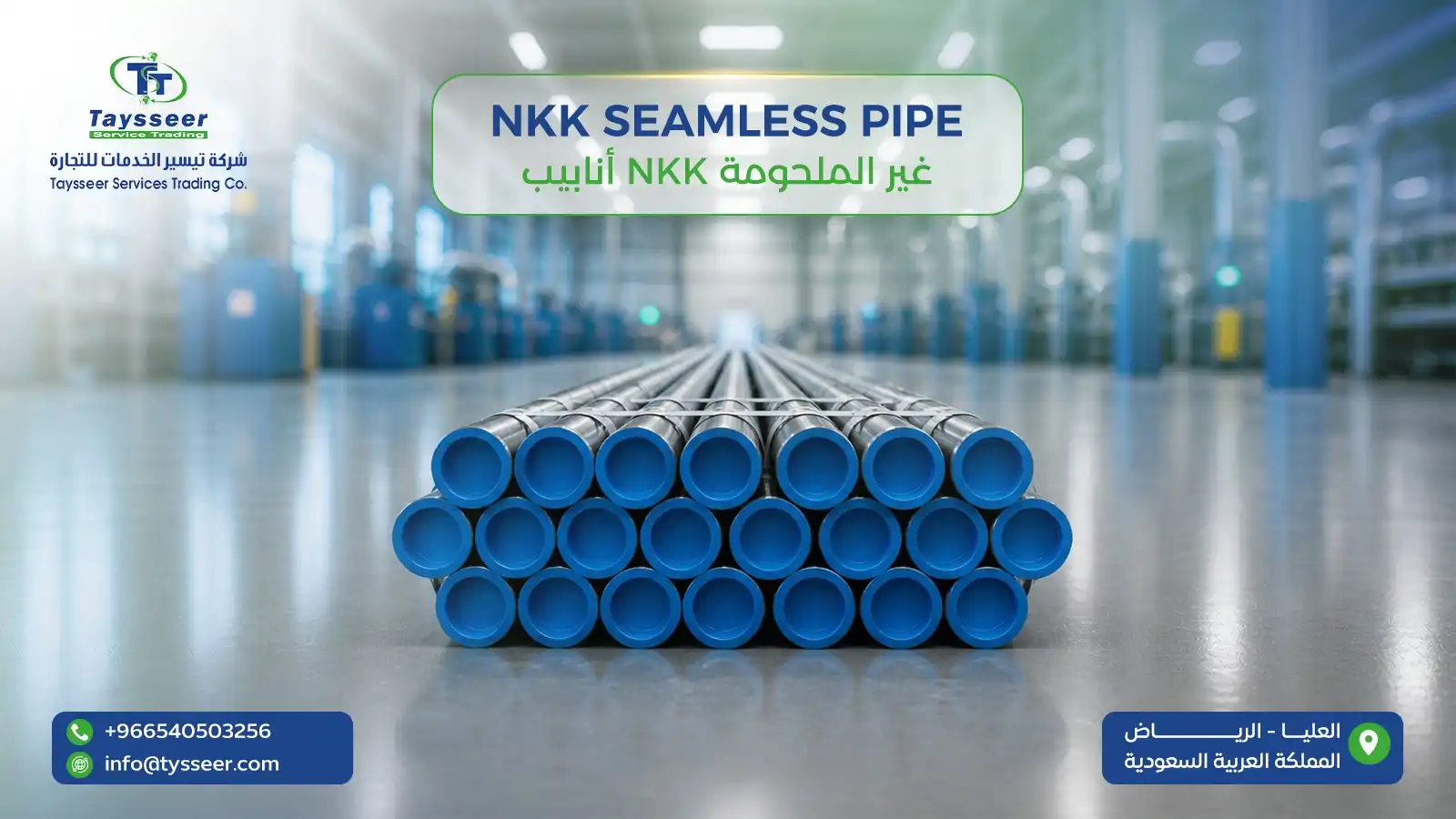
For seamless pipe procurement in Saudi Arabia, NKK (now part of JFE Steel, Japan) is one of the most consistently specified and accepted brands on government and ARAMCO projects. Understanding why NKK holds this position is useful for engineers preparing specifications and procurement teams sourcing materials.
NKK seamless pipe is produced to ASTM A106 Grade B and API 5L specifications. The product carries full mill test certificates, third-party inspection options, and a documented quality history that is recognized in Saudi Aramco’s approved vendor lists and government project submittals.
For procurement on Saudi projects where seamless pipe is specified, insisting on mill test certificates from the original mill of production – not just a distributor’s certificate – is standard practice on properly managed projects. NKK certificates are straightforward to verify. Generic seamless pipe sourced through trading companies with unclear mill origins creates documentation problems during inspection and handover.
The Cost and Availability Reality in Saudi Arabia
The price premium for seamless over ERW in the Saudi market typically runs:
| Size Range | Seamless Premium over ERW |
|---|---|
| DN15 to DN50 | 20-35% |
| DN50 to DN150 | 30-50% |
| DN150 to DN300 | 40-60% |
| Above DN300 | 50-80% |
These premiums are substantial on large projects. A government hospital or commercial tower project with tens of thousands of linear meters of piping faces a significant budget impact from the seamless/ERW specification decision.
Stock availability is the other practical factor. ERW pipe in standard building services sizes (DN25 to DN200) is consistently available from Saudi distributors in short lead times. Seamless pipe, particularly in larger diameters and heavier wall thicknesses, is import-dependent and can carry 6-12 week lead times for non-stock items. On fast-track Saudi government projects, this lead time difference is a program risk that must be factored into procurement planning.
How to Write the Specification Correctly
Vague pipe specifications – “carbon steel pipe to applicable standards” – create procurement disputes and compliance problems. The following guidance covers what a correct pipe specification includes.
For seamless pipe:
Carbon steel seamless pipe to ASTM A106 Grade B, Schedule 40 (or as required by pressure design), with full mill test certificates to EN 10204 Type 3.1. Pipe ends to be plain end (PE), beveled end (BE), or threaded as shown on drawings. All pipe to be clearly marked with mill identification, heat number, and specification designation. NKK, Sumitomo, or approved equal from an Aramco-recognized mill.
For ERW pipe (building services):
Carbon steel ERW pipe to ASTM A53 Grade B Type E, Schedule 40, with mill test certificates to EN 10204 Type 2.2 minimum. Pipe to be clean internally, free from scale and debris, with ends prepared as shown on drawings. Local or regional mill supply acceptable subject to submission of mill test certificates and project engineer approval.
For galvanized ERW pipe:
Carbon steel ERW pipe to ASTM A53 Grade B Type E, hot-dip galvanized to ASTM A123 after fabrication or to ASTM A53 as-produced galvanized. Zinc coating minimum 600 g/m² on internal and external surfaces.
Side-by-Side Specification Decision Summary
| Application | Recommended Pipe Type | Standard | Notes |
|---|---|---|---|
| HVAC chilled water (standard pressure) | ERW | ASTM A53 Gr. B | B31.9 scope – ERW fully compliant |
| HVAC chilled water (high-rise, >1.6 MPa) | Seamless | ASTM A106 Gr. B | Pressure design drives selection |
| Heating hot water (standard) | ERW | ASTM A53 Gr. B | B31.9 scope |
| Steam (low pressure, <1.03 MPa) | ERW acceptable | ASTM A53 Gr. B | Confirm B31.1 compliance |
| Steam (above 1.03 MPa) | Seamless | ASTM A106 Gr. B | B31.1 mandatory |
| Fire suppression (standard) | ERW | ASTM A53 Gr. B | NFPA 13 compliant |
| Fire suppression (Aramco) | Seamless | ASTM A106 Gr. B | SAES requirement |
| Domestic water (galvanized) | ERW galvanized | ASTM A53 Gr. B | Standard building services |
| Process piping (Aramco) | Seamless | ASTM A106 / API 5L | SAES-L-105 governs |
| Compressed air (standard) | ERW | ASTM A53 Gr. B | B31.9 scope |
| Sour service / wet H2S | Seamless | ASTM A106 + NACE MR0175 | Weld zone hardness critical |
| Cooling tower piping | ERW with corrosion allowance | ASTM A53 Gr. B | Monitor water chemistry |
Frequently Asked Questions
Q: An Aramco project specification says “seamless pipe” but the budget only allows for ERW. Can we substitute?
No, not without formal engineering approval from the Aramco project engineer and a formal deviation or concession request through the project management system. Aramco specifications are contractually binding on Aramco projects. Substituting ERW for specified seamless without approval is a non-conformance that will be identified during inspection and will require replacement at the contractor’s cost.
Q: Does NFPA 13 require seamless pipe for fire suppression systems in Saudi Arabia?
NFPA 13 permits both seamless and ERW pipe for standard sprinkler systems, subject to the material meeting the listed standards. Saudi Civil Defence applies NFPA 13 as its reference standard. ERW pipe to ASTM A53 Grade B is compliant for standard systems. Some project-specific specifications add requirements above the NFPA 13 minimum – always review the project specification, not just the base code.
Q: Mill test certificates are requested but the supplier only provides a distributor certificate. Is this acceptable?
On government and Aramco projects, no. EN 10204 Type 3.1 mill test certificate is issued by the mill of production and certifies the specific heat of steel used for the pipe in question. A distributor certificate is not equivalent. Insist on Type 3.1 certificates traceable to the originating mill. For standard building services projects, Type 2.2 (works certificate) is generally acceptable.
Q: Is there a meaningful quality difference between NKK seamless pipe and other Japanese or European mills?
Japanese mills – NKK/JFE, Sumitomo, Nippon Steel – and established European mills (Tenaris, Vallourec) all produce seamless pipe to consistent quality standards with reliable documentation. The practical advantage of NKK and Sumitomo on Saudi projects is pre-acceptance on Aramco approved vendor lists and familiarity among Saudi inspection authorities. Chinese-manufactured seamless pipe is available at lower cost but requires more careful documentation review and may not be accepted on Aramco or high-specification government projects without prior approval.
Q: What wall thickness schedule should be specified as a default for HVAC piping in Saudi Arabia?
Schedule 40 is the standard default for carbon steel HVAC piping in Saudi Arabia for diameters up to DN300. Above DN300, standard wall (STD) or specific pressure-design wall thickness is more appropriate. Schedule 80 is specified where additional corrosion allowance is needed for systems with poor water treatment control, or for threaded connections in sizes where Schedule 40 thread engagement is marginal.
Conclusion
The seamless versus ERW decision is a technical specification decision, not a procurement preference. The correct answer is determined by the applicable piping code, the service conditions, the project-specific standards (particularly for Aramco projects), and the pressure and temperature design parameters.
For the majority of Saudi building services and HVAC projects, ERW pipe to ASTM A53 Grade B is the correct and fully code-compliant specification within ASME B31.9 limits. Specifying seamless across an entire building services project because “seamless is better” over-spends the piping budget without improving safety or compliance.
For process piping, Aramco projects, high-pressure applications, sour service, and cyclic or fatigue-sensitive systems, seamless pipe is the correct specification and substituting ERW creates genuine compliance and safety risk.
The specification note on the drawing should state the product standard, grade, and schedule explicitly. “Carbon steel pipe” without a standard reference is not a specification – it is an invitation for the cheapest available product to be procured, documented with whatever certificate the supplier happens to have, and installed without the engineer ever knowing whether it met the design intent.
Tysseer Trading Services Company supplies NKK seamless pipe and ASTM A53 ERW pipe for HVAC, fire protection, and building services projects across Saudi Arabia, with mill test certificates available for all supplied materials and technical support for specification development and procurement.