If you have worked on commercial or government HVAC projects in Saudi Arabia, you have almost certainly used Foster 32-17 or seen it specified without fully understanding why it is on the spec sheet and what happens if you substitute something cheaper. This guide covers exactly that – what Foster 32-17 is, what it does, how to apply it correctly, and when it is the right product for your project.
What Is Foster 32-17?
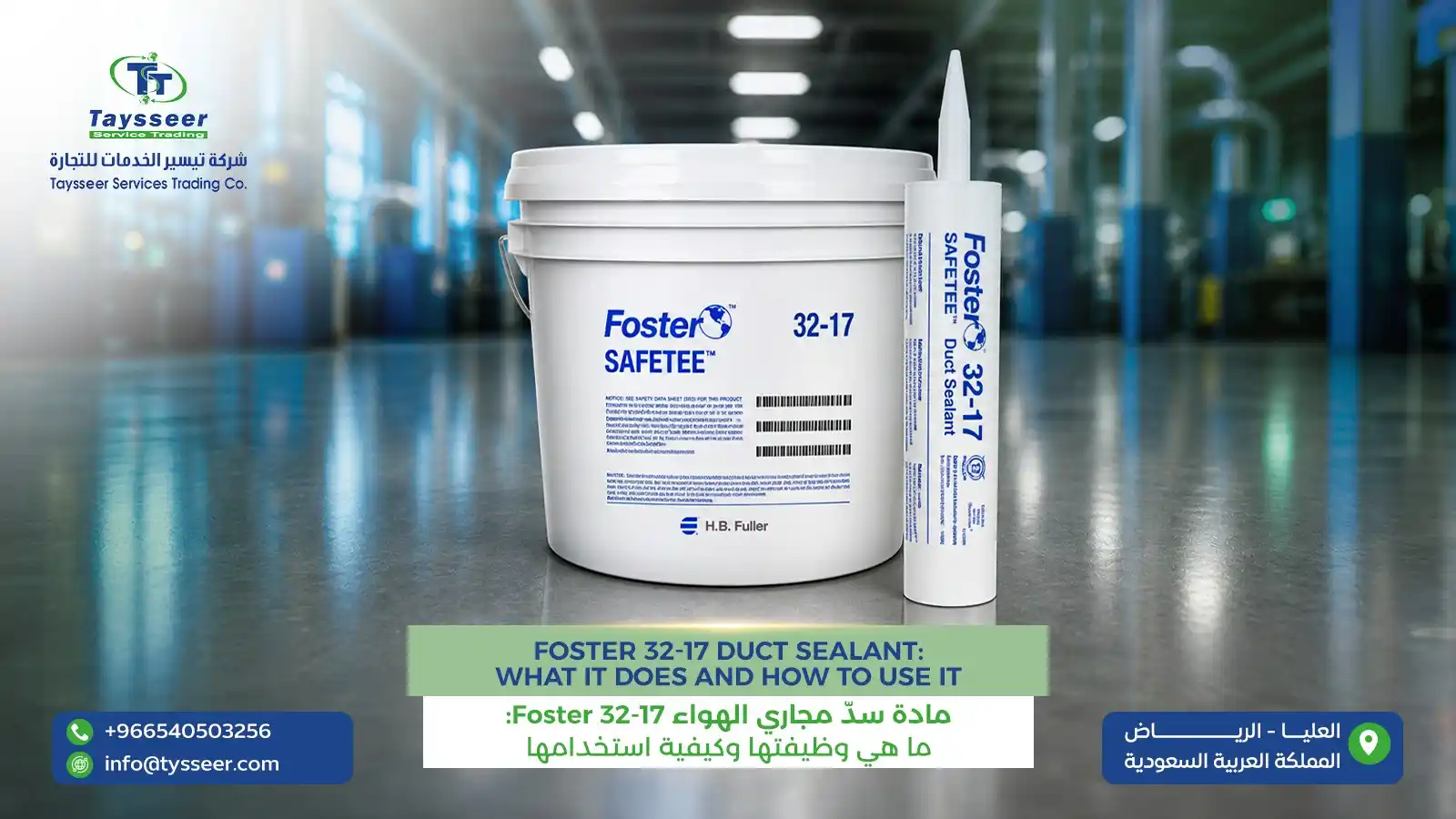
Foster 32-17 is a water-based, vapor-retarding duct sealant manufactured by H.B. Fuller (formerly Foster Products). It is formulated specifically for sealing joints, seams, and connections in HVAC ductwork insulation systems – particularly fiber glass and elastomeric rubber insulation on sheet metal ducts.
The product is not a general-purpose adhesive and it is not a mastic duct sealant in the sense that sheet metal contractors use internally for air leakage. It belongs to a specific category: insulation system sealants that seal the outer surface of insulation against air, moisture, and vapor infiltration while also providing a degree of physical protection to the insulation face.
Foster 32-17 is white when wet and dries to a flexible, paintable film. It is water-based, which means it is low-odor, non-flammable in its liquid state, and can be cleaned up with water before it cures.
What Problem Does It Solve?
To understand why Foster 32-17 is specified, you need to understand the failure mode it prevents.
When fiber glass duct liner or duct wrap insulation is installed on a duct system, the cut edges, butt joints, and overlap seams are vulnerable points. In a typical Saudi HVAC installation, chilled air runs through ducts at 12-16°C while the space above the ceiling or inside the plant room may reach 40-45°C during summer. This temperature differential drives moisture vapor toward the cold duct surface.
If the insulation seams are not properly sealed, vapor penetrates at the joints, condenses inside the insulation, saturates the fiber glass, and destroys its thermal performance. The insulation becomes a reservoir for moisture rather than a thermal barrier. Mold growth follows in the fiber matrix. The duct system begins to sweat externally, damaging ceilings and triggering complaints.
Foster 32-17 applied correctly at all joints and edges creates a continuous vapor barrier skin over the insulation system that closes these entry points. It also seals the cut edges of fiber glass insulation, which are otherwise exposed fibers that absorb moisture readily.
This is why it appears in project specifications alongside Kimmco duct liner or similar products – the two work as a system, not independently.
Key Specifications
| Property | Value |
|---|---|
| Type | Water-based acrylic sealant |
| Color (wet) | White |
| Color (dry) | White to off-white |
| Solids content | Approximately 64% by weight |
| Application temperature | 10°C to 52°C |
| Service temperature range | -29°C to +93°C |
| Vapor permeance (dry film) | ≤ 0.02 perms (ASTM E96) |
| Flame spread index | 5 (ASTM E84) |
| Smoke developed index | 5 (ASTM E84) |
| Drying time (touch dry) | 1-2 hours at 23°C |
| Full cure | 24-72 hours depending on conditions |
| Coverage rate (brush applied) | Approximately 2.4-3.7 m² per liter |
| VOC content | Low – compliant with most regional standards |
The vapor permeance figure is the critical number. At ≤ 0.02 perms dry, Foster 32-17 is classified as a Class I vapor retarder under ASHRAE standards – effectively a vapor barrier rather than just a retarder. This is what makes it suitable for chilled duct applications in Gulf humidity conditions.
The fire performance figures (flame spread 5, smoke developed 5) are among the lowest achievable for a coating product. This is why it is accepted on projects that require compliance with NFPA 90A and similar fire codes for duct system materials.
Where It Is Used on a Typical Project
Foster 32-17 has specific application points within an insulation system. It is not brushed over the entire duct surface like a paint.
Cut edges of fiber glass insulation: Every cut edge exposes the raw fiber glass mat to the environment. Brush a liberal coat of Foster 32-17 onto all cut edges immediately after cutting. This closes the fiber matrix and prevents moisture absorption at the most vulnerable point.
Butt joints and seams: Where two sections of insulation meet end-to-end, apply Foster 32-17 to both faces before pressing them together, then apply a reinforcing coat over the joint once assembled. On duct wrap, this applies at every circumferential butt joint and at the longitudinal overlap seam.
Staple lines: Where staples are used to secure duct liner or duct wrap, each staple penetrates the vapor barrier facing. Apply Foster 32-17 over the staple line to seal the puncture points.
Fitting and elbow edges: At duct fittings, the insulation is cut and pieced, creating multiple cut edges and joints in close proximity. These areas need careful attention – apply Foster 32-17 generously and use reinforcing fabric (open-weave glass cloth) embedded in the sealant on complex geometry.
System terminations: Where insulation ends at a damper, diffuser neck, or duct penetration, the termination edge must be sealed. A common failure point on Saudi projects is insulation that is installed correctly along the duct run but left unsealed at the termination points where it abuts hardware.
How to Apply Foster 32-17 Correctly
Surface Preparation
The substrate must be clean, dry, and free of dust, oil, and loose particles. On new duct liner or duct wrap installation this is straightforward. On repair or overcoat work, remove any loose or delaminated facing before applying.
Temperature matters. Do not apply below 10°C – the product will not cure properly. In Saudi summer conditions, surfaces in direct sun can exceed 60°C which accelerates skinning and reduces working time. On outdoor or semi-outdoor installations during summer, apply in the early morning and keep buckets in shade.
Application Method
Foster 32-17 can be applied by brush, roller, or spray. Brush application is standard for site work in Saudi Arabia.
Brush application: Use a stiff-bristle brush, 50-75mm wide for seams and edges. Apply in a single pass with moderate pressure to work the sealant into the fiber glass surface rather than just coating the top. On cut edges, a second coat after the first has tacked off (30-60 minutes) improves vapor barrier continuity.
Roller application: Use a short-nap roller (6mm) for covering larger flat areas. Not practical for edges and joints but useful if applying a flood coat over large areas of duct liner facing.
Spray application: Possible with airless spray equipment but rarely used on Saudi HVAC sites due to overspray risk in occupied or partially completed buildings. Requires thinning with up to 10% water and proper PPE for the applicator.
Fabric Reinforcement
On joints subject to movement or vibration – which on Saudi projects includes any duct section near AHU connections, flexible duct terminations, or rooftop installations subject to wind loading – embed open-weave glass fiber cloth in the wet sealant. Apply a base coat, press the fabric into the wet surface, smooth out wrinkles, and apply a second coat over the fabric while the first is still wet. This creates a reinforced joint that resists cracking under thermal cycling.
This is not optional on outdoor duct joints in Saudi conditions. Thermal expansion and contraction between day and night temperatures can be 30-40°C on rooftop installations, which creates significant movement at joints over time.
Dry Film Thickness
The vapor barrier performance specification is based on achieving adequate dry film thickness. A single brush coat of Foster 32-17 produces approximately 0.2-0.3mm dry film thickness. For full vapor barrier performance, two coats are recommended on all joints and cut edges, with the second coat applied after the first is touch dry.
Do not dilute the product beyond 10% water for spray applications – excessive dilution reduces solids content and dry film thickness, compromising vapor barrier performance.
Foster 32-17 vs. Similar Products
Foster produces several duct sealant and insulation coating products and they are sometimes confused on site and in specifications.
| Product | Type | Primary Use |
|---|---|---|
| Foster 32-17 | Vapor-retarding sealant | Sealing insulation joints and edges |
| Foster 30-36 | Adhesive/sealant | Bonding and sealing duct insulation |
| Foster 60-20 | Lagging adhesive | Bonding insulation to pipe and duct |
| Foster 95-44 | Mastic sealant | Heavy-duty coating on pipe insulation |
Foster 32-17 vs. Foster 30-36: The most common point of confusion. Foster 30-36 is primarily an adhesive for bonding insulation to the duct surface, with secondary sealing properties. Foster 32-17 is primarily a vapor-retarding sealant with secondary adhesive properties. On a correctly executed installation, both products appear – 30-36 for bonding, 32-17 for sealing joints and edges. Using 32-17 as an adhesive is not incorrect but is less efficient. Using 30-36 alone without 32-17 at joints leaves vapor barrier continuity incomplete.
Compliance and Specification Context
Foster 32-17 appears in Saudi project specifications in several ways:
Named directly: Some ARAMCO and government health facility specifications name Foster 32-17 by product number. In this case, substitution requires formal engineer approval and a comparable product data sheet demonstrating equivalent vapor permeance and fire performance.
Performance specified: Specifications written around NFPA 90A, ASHRAE 90.1, or SMACNA standards typically specify a vapor-retarding sealant with flame spread ≤ 25 and vapor permeance ≤ 0.02 perms. Foster 32-17 meets these requirements comfortably and is the benchmark product against which alternatives are measured.
As part of a system: Some specifications reference a complete insulation system from a single manufacturer. Where Kimmco or Afico products are specified alongside a Foster sealant, the intent is a tested system. Mixing brands within a specified system may require engineer approval.
For ARAMCO projects: Foster products carry a strong track record of acceptance on ARAMCO projects. Confirm current approved vendor status with your ARAMCO project engineer before submitting, as approval lists are periodically updated.
Storage and Handling
Foster 32-17 is water-based and has specific storage requirements that matter on Saudi sites:
Temperature: Store between 5°C and 32°C. Do not freeze – freezing permanently damages the emulsion and the product cannot be recovered by thawing. On Saudi sites, this means storage in an air-conditioned store or shaded, ventilated area. Containers left in direct sun in summer can exceed 60°C internally, which accelerates skinning and reduces shelf life.
Shelf life: 12 months from manufacture date in original sealed containers stored correctly. Check manufacture date on delivery – some products sitting in local distributor stock may be close to or past shelf life. Expired product may skin over prematurely on application and will not achieve specified vapor permeance.
Waste disposal: Water-based, low-VOC. Allow waste product to dry before disposal in accordance with local municipality requirements. Do not wash uncured product into drains in quantity.
Frequently Asked Questions
Q: Can Foster 32-17 be used on elastomeric rubber insulation like Armaflex?
Foster 32-17 is primarily formulated for fiber glass insulation systems. For elastomeric rubber insulation, the manufacturer recommends Foster 30-36 or a compatible contact adhesive for joint bonding. However, Foster 32-17 can be used as an overcoat sealant on elastomeric rubber joints where additional vapor barrier continuity is required. Confirm compatibility with the insulation manufacturer for the specific product combination.
Q: How much Foster 32-17 is needed per project?
Coverage varies by application method and substrate porosity. On fiber glass duct liner with brush application at two coats on joints and edges, a practical estimate is 0.5-0.8 liters per 10 linear meters of duct depending on duct size and number of joints. Order with a 15-20% buffer – running out of sealant mid-installation and leaving joints unsealed is a common cause of system failure.
Q: Is Foster 32-17 suitable for outdoor duct applications?
Yes, with qualifications. The product is weather-resistant when fully cured and is used on outdoor duct insulation systems. However, on exposed outdoor runs in Saudi Arabia, the cured film should be protected with aluminum jacketing. Prolonged UV exposure without jacketing will degrade the acrylic film over time. Foster 32-17 is the sealant layer within the system – it is not a substitute for mechanical protection from jacketing.
Q: Can Foster 32-17 be painted over?
Yes. The cured film accepts latex and acrylic paints without a primer coat. On installations where the duct insulation is left exposed and a finished appearance is required, painting over Foster 32-17 is straightforward. Allow full cure (24-72 hours) before painting.
Q: What is the difference between Foster 32-17 and a standard duct mastic?
Standard duct mastic (such as the type sheet metal contractors apply internally at duct joints for air leakage) is a thick, paste-like compound applied in a heavy layer to seal metal-to-metal or metal-to-flex connections. It is not a vapor-retarding coating and it has no place in an insulation sealing application. Foster 32-17 is a thin-film coating product designed to create a vapor barrier over insulation surfaces – a completely different function. The two products are not interchangeable.
Conclusion
Foster 32-17 earns its place on project specifications because it solves a specific problem – vapor infiltration at insulation joints – that generic sealants and adhesives do not address adequately in Gulf climate conditions. The product’s combination of very low vapor permeance and excellent fire performance makes it the benchmark specification for duct insulation sealing on Saudi HVAC projects.
Correct application makes the difference. The product only performs as specified when applied at adequate film thickness on properly prepared surfaces, with fabric reinforcement at joints subject to movement, and with second coats on all cut edges. Rushing the sealing stage of an insulation installation to save time is one of the most reliable ways to generate warranty callbacks six months into a building’s operation.
Tysseer Trading Services Company supplies Foster 32-17 and the complete range of Foster insulation sealants and adhesives for HVAC projects across Saudi Arabia, with technical guidance available for product selection and application specifications.