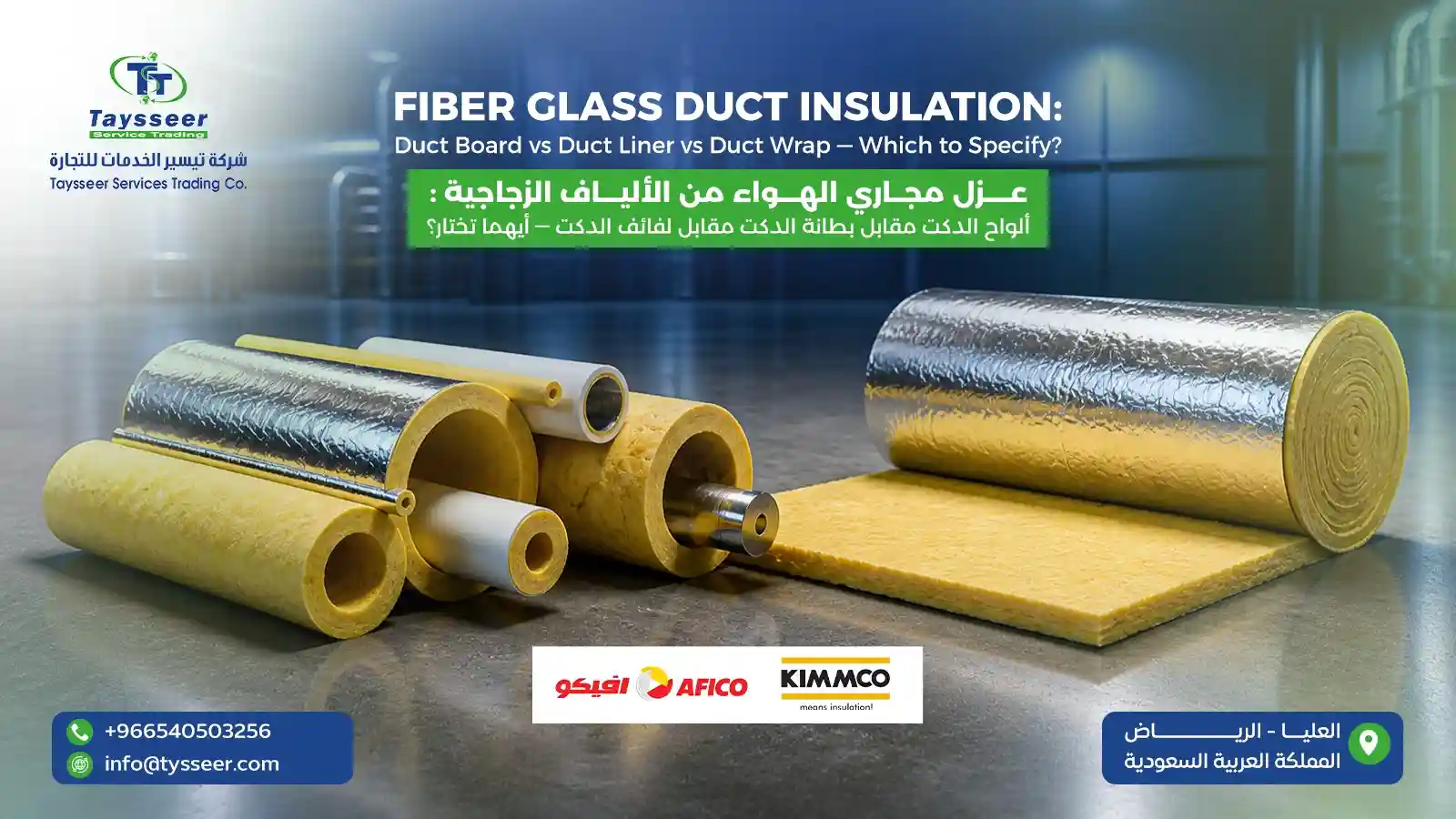
The three fiber glass duct insulation products – duct board, duct liner, and duct wrap – are often treated as interchangeable on project specifications, particularly in early design stages when the mechanical engineer writes a generic “fiber glass duct insulation” note on the drawing. They are not interchangeable. Each product has a distinct structural role, thermal performance profile, acoustic behavior, and installation logic. Specifying the wrong one creates problems that show up during commissioning or, worse, after handover.
This guide is written for mechanical engineers and design consultants working on Saudi HVAC projects. It covers what each product actually is, where each belongs in a duct system, how they compare on the specifications that matter, and what the Saudi market context means for your selection.
The Core Distinction Before Anything Else
The most important thing to understand before comparing specifications is that these three products serve different structural functions:
Duct board replaces sheet metal. The duct board itself is the duct – you fabricate air distribution ducts directly from the board. There is no sheet metal substrate underneath.
Duct liner lines the inside of a sheet metal duct. The sheet metal duct is fabricated first, then the liner is applied to the interior surface. The sheet metal carries the structural load.
Duct wrap wraps the outside of a sheet metal duct. Again, the sheet metal duct exists first. The wrap is applied to the exterior surface after installation.
This distinction determines everything else. The three products are not competing options for the same application – they are different system components that happen to be made from the same base material.
Duct Board
What It Is
Duct board is a rigid or semi-rigid fiber glass panel, typically 25mm or 50mm thick, faced on one side with a factory-applied aluminum foil scrim kraft (FSK) facing that serves as the air barrier and vapor retarder. The interior surface – the air side – has a resin-coated mat facing to resist erosion from airflow and to prevent fiber release into the air stream.
Ducts are fabricated on site by scoring and snapping the board to create the four sides of a rectangular duct section, which are then joined with staples and sealed with FSK tape and Foster 32-17 sealant at all joints.
Where It Belongs
Duct board is the correct choice for low-pressure supply air distribution systems in the following locations:
- Ceiling void distribution networks in commercial buildings, hotels, and hospitals.
- Branch duct runs from sheet metal main ducts to diffusers.
- Short duct runs in residential-scale systems.
- Any location where weight reduction matters – duct board systems are significantly lighter than equivalent sheet metal plus external insulation.
Duct board is not appropriate for:
- High-velocity or high-pressure systems (above Class 1 / 500 Pa static pressure).
- Return air plenums where negative pressure causes inward deflection.
- Outdoor installations without additional weather protection.
- Ducts subject to mechanical damage or heavy maintenance access requirements.
- Kitchen exhaust, fume hood exhaust, or any application involving elevated temperatures or grease-laden air.
Key Specifications
| Property | Typical Value |
|---|---|
| Density | 32 – 48 kg/m³ |
| Thickness (standard) | 25 mm or 50 mm |
| Thermal conductivity (λ) | 0.033 – 0.036 W/(m·K) at 24°C mean temp |
| R-value (25mm) | R-1.8 (m²·K/W) approximately |
| R-value (50mm) | R-3.5 (m²·K/W) approximately |
| Facing | FSK (foil scrim kraft) exterior, resin mat interior |
| Maximum air velocity (interior face) | 10 m/s (2000 fpm) |
| Maximum operating pressure | 500 Pa (Class 1) |
| NRC (noise reduction coefficient) | 0.65 – 0.75 |
| Maximum service temperature | 121°C |
| Flame spread index | ≤ 25 (ASTM E84) |
| Smoke developed index | ≤ 50 (ASTM E84) |
Acoustic Performance
Duct board provides meaningful acoustic attenuation that sheet metal ducts with external insulation do not. The fiber glass interior face absorbs sound energy traveling through the duct, which reduces breakout noise into occupied spaces and cross-talk between rooms served by the same duct system.
For engineers designing open-plan offices, hotel guest rooms, hospital wards, and any space with stringent noise criteria in Saudi Arabia, this is a specification argument in favor of duct board that is often overlooked when the default is sheet metal plus duct wrap.
Saudi Market Context
Kimmco and Afico both produce duct board for the Saudi market. Kimmco’s DuctBoard product and Afico’s equivalent are the most commonly available. Thickness availability is generally good for 25mm; 50mm can require longer lead times and should be confirmed with the supplier before specifying on a project with a tight program.
Duct Liner
What It Is
Duct liner is a flexible fiber glass blanket or semi-rigid board product applied to the interior surface of a sheet metal duct after fabrication. The air-side face has a resin-reinforced coating – sometimes called a black mat or coated mat facing – that resists erosion from airflow and prevents loose fibers from entering the air stream. The sheet metal side is typically unfaced or has a light kraft backing.
Liner is available in thicknesses of 25mm and 50mm. It is cut to size and adhered to the sheet metal interior using a compatible contact adhesive (Foster 30-36 or equivalent) and mechanically secured with weld pins or impale clips at regular spacing.
Where It Belongs
Duct liner is the correct choice when:
- Acoustic attenuation is a primary design requirement and sheet metal duct construction is already specified.
- The system is higher pressure than duct board can accommodate.
- External space constraints make external insulation impractical – in tight ceiling voids, applying wrap to the outside of a duct may be impossible after installation.
- Condensation control on the duct exterior is not a concern (because the insulation is inside, the sheet metal exterior remains at near-room temperature rather than near supply air temperature).
Duct liner is not appropriate for:
- Return air ducts handling air from kitchens, bathrooms, or any space with high humidity or contamination – fiber glass liner in these locations accumulates moisture and debris.
- High-humidity applications where the air stream itself carries significant moisture load.
- Any system where hygiene standards require a smooth, cleanable interior surface (operating theatres, clean rooms, food production).
- Very high velocity systems where face erosion is a risk even with coated facing.
Key Specifications
| Property | Typical Value |
|---|---|
| Density | 24 – 32 kg/m³ |
| Thickness (standard) | 25 mm or 50 mm |
| Thermal conductivity (λ) | 0.034 – 0.038 W/(m·K) at 24°C mean temp |
| Air-side facing | Resin-coated black mat |
| Maximum air velocity | 6 m/s (1200 fpm) standard mat facing |
| Maximum operating pressure | 750 Pa (with correct adhesive and pin spacing) |
| NRC | 0.70 – 0.85 (higher than duct board due to exposed fiber face) |
| Flame spread index | ≤ 25 (ASTM E84) |
| Smoke developed index | ≤ 50 (ASTM E84) |
The Velocity Limitation
The maximum air velocity figure for duct liner deserves attention. At 6 m/s, fiber erosion from the coated mat surface begins to occur. On main supply ducts near AHU discharge where velocity can reach 8-10 m/s, standard duct liner facing is not adequate. Either specify a higher-density liner product with a reinforced facing rated for higher velocity, or use a different insulation approach on high-velocity sections.
This is one of the most common specification errors on Saudi projects – duct liner specified uniformly across a system without checking whether velocity limits are exceeded on main duct sections near the AHU.
Saudi Market Context
Duct liner is less consistently stocked by Saudi distributors than duct wrap. The black mat facing product in 25mm thickness is generally available; 50mm and higher-density grades may require import lead times. Confirm availability before finalizing specifications on projects where duct liner is the primary system.
Duct Wrap
What It Is
Duct wrap – sometimes called blanket insulation or duct blanket – is a flexible fiber glass blanket applied to the exterior surface of a sheet metal duct after the duct is installed in position. It is unfaced on the duct side and faced on the exterior with FSK facing (foil scrim kraft) that serves as the vapor retarder and provides mechanical protection.
Wrap is typically supplied in rolls and is applied by wrapping it around the duct circumference with a minimum 50mm overlap on the longitudinal seam, secured with outward-clinching staples and sealed at all joints and edges with FSK tape and Foster 32-17 sealant.
Where It Belongs
Duct wrap is the correct choice for:
- External insulation on sheet metal ducts running through unconditioned spaces – ceiling voids, plant rooms, roof level.
- Retrofit insulation on existing duct systems where the duct is already in place.
- Chilled water air handling unit casings and fan coil unit connections where external insulation is required.
- Any application where the duct geometry is complex and rigid board products cannot be formed to fit.
Duct wrap is not appropriate for:
- Applications requiring acoustic attenuation from the interior – wrap on the outside provides minimal sound absorption into the air stream.
- High-humidity outdoor locations without additional jacketing – the FSK facing provides limited weather protection and must be covered with aluminum jacketing on outdoor installations.
- Locations where the wrap will be subject to mechanical damage or foot traffic proximity.
Key Specifications
| Property | Typical Value |
|---|---|
| Density | 10 – 16 kg/m³ |
| Thickness (standard) | 25 mm, 50 mm, 75 mm |
| Thermal conductivity (λ) | 0.036 – 0.040 W/(m·K) at 24°C mean temp |
| Facing | FSK (foil scrim kraft) |
| Flexibility | Full flexibility – wraps around any geometry |
| Maximum service temperature | 121°C |
| Flame spread index | ≤ 25 (ASTM E84) |
| Smoke developed index | ≤ 50 (ASTM E84) |
Note that duct wrap has a lower density than duct liner and duct board. This is by design – it does not need structural rigidity, and lower density means better flexibility for wrapping around complex duct geometry. However, lower density also means lower thermal resistance per unit thickness, which is why duct wrap is often specified at 50mm or 75mm thickness where duct board at 25mm provides comparable thermal performance.
Thickness Selection for Saudi Conditions
The same logic that applies to rubber pipe insulation applies here – European thickness tables underestimate the requirement for Saudi conditions.
For chilled supply air ducts running through unconditioned ceiling voids at typical Saudi summer conditions:
| Duct Location | Recommended Wrap Thickness |
|---|---|
| Conditioned ceiling void (24-26°C) | 25 mm |
| Unconditioned ceiling void (35-42°C summer) | 50 mm |
| Outdoor rooftop duct runs | 75 mm + aluminum jacketing |
| Plant room (unconditioned, 38-45°C) | 50 mm minimum |
Saudi Market Context
Duct wrap is the most consistently available of the three products in the Saudi market. Kimmco, Afico, and regional equivalents all stock 25mm and 50mm FSK-faced wrap in standard roll widths. For 75mm, confirm stock or lead time with the supplier. This availability factor makes duct wrap the default choice on many Saudi projects where lead time certainty matters.
Side-by-Side Comparison
| Specification | Duct Board | Duct Liner | Duct Wrap |
|---|---|---|---|
| System position | Replaces sheet metal | Interior of sheet metal | Exterior of sheet metal |
| Sheet metal required | No | Yes | Yes |
| Density | 32-48 kg/m³ | 24-32 kg/m³ | 10-16 kg/m³ |
| Standard thickness | 25, 50 mm | 25, 50 mm | 25, 50, 75 mm |
| Thermal conductivity | 0.033-0.036 W/(m·K) | 0.034-0.038 W/(m·K) | 0.036-0.040 W/(m·K) |
| Max air velocity | 10 m/s | 6 m/s | N/A (external) |
| Max pressure class | Class 1 (500 Pa) | Class 2 (750 Pa) | N/A (external) |
| Acoustic attenuation | Good | Best | Minimal |
| Outdoor suitability | No (unprotected) | No | Yes (with jacketing) |
| Fabrication | On site from board | Adhered to sheet metal | Wrapped post-install |
| KSA market availability | Good (25mm) | Moderate | Good |
| Relative installed cost | Lowest (no sheet metal) | Highest (sheet metal + liner) | Medium |
How to Choose: A Decision Framework for Engineers
The right product is determined by answering four questions in sequence.
1. Is this a new-build low-pressure distribution duct in a conditioned or semi-conditioned space?
If yes, duct board is the most cost-efficient solution. No sheet metal fabrication cost, good thermal performance, adequate acoustic attenuation, and lighter weight. This is the correct default for branch distribution ductwork in most Saudi commercial and government building types.
2. Is acoustic performance a primary requirement?
If yes and the system pressure is above duct board limits, or sheet metal is already specified for structural reasons, then duct liner is the correct choice. Hotel rooms, hospital wards, private offices, and boardrooms in Saudi Arabia regularly have acoustic requirements that make duct liner the specification of choice on sheet metal main duct systems.
3. Is the duct already fabricated and installed, or is this a main duct in an unconditioned space?
If yes to either, duct wrap is the correct product. It installs around any existing geometry, it is the practical solution for main sheet metal ducts running through plant rooms and ceiling voids, and it is the only appropriate choice for outdoor or semi-outdoor duct runs (with aluminum jacketing over the top).
4. Is the location subject to contamination, high humidity, or hygiene requirements?
If yes, eliminate duct liner from consideration. Consider duct board for low-pressure systems or sheet metal with external duct wrap for higher-pressure systems in these locations.
Specification Language Guidance
Generic specification notes cause procurement and installation problems. Below are concise specification notes for each product type that communicate the actual requirement clearly.
For duct board:
Fiber glass duct board to ASTM C1071 or equivalent, minimum density 32 kg/m³, 25mm thickness unless noted otherwise on drawings. FSK facing on exterior face, resin-coated erosion-resistant mat on air side. Maximum air velocity 10 m/s. All joints sealed with FSK tape and vapor-retarding sealant (Foster 32-17 or approved equal). Fabricated and installed to SMACNA Fibrous Glass Duct Construction Standards, latest edition.
For duct liner:
Fiber glass duct liner to ASTM C1071 or equivalent, minimum density 24 kg/m³, thickness as shown on drawings. Resin-coated black mat facing on air side rated for minimum 6 m/s air velocity. Adhered with contact adhesive (Foster 30-36 or approved equal) at minimum 90% coverage and mechanically fastened with impale clips at maximum 400mm spacing. All edges sealed with vapor-retarding sealant (Foster 32-17 or approved equal).
For duct wrap:
Fiber glass duct blanket to ASTM C1290 or equivalent, minimum density 10 kg/m³, thickness as scheduled. FSK facing on exterior. Applied with minimum 50mm overlap at longitudinal seams, outward-clinching staples at 150mm spacing, all joints and edges sealed with FSK tape and vapor-retarding sealant (Foster 32-17 or approved equal). Outdoor installations to receive aluminum jacketing (3003-H14, minimum 0.5mm) over insulation system.
Frequently Asked Questions
Q: Can duct board and duct wrap be used together on the same duct system?
Yes, and this is common practice on Saudi projects. Duct board is used for branch distribution runs where it replaces sheet metal, while duct wrap is applied to the sheet metal main duct sections serving those branches. The two products meet at the connection between the sheet metal main duct and the duct board branch, which requires careful sealing with FSK tape and Foster 32-17 to maintain vapor barrier continuity across the transition.
Q: Why does the specification sometimes call for both duct liner and duct wrap on the same duct?
This occurs on ducts where acoustic attenuation requires interior liner and thermal insulation in an unconditioned space requires exterior wrap. It is not a common requirement but appears on high-specification projects such as recording studios, broadcast facilities, and premium hotel rooms in Saudi Arabia. The combined system adds cost and complexity but delivers both acoustic and thermal performance that neither product achieves alone.
Q: Is duct board compliant with Saudi building codes for return air ducts?
SASO 2662 and referenced standards do not prohibit duct board for return air applications, but the design conditions must be checked carefully. Return air at typical Saudi building conditions carries higher humidity than supply air. The FSK facing on duct board is a Class I vapor retarder, but if the return air contains elevated moisture – as in duct systems that incorporate toilet exhaust or kitchen areas – the interior resin mat facing is not designed for sustained moisture exposure. For clean return air applications in dry Saudi interior locations, duct board is acceptable. For mixed-use or high-humidity return applications, sheet metal with external duct wrap is the safer specification.
Q: Kimmco vs Afico – is there a meaningful difference for duct insulation products?
Both manufacturers produce fiber glass duct insulation products that meet the relevant ASTM and SASO standards. Thermal performance between comparable grades is within measurement tolerance. The practical differences for Saudi engineers are availability – Kimmco has broader distribution in the Riyadh market while Afico has stronger presence in some other regions – and documentation support for project submittals, which both provide adequately. Specifying “Kimmco, Afico, or approved equal” covers both and gives the contractor procurement flexibility without opening the specification to unqualified substitutes.
Q: What is the correct product for insulating a pre-insulated duct system?
Pre-insulated duct panels – phenolic foam or polyurethane core panels with aluminum faces – are a separate product category from fiber glass duct board and are not covered in this guide. If a project specification calls for pre-insulated ductwork, this refers to a factory-fabricated panel system, not site-applied fiber glass insulation.
Conclusion
Duct board, duct liner, and duct wrap are complementary products within a complete duct insulation system, not competing alternatives for the same application. The specification decision follows from the structural role of the duct, the system pressure class, the acoustic requirements of the served spaces, and the environmental conditions at the installation location.
For Saudi HVAC projects, the default combination for most commercial buildings is duct board on low-pressure branch distribution runs, sheet metal with duct wrap on main duct runs through unconditioned spaces, and duct liner on main ducts in acoustically sensitive zones. Outdoor duct runs in any configuration require aluminum jacketing over the insulation system as a non-negotiable requirement in Gulf conditions.
Getting the product selection right at the specification stage costs nothing. Getting it wrong costs re-work, warranty callbacks, and in some cases, full system replacement.
Tysseer Trading Services Company supplies Kimmco, Afico, and other approved fiber glass duct insulation products across all three categories for HVAC projects in Saudi Arabia, with technical support available for specification development and project submittals.