A contractor in Jeddah specified aluminum foil tape for a commercial cooling project. The building sat in direct sun, and by year two, the tape had peeled away from the insulation. Cold air leaked, efficiency dropped, and the cooling load increased by 35 percent. The customer demanded fixes under warranty. The contractor spent SAR 80,000 replacing failed tape and insulation.
Six months later, the same contractor used FSK tape on a similar project. The tape held through three summers, zero peeling, zero warranty claims.
The difference? Understanding when each tape works and when it fails.
Aluminum foil tape and FSK tape both seal HVAC insulation, but they’re designed for different conditions. Choosing the wrong one costs money in failed projects, warranty claims, and emergency callbacks. Choosing the right one means better performance and fewer headaches.
If you’re specifying tape for HVAC duct insulation, pipe wrapping, or equipment covers, you need to know the difference.
Key Takeaways: Choosing Between Aluminum Foil and FSK Tape
Aluminum foil tape is better for:
- Interior, temperature-controlled ductwork
- Low-humidity environments
- Budget-constrained residential projects
- Secondary sealing applications
- Ductwork with zero outdoor exposure
FSK tape is better for:
- Outdoor or rooftop ductwork
- Coastal and humid climates
- High-temperature applications
- Government and critical facilities
- Projects with performance guarantees
- Any ductwork you won’t easily access for maintenance
Cost reality: FSK tape costs 30-40 percent more initially, but delivers 2-3 times longer service life. Over a 5-year period, FSK is cheaper.
Installation is critical: Proper surface prep, adequate overlap, firm pressure, and adequate curing time matter more than tape brand or type.
Environmental factors matter most: If the ductwork is exposed to sun, humidity, salt air, or temperature cycling, FSK tape is the only correct choice. Aluminum tape will fail, and you’ll pay twice.
The Jeddah contractor’s lesson is clear: Choosing aluminum tape for an exposed rooftop application cost him SAR 80,000 in warranty work. FSK tape would have cost an extra SAR 120-150 in material. That’s an investment with an 666:1 return in failure avoidance.
Quick Reference: Aluminum Foil vs FSK Tape Comparison Table
| Feature | Aluminum Foil Tape | FSK Tape |
|---|---|---|
| Material | Pure aluminum + acrylic adhesive | Fiberglass scrim + kraft paper + rubber adhesive |
| Thickness | 0.05-0.1mm | 0.3-0.5mm |
| Temperature rating | 80-120°C (adhesive fails at 60-70°C) | 70-100°C (stable to 70°C) |
| Humidity resistance | Moderate | Excellent |
| UV resistance | Poor | Good |
| Lifespan (indoor) | 7-10 years | 10-15 years |
| Lifespan (outdoor/humid) | 2-3 years | 5-7 years |
| Initial cost per meter | SAR 5-8 | SAR 7-13 |
| Ease of installation | Easy | Moderate |
| Adhesive strength | Moderate (builds over 24-48h) | Strong (immediate) |
| Vapor barrier | Aluminum foil | Kraft paper + scrim |
| Recommended use | Interior, mild conditions | Exterior, demanding conditions |
| Compliance | ASTM D1000 (if certified) | ASTM D1000 (if certified) |
For sourcing aluminum foil tape, FSK tape, and other HVAC insulation materials that meet Saudi building standards, Tysseer Trading supplies Aspen foil tape, Shurtape FSK products, and all supporting documentation. Contact us for technical specifications, bulk pricing, and same-day delivery in Riyadh.
What Is Aluminum Foil Tape?
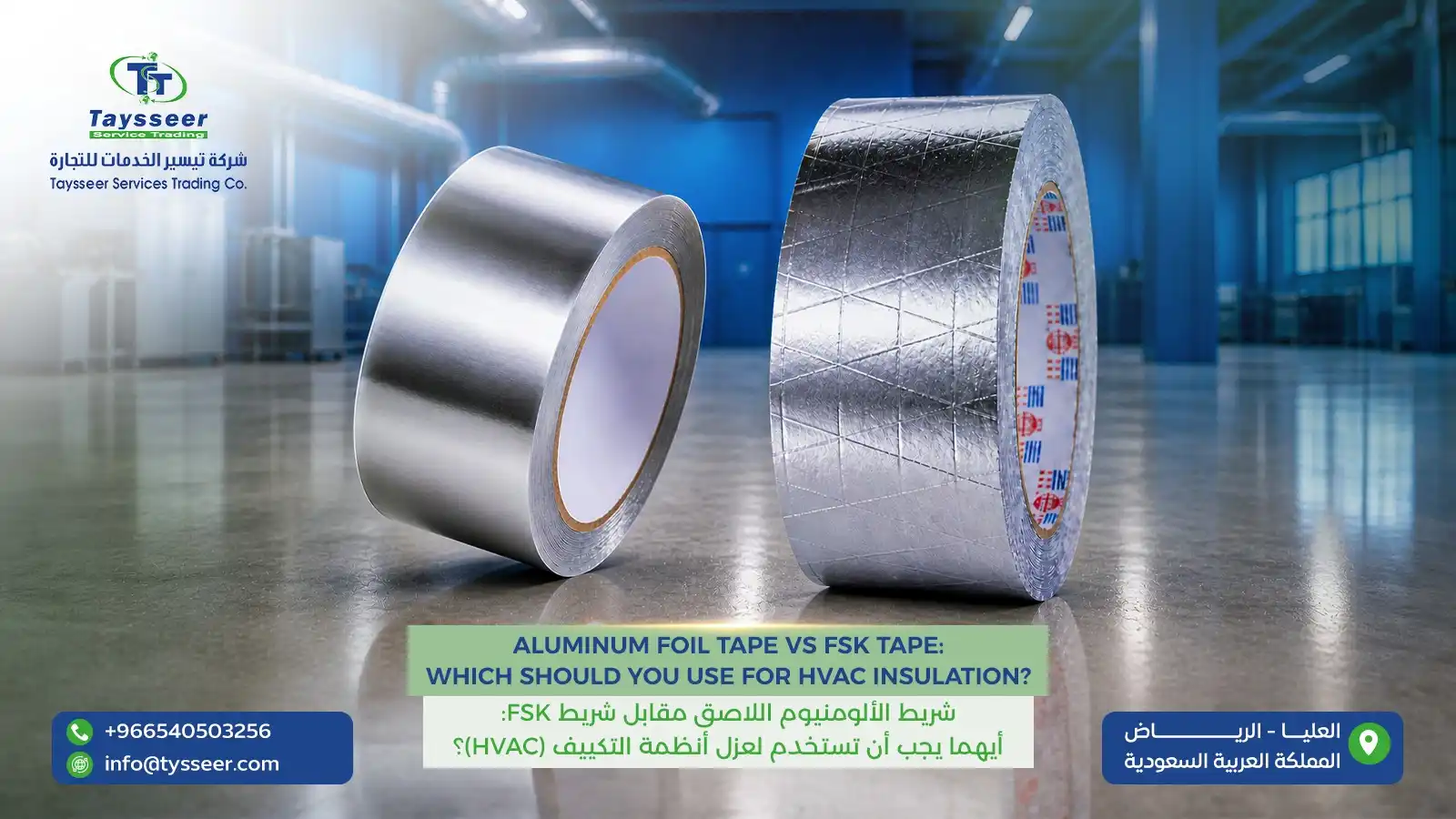
Aluminum foil tape is a thin layer of pure or semi-pure aluminum bonded to a pressure-sensitive adhesive (usually acrylic-based). It’s installed directly over fiberglass or foam insulation to seal joints and seams.
Basic construction:
- Backing: Aluminum foil, typically 0.05mm to 0.1mm thick
- Adhesive: Acrylic or rubber-based, pressure-sensitive
- Release liner: Paper or plastic backing that’s removed before installation
The tape is silver-colored, lightweight, and flexible. It conforms easily to curved surfaces and duct geometry.
How it works:
When applied to insulation, the pressure-sensitive adhesive bonds to the surface. The aluminum foil reflects radiant heat and provides a vapor barrier. The adhesive creates an air-tight seal at joints and seams, preventing air leakage and moisture penetration.
What Is FSK Tape?
FSK stands for Fiberglass-Scrim-Kraft. The tape has three layers:
- Fiberglass scrim (reinforcing mesh)
- Kraft paper facing (top layer)
- Pressure-sensitive adhesive
Unlike aluminum foil tape, FSK tape looks like brown kraft paper with a fiberglass mesh embedded in it. It’s thicker and more rigid than aluminum foil tape.
How it works:
FSK tape is designed to attach directly to fiberglass insulation boards. The scrim provides mechanical strength, and the kraft paper facing provides a vapor barrier. The adhesive bonds the tape to the insulation and creates a seal at joints.
The key difference: FSK tape becomes part of the insulation system, not just a surface seal.
Key Differences Between Aluminum Foil Tape and FSK Tape
Understanding these differences helps you choose the right tape for your application.
1. Material and Construction
Aluminum foil tape:
- Pure or semi-pure aluminum backing
- Thin (0.05-0.1mm aluminum layer)
- Lightweight
- More flexible and bendable
FSK tape:
- Three-layer construction (fiberglass, kraft, adhesive)
- Thicker overall (approximately 0.3-0.5mm)
- Reinforced with fiberglass scrim
- More rigid and tear-resistant
2. Adhesive Type and Bond Strength
Aluminum foil tape:
- Usually acrylic or synthetic rubber-based adhesive
- Pressure-sensitive (tackiness from application pressure alone)
- Bonds to most surfaces, including plastics and metals
- Lower initial tack, builds strength over days
FSK tape:
- Usually natural rubber or synthetic adhesive
- Higher initial tack and aggressive bonding
- Designed specifically for fiberglass insulation
- Bonds immediately upon application
For humid environments (which Saudi Arabia has in coastal areas), FSK tape’s stronger initial adhesion performs better. Aluminum tape can take days to reach full bond strength, during which humidity or temperature changes can weaken the adhesive.
3. Temperature Performance
Aluminum foil tape:
- Typically rated to 80°C (some premium grades to 120°C)
- Adhesive begins to soften above 70°C
- In high-heat applications, edges curl and adhesive fails
FSK tape:
- Typically rated to 70°C (some varieties to 100°C)
- More stable over a wider temperature range
- Less likely to peel at edges in fluctuating temperatures
This might seem counterintuitive—aluminum tape appears to have a higher temperature rating. But in real-world applications, aluminum tape’s adhesive weakens in sustained heat, causing peeling. FSK tape’s thicker construction and stronger adhesive hold up better in variable temperatures.
4. Moisture and Humidity Resistance
Aluminum foil tape:
- Thin aluminum provides basic vapor barrier
- If adhesive fails, moisture penetrates quickly
- In coastal or humid climates (like Jeddah and Dammam), adhesive failure leads to moisture intrusion
- Susceptible to corrosion if water seeps beneath the tape
FSK tape:
- Kraft paper facing provides robust vapor barrier
- Fiberglass scrim blocks water ingress even if adhesive fails in spots
- More resistant to coastal humidity
- Less prone to corrosion because the fiberglass and kraft protect the insulation
For projects in Saudi coastal cities where humidity and salt air accelerate adhesive failure, FSK tape’s redundancy (scrim plus kraft) provides better protection.
5. Durability and Longevity
Aluminum foil tape:
- Adhesive fails in 2-5 years in harsh climates (high heat, UV, humidity)
- Edges curl and peel first
- Once peeling starts, it accelerates
- Aluminum foil can corrode if moisture penetrates
FSK tape:
- Adhesive holds 5-10 years in typical climates
- In coastal climates, 3-7 years (still longer than aluminum tape)
- Fiberglass scrim provides mechanical integrity even if adhesive loses tackiness
- Kraft paper protects insulation from environmental stress
The Jeddah example above demonstrates this. Aluminum tape failed by year two. FSK tape held through three summers. That’s a typical pattern in hot, humid climates.
6. Cost Difference
Aluminum foil tape:
- SAR 25-40 per 50-meter roll
- Cheaper initial material cost
- Often requires replacement due to early failure
FSK tape:
- SAR 35-65 per 50-meter roll
- Higher initial cost
- Longer service life means fewer replacements
On a commercial project with 500 meters of ductwork needing tape sealing, aluminum foil tape costs roughly SAR 250-400. FSK tape costs SAR 350-650. The material difference is SAR 100-250. But if aluminum tape fails and requires replacement in two years, the replacement cost plus labor easily exceeds SAR 2,000. FSK tape’s longer life makes it cheaper over the project’s lifetime.
7. Installation and Handling
Aluminum foil tape:
- Easy to tear by hand
- Conforms quickly to curved surfaces
- Pressure-sensitive (sticks immediately but weakly)
- Can be repositioned if applied incorrectly
- Thin and lightweight—easy to handle
FSK tape:
- Requires utility knife to cut (thicker material)
- Takes more pressure to conform to curves
- Aggressive adhesion—difficult to reposition once applied
- Heavier and less flexible
- More aggressive application can stretch and tear
For installers unfamiliar with tape application, aluminum foil tape is more forgiving. For experienced crews, FSK tape’s performance advantages outweigh the handling difficulty.
When to Use Aluminum Foil Tape
Aluminum foil tape is the right choice in specific applications:
Indoor, Temperature-Controlled Environments
Aluminum foil tape performs well in HVAC systems where temperatures are stable and controlled. Examples:
- Interior ductwork in air-conditioned office buildings
- Supply ducts in data centers (temperatures 20-25°C year-round)
- Return air plenums in climate-controlled warehouses
- Equipment covers in indoor mechanical rooms
In these applications, temperature doesn’t exceed 60°C, humidity is controlled, and UV exposure is zero. Aluminum tape easily lasts 7-10 years.
Low-Humidity Climates
Regions with dry climates (interior Saudi Arabia, for example) where relative humidity stays below 40 percent see much longer aluminum tape lifespan. The adhesive doesn’t weaken from moisture exposure.
Budget-Constrained Residential Projects
For residential HVAC systems with short payback periods, aluminum foil tape is acceptable. Homeowners rarely experience performance issues within the first 5 years, and the lower material cost appeals to price-sensitive markets.
Secondary Sealing Applications
Aluminum foil tape works well for secondary sealing—sealing smaller gaps, joints in insulation, or temporary fixes. It’s not the primary weather barrier; it’s supplementary.
Ductwork Not Exposed to Elements
Supply ducts entirely within walls or dropped ceilings, with no outdoor exposure, are ideal for aluminum foil tape. No UV, no temperature cycling, no moisture stress.
When to Use FSK Tape
FSK tape is the better choice in demanding applications:
Outdoor or Exposed Ductwork
Any ductwork on roofs, exterior walls, or exposed to sunlight should use FSK tape. UV exposure and temperature cycling (50°C during the day, 25°C at night in Saudi summer) cause aluminum tape to degrade faster.
For rooftop HVAC units in Riyadh, where summer temperatures hit 50°C and roofs can reach 70°C, FSK tape’s stability is essential. Aluminum tape will peel within 2-3 years.
High-Temperature Applications
Equipment covers, hot water pipes, or ducts carrying hot air (above 60°C continuously) require FSK tape. FSK’s thicker construction and stronger adhesive withstand temperature stress better.
Example: A chiller unit’s hot discharge line requires insulation and sealing. Aluminum tape’s adhesive will soften and fail. FSK tape holds.
Humid or Coastal Environments
In Jeddah, Dammam, or any coastal city where salt air and humidity accelerate corrosion, FSK tape’s fiberglass scrim and kraft facing provide redundant vapor barriers. If one layer fails, the next one still protects the insulation.
A government facility near the Persian Gulf coast should always specify FSK tape. The SAR 200-300 extra material cost prevents SAR 5,000+ in moisture damage to insulation.
Critical HVAC Systems in Government Projects
Ministry buildings, ARAMCO facilities, hospital HVAC systems, and other critical installations should use FSK tape as standard. The longer service life and fewer warranty claims justify the higher material cost.
When the building’s cooling system failing means a government office or hospital is non-functional, FSK tape’s reliability is worth the premium.
Ductwork That Won’t Be Easily Accessible for Maintenance
If ductwork is high up on a wall, in a roof plenum, or difficult to access, use FSK tape. Maintenance is expensive, so longer-lasting tape reduces future service calls.
Projects with Performance Guarantees
If you’re guaranteeing ductwork performance or offering extended warranties, FSK tape reduces your risk. Its longer lifespan means fewer warranty claims.
Application Best Practices for Both Tapes
Regardless of which tape you choose, proper application determines performance.
Surface Preparation
Before applying either tape, clean the insulation surface:
- Remove dust and debris with a dry cloth
- Ensure the surface is dry (moisture prevents adhesion)
- In humid environments, apply tape immediately after cleaning—don’t wait
Skipping surface prep is the single biggest cause of tape failure. Dust between the insulation and tape creates weak spots where peeling starts.
Overlap and Coverage
Tape should overlap joints by at least 50 millimeters on each side. This creates redundancy—if one edge lifts, the overlap still seals.
For seams in ductwork insulation, apply tape so it covers half the seam on the insulation and half on the adjacent surface. A single-sided application (tape only on one piece of insulation) will eventually peel.
Pressure Application
Apply firm, even pressure across the entire tape surface. For aluminum foil tape, this is critical—the pressure activates the adhesive. Weak pressure means weak adhesion.
For FSK tape, pressure helps the scrim conform to the surface, ensuring mechanical grip beyond just adhesive.
Use a hand roller or block of wood to press the tape firmly. Avoid gaps or air pockets.
Temperature During Application
Apply tape when temperatures are moderate (15-30°C). In extreme heat (above 40°C), the adhesive is softer and won’t bond as effectively. In cold (below 10°C), the adhesive stiffens and requires more pressure to activate.
On a hot Saudi summer day, apply tape in the early morning or shade, not in direct sun.
Avoid Stretching
Don’t stretch tape during application. Stretching thins the material and weakens the bond. Apply with slight tension—enough to keep the tape taut, not enough to pull.
Moisture Protection
In humid climates, allow tape adhesive to cure fully before exposing the insulation to moisture. For aluminum foil tape, this means waiting 24 hours. For FSK tape, 12 hours is usually sufficient.
Real-World Comparison: Three Saudi Project Examples
Project 1: Office Building in Riyadh (Interior Ductwork)
Conditions: Climate-controlled interior ducts, temperatures 18-26°C, humidity 30-45 percent, no UV exposure.
Recommendation: Aluminum foil tape.
Result: After 8 years, aluminum tape still adhered, no peeling, no air leakage. Performance was excellent because conditions were mild and stable.
Cost: SAR 180 for aluminum tape. No replacements needed.
Project 2: Rooftop HVAC Unit in Jeddah (Exposed Supply Duct)
Conditions: Rooftop exposure, temperatures 30-70°C, humidity 60-80 percent, UV exposure 12+ hours daily.
Specification: Aluminum foil tape was used (incorrect choice).
Result: By year 2, tape edges were peeling. By year 3, the tape was mostly gone. Insulation absorbed moisture, reducing R-value. Cooling efficiency dropped 30 percent.
Corrective action: Replaced with FSK tape. After 5 years, FSK tape still adhered, no peeling.
Cost: Initial aluminum tape SAR 200. Replacement tape and labor SAR 3,500. FSK tape would have cost SAR 320 initially and avoided the SAR 3,500 failure.
Project 3: Government Ministry Building in Dammam (Mixed Conditions)
Conditions: Interior ducts (climate-controlled) and exterior rooftop section. Mixed indoor/outdoor exposure. Humidity 60-75 percent year-round.
Specification: Different tapes for different sections—aluminum foil for interior, FSK for exterior.
Result: Interior aluminum tape performed well (8 years, no failure). Exterior FSK tape held perfectly through salt air and high humidity (7 years, minimal degradation).
Cost: SAR 280 total for aluminum tape (interior), SAR 420 for FSK tape (exterior). Zero failures, zero replacements.
Lesson: Matching tape to environment is more important than choosing one tape for everything.
Standards and Specifications for HVAC Tape
When specifying tape for government or commercial projects in Saudi Arabia, reference these standards:
ASTM D1000 (Standard Specification for Pressure-Sensitive Adhesive Tapes)
ASTM D1000 defines tape testing requirements including adhesion, tensile strength, elongation, and moisture resistance. Both aluminum foil and FSK tapes can meet ASTM D1000 if properly manufactured.
When specifying tape, ask the supplier: “Does this tape meet ASTM D1000?” A quality tape will have certification.
SASO 2662 (Saudi Building Code for HVAC Systems)
SASO 2662 doesn’t specifically mandate aluminum or FSK tape, but Section 7 requires proper insulation sealing and vapor barriers. Both tapes can satisfy this requirement if installed correctly.
The standard’s requirement is functional: ductwork insulation must maintain its R-value and prevent air leakage. Either tape type meets this if chosen appropriately for the application.
CSI Division 23 (HVAC Systems Specifications)
CSI Division 23 typically specifies tape based on application:
- Aluminum foil tape for interior, low-temperature applications
- FSK tape for exterior or high-temperature applications
If your project follows CSI specifications, reference Division 23 section 23 05 13 (Duct Insulation). This section often recommends tape type based on location.
Tape Selection Checklist for Your Project
Use this simple checklist to choose between aluminum foil and FSK tape:
Is the ductwork exposed to outdoor weather (rain, sun, temperature cycling)?
- YES: Use FSK tape
- NO: Continue to next question
Is the ductwork in a high-humidity environment (coastal region, industrial facility with steam)?
- YES: Use FSK tape
- NO: Continue to next question
Will the ductwork or surrounding air temperature exceed 60°C continuously?
- YES: Use FSK tape
- NO: Continue to next question
Is this a critical building (government facility, hospital, data center) with performance guarantees?
- YES: Use FSK tape (reduces warranty risk)
- NO: Continue to next question
Is the project budget severely constrained and ductwork is in a mild, indoor environment?
- YES: Aluminum foil tape is acceptable
- NO: Use FSK tape for reliability
Result:
- If you answered YES to any question except the last, use FSK tape.
- If you only said YES to the last question, aluminum foil tape is acceptable.
- If all answers were NO, either tape works, but FSK is safer for long-term performance.
Cost-Benefit Analysis: Aluminum Foil vs FSK
Let’s analyze a real cost scenario for a medium commercial HVAC project (500 meters of ductwork requiring tape sealing):
Aluminum Foil Tape Scenario
Initial material cost: SAR 250-400 (50-meter rolls, SAR 5-8 per meter) Installation labor: SAR 1,500 (experienced crew, 500m in 3 days) Total initial cost: SAR 1,750-1,900
Expected lifespan: 3-5 years in typical Saudi climate Failure mode: Tape peeling by year 3-4, requiring full replacement
Replacement (year 3):
- Material: SAR 300
- Labor: SAR 2,000 (tape removal is slower than initial install)
- Total replacement: SAR 2,300
5-year total cost: SAR 1,900 + SAR 2,300 = SAR 4,200
FSK Tape Scenario
Initial material cost: SAR 350-650 (50-meter rolls, SAR 7-13 per meter) Installation labor: SAR 2,000 (requires more careful application) Total initial cost: SAR 2,350-2,650
Expected lifespan: 7-10 years in typical Saudi climate Failure mode: Minimal degradation after 7 years, often no replacement needed
5-year total cost: SAR 2,350-2,650 (no replacement)
Net Difference
Aluminum foil tape requires replacement by year 5, costing SAR 4,200 total. FSK tape costs SAR 2,350-2,650 with no replacement needed in 5 years. FSK saves SAR 1,550-1,850 over five years on a 500-meter project.
Scale this to a large commercial facility with 2,000 meters of ductwork:
- Aluminum foil: SAR 16,800 over 5 years (including replacement)
- FSK: SAR 9,400-10,600 over 5 years
- Savings with FSK: SAR 6,200-7,400
The higher initial cost of FSK tape is recovered through longer service life and avoided replacements.
Tape Brands Available in Saudi Arabia
When sourcing tape locally, these brands are commonly available:
Aluminum Foil Tape
Aspen Foil Tape: Widely available through HVAC distributors in Riyadh and Jeddah. SAR 30-45 per 50m roll. Good for interior applications.
Shurtape AF-150: Premium aluminum foil tape, available through specialty suppliers. SAR 50-70 per roll. Higher temperature rating (120°C). Better for demanding applications.
Local/Generic brands: SAR 20-30 per roll. Availability varies; quality can be inconsistent. Request ASTM D1000 certification before purchasing.
FSK Tape
Shurtape FSK-150: Premium FSK tape, rated to 100°C. SAR 60-85 per 50m roll. Widely available through major HVAC suppliers in Saudi Arabia.
3M 3939: Industrial-grade FSK, SAR 70-95 per roll. Excellent adhesion and durability. Available through 3M distributors.
Local brands: SAR 35-50 per roll. Quality varies. Verify the fiberglass scrim is well-bonded and kraft facing is intact before using.
Flamebar FSK-type tape: Fire-rated FSK tape for critical applications. SAR 80-120 per roll. Used on fire-rated ductwork in government buildings.
When purchasing, specify:
- Application type (interior/exterior, temperature range)
- Quantity in meters (not rolls)
- Certification (ASTM D1000)
- Testing documentation
Requesting these details upfront prevents buying the wrong product.
Common Installation Mistakes That Reduce Tape Performance
Mistake 1: Applying Tape to Dirty or Damp Insulation
Dust, dirt, or moisture between the tape and insulation prevents adhesive bonding. The tape peels within months.
Fix: Clean the surface with a dry cloth immediately before taping. In humid environments, use a quick-drying solvent wipe.
Mistake 2: Insufficient Overlap
Tape applied with less than 50mm overlap at seams leaves gaps. Air and moisture penetrate the gaps, causing peeling.
Fix: Ensure 50mm minimum overlap. For critical applications, overlap 75-100mm.
Mistake 3: Weak Pressure During Application
Light hand pressure doesn’t activate the adhesive. The tape sits loosely on the surface and peels under vibration or temperature change.
Fix: Use firm, even pressure with a hand roller. Spend extra time on pressure application—it’s the single most important installation step.
Mistake 4: Applying Tape in Extreme Temperatures
Adhesive doesn’t bond well in direct sun (adhesive is too soft) or in cold (adhesive is too stiff).
Fix: Apply tape in shade or during cooler hours (morning before sun exposure).
Mistake 5: Stretching the Tape During Application
Stretching thins the material and weakens the adhesive bond.
Fix: Apply with even, slight tension—enough to keep the tape flat, not enough to pull.
Mistake 6: Not Allowing Curing Time Before Operation
Some adhesives need 24-48 hours to fully cure before the system operates.
Fix: For aluminum foil tape, wait 24 hours. For FSK tape, wait 12 hours before pressurizing the system.
Frequently Asked Questions About HVAC Tape
Q: Can I use aluminum foil tape on outdoor ductwork?
A: Not recommended. Aluminum tape fails in 2-3 years outdoors. Use FSK tape instead. The material cost difference is small compared to replacement labor.
Q: Is one tape brand clearly better than others?
A: Shurtape is the most reliable brand worldwide, available in Saudi Arabia. 3M is also excellent. Local/generic brands vary. Request ASTM D1000 certification regardless of brand.
Q: Can I apply new tape over old, peeling tape?
A: No. Old tape must be removed first. Applying new tape over failing tape just delays the problem—the new tape will fail when the old tape underneath finally gives way.
Q: What’s the maximum temperature each tape can handle?
A: Aluminum foil tape handles up to 80-120°C depending on grade. FSK handles up to 70-100°C. But in real applications, the adhesive weakens before reaching these limits. Assume a practical maximum of 60°C for aluminum tape, 70°C for FSK tape.
Q: Do I need to seal tape edges with caulk?
A: In outdoor or high-humidity applications, yes. Seal the tape edges with high-temperature silicone caulk to prevent moisture from creeping under the tape.
Q: How long does tape adhesive take to fully cure?
A: Aluminum foil tape: 24-48 hours. FSK tape: 12-24 hours. Full pressure on the system should be applied after curing, not immediately.
Q: Can I use duct tape instead of aluminum or FSK tape?
A: No. Duct tape (cloth-backed adhesive tape) is not designed for HVAC insulation. The adhesive fails in heat, and it doesn’t provide the vapor barrier required by building codes.
Q: What’s the environmental difference between aluminum and FSK tape?
A: FSK tape uses natural kraft paper and fiberglass, which are more environmentally friendly than aluminum foil. Neither tape is ideal for sustainability, but FSK’s longer lifespan means fewer replacements and less waste.