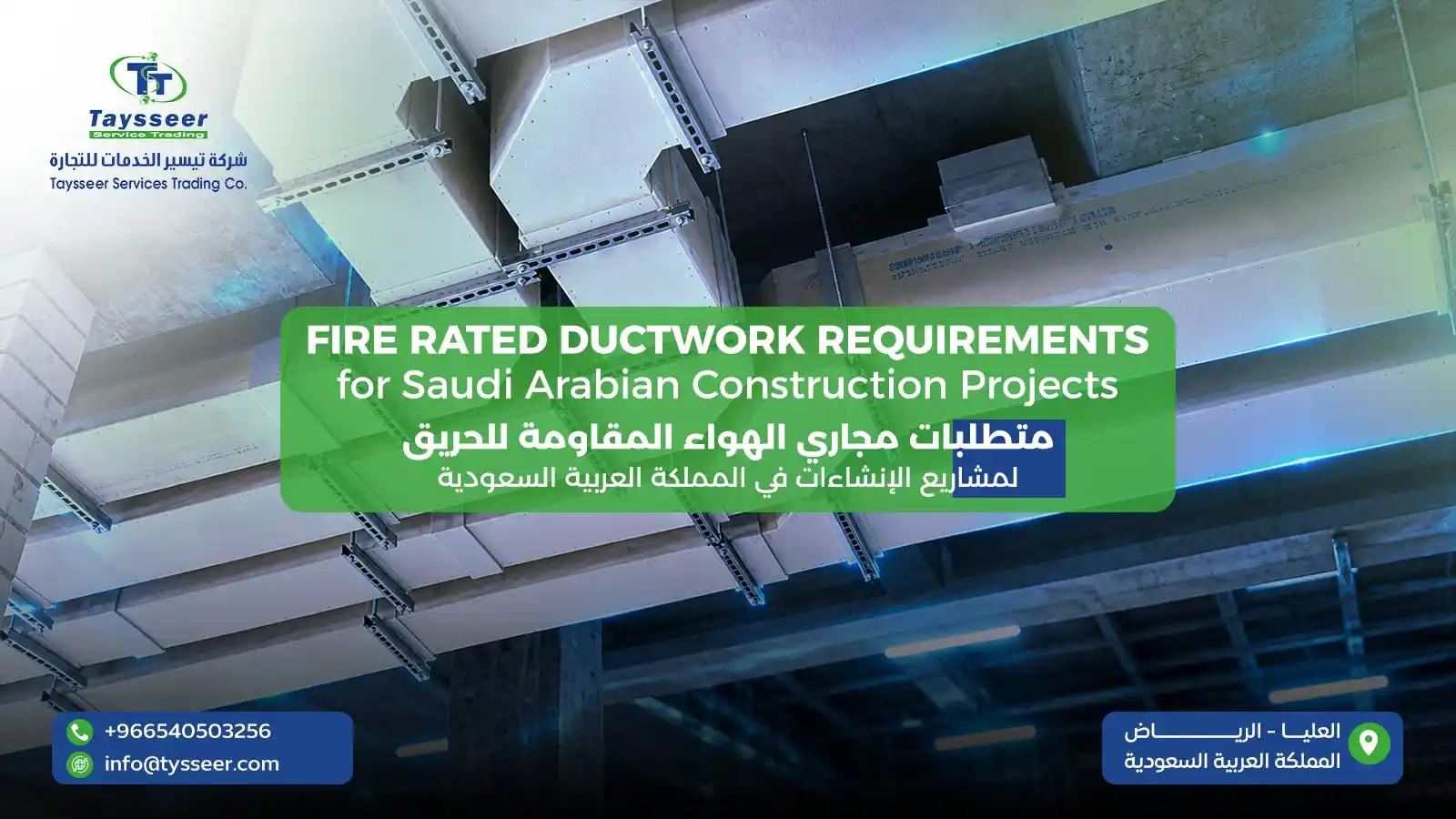
Fire rated ductwork is one of the most consistently misspecified and poorly understood elements in Saudi HVAC projects. The specification note reads “fire rated ductwork to applicable standards” and then the procurement team buys whatever is locally available, the installation crew applies it in the way they have always done, and nobody verifies whether the assembled system actually meets the fire rating claimed on the product data sheet.
This guide is written for mechanical engineers and government contractors who need to understand what fire rated ductwork actually means under Saudi codes, which standards govern, where it is required, and how to specify and verify compliance correctly.
Why Fire Rated Ductwork Exists
Duct systems present a specific fire risk that ordinary construction elements do not. An air distribution network connects virtually every occupied space in a building through a continuous pathway. In a fire event, this pathway becomes a route for smoke, toxic gases, and flame to propagate from the fire origin to spaces that would otherwise be protected by fire-rated compartmentation.
A standard sheet metal duct running through a fire-rated wall or floor assembly undermines the integrity of that assembly the moment the duct penetrates it. The duct itself conducts heat, and the air pathway carries smoke. Fire rated ductwork – combined with fire dampers, penetration seals, and correct system design – is the engineered response to this risk.
The consequence of getting this wrong on a Saudi government project is not just a failed inspection. It is potential liability for loss of life in a fire event where the duct system allowed smoke to spread to areas that should have been protected.
The Regulatory Framework in Saudi Arabia
Primary Reference: Saudi Building Code
The Saudi Building Code (SBC) is the primary regulatory framework for construction in the Kingdom. The SBC 801 volume covers fire protection requirements and references both SASO standards and international codes, primarily NFPA.
SBC 801 references NFPA 90A (Standard for the Installation of Air-Conditioning and Ventilating Systems) and NFPA 92 (Standard for Smoke Control Systems) as the principal technical standards for duct system fire protection. Engineers working on Saudi projects should treat NFPA 90A as effectively mandatory – it is the standard most inspection authorities reference when reviewing duct system drawings and submittals.
Saudi Civil Defence
The General Directorate of Civil Defence (GDCD) has authority over fire protection system approvals on construction projects in Saudi Arabia. For government projects, hospital projects, high-rise developments, and large commercial facilities, Civil Defence review and approval of fire protection drawings – including duct penetration details and fire damper schedules – is a formal requirement before a certificate of occupancy is issued.
Civil Defence inspectors in Saudi Arabia apply NFPA standards as their primary technical reference. Projects that attempt to use non-NFPA compliance documentation face difficulties during inspection regardless of whether an alternative standard is technically equivalent.
SASO Standards
The Saudi Standards, Metrology and Quality Organization (SASO) has adopted several standards relevant to fire rated ductwork materials:
SASO ISO 834: Fire resistance tests for building elements – the test standard referenced for fire rated duct assemblies.
SASO 2663: Saudi Building Code – Fire Protection, which incorporates the building-type-specific requirements for duct fire protection.
SASO 1195: Covers fire damper performance requirements referenced in duct system specifications.
For material submittals on government projects, test certificates referencing SASO-adopted standards carry weight in addition to NFPA-referenced test standards. Ideally, submittal packages reference both.
ARAMCO Standards
For projects on Saudi Aramco facilities, the applicable standard is SAES-K-001 (Requirements for Air Conditioning and Heating Systems) and SAES-K-002 (Requirements for Heating, Ventilating and Cooling Systems). These standards have specific duct material and fire rating requirements that differ in some respects from general SBC requirements. Engineers working on ARAMCO projects must obtain current versions of these standards directly from ARAMCO – they are not publicly available and are updated periodically.
Where Fire Rated Ductwork Is Required
Understanding where fire rated ductwork is required is as important as understanding what it is. Not every duct on a project needs fire rating. Applying fire rated products indiscriminately adds cost without improving safety; missing required locations is a compliance failure.
Duct Penetrations Through Fire-Rated Assemblies
Any duct that penetrates a fire-rated wall, floor, or ceiling assembly requires a fire-rated penetration treatment. This is either:
- A fire damper at the penetration point (the most common solution for HVAC ducts that need to remain open during normal operation), or
- A fire-rated duct wrap or enclosure system that maintains the fire rating of the duct through the penetration zone (used where fire dampers are not permitted – for example, smoke control ducts that must remain open during a fire event).
Under NFPA 90A, the duct penetration treatment must maintain the fire resistance rating of the assembly being penetrated. A two-hour fire-rated wall requires a two-hour rated damper or two-hour rated duct enclosure at the penetration.
Ducts Within Smoke Control Systems
Smoke control systems – stairwell pressurization, corridor smoke control, atrium smoke management – typically use ducts that must remain operational during a fire event. These ducts cannot have fire dampers (which would close and defeat the system) and therefore require the duct itself to be constructed or protected to maintain structural and operational integrity throughout the design fire duration.
NFPA 92 governs smoke control system design. For duct systems serving smoke control functions in Saudi buildings, the duct enclosure or construction must typically achieve a one-hour or two-hour fire resistance rating depending on the system design and building type.
This is one of the most technically demanding fire rated ductwork applications and the one most frequently under-specified on Saudi projects.
Kitchen Exhaust Ducts
Kitchen exhaust ducts carry grease-laden air and present a specific fire risk – grease accumulation in the duct creates a fuel-loaded pathway. NFPA 96 (Standard for Ventilation Control and Fire Protection of Commercial Cooking Operations) governs kitchen exhaust duct construction and is referenced in the SBC for commercial kitchen applications.
Requirements for kitchen exhaust ducts include:
- Minimum 1.37mm (16-gauge) black steel or stainless steel construction – no fiber glass or flexible duct.
- Continuous liquid-tight external welds on all seams.
- Fire-rated enclosure through any fire-rated assembly penetration.
- Clearance requirements from combustible construction.
- Listed grease duct enclosure systems where specified.
Kitchen exhaust ducts on Saudi hotel, hospital, and government building projects are frequently under-specified and under-inspected. Civil Defence increasingly enforces NFPA 96 requirements on these applications.
High-Rise Buildings
For buildings exceeding 23 meters in height – the threshold referenced in Saudi regulations for high-rise classification – additional duct system fire protection requirements apply. These include requirements for fire-rated enclosures on supply and return air shafts serving multiple floors, and more stringent requirements for duct penetrations through floor assemblies.
The specific height thresholds and requirements are defined in SBC 801 with reference to NFPA 101 (Life Safety Code). Engineers working on high-rise projects in Saudi Arabia should verify current requirements with the local Civil Defence authority, as enforcement has become more rigorous following fire incidents in the region.
Healthcare Facilities
Saudi Ministry of Health projects and private hospital developments follow the SBC healthcare occupancy requirements, which are more stringent than standard commercial requirements. Duct systems in smoke compartments, serving operating theatres, intensive care units, and patient sleeping areas have specific fire damper, duct construction, and smoke control requirements.
NFPA 99 (Health Care Facilities Code) is increasingly referenced alongside NFPA 90A on Saudi healthcare projects.
Fire Rated Ductwork Systems: What the Products Actually Are
The term “fire rated ductwork” covers several distinct system types. Understanding the difference matters for specification and procurement.
Intumescent Duct Wrap Systems
An intumescent wrap is a flexible blanket material applied to the exterior of a standard sheet metal duct. When exposed to fire, the intumescent material expands – typically to 8-10 times its original thickness – and forms an insulating char layer that limits heat transfer through the duct wall and prevents structural collapse for the rated duration.
How it works: The wrap expands under heat and fills the annular gap between the duct and the surrounding structure at penetration points, maintaining compartmentation while the duct maintains structural integrity long enough for evacuation.
Rated durations: Intumescent wrap systems are typically available in 60-minute (E60) and 120-minute (E120) ratings depending on the product and installation thickness.
Application: Applied like a conventional insulation wrap, with overlapping layers to achieve the required thickness for the rated duration. All joints must be secured and sealed per the manufacturer’s tested installation detail – any deviation from the tested detail invalidates the rating.
Brands commonly available in Saudi Arabia: Flamebar BW11 (Ductclad), Promat Durasteel systems, Rockwool ProRox fire-rated systems. Each carries independent fire test certificates from recognized testing bodies (WARRES, UL, or equivalent) and these test certificates must be submitted with the product submittal.
Fire Rated Enclosure Systems (Shaft Walls and Enclosures)
For ducts requiring fire rating over extended runs – not just at penetration points – the duct is enclosed within a fire-rated shaft or enclosure constructed from fire-rated board (calcium silicate, vermiculite board, or gypsum-based fire rated products).
This approach is used where:
- The duct run through an unprotected space is long enough that wrapping the duct itself is uneconomical.
- The duct serves a smoke control function and the entire shaft must maintain integrity.
- The duct material itself (fiber glass duct board, for example) cannot achieve fire rating and must be enclosed within a rated structure.
Factory-Built Fire Rated Duct Systems
Certain manufacturers produce ductwork that is factory-fabricated with integral fire rating – typically a steel duct with factory-applied fire-rated enclosure forming a single unit. These systems are used on projects where site application of fire protection to standard ducts is impractical or where factory quality control of the fire rating application is required by the specification.
These systems are more expensive than site-applied solutions but eliminate the quality control uncertainty of field-applied intumescent wraps.
Fire Dampers
Fire dampers are not duct insulation products but are an integral part of the fire-rated duct system and must be addressed in any complete specification. A fire damper installed in a non-rated duct penetrating a fire-rated wall does not make the system compliant – the damper must be listed for use in a fire-rated assembly and the installation must follow the listed installation detail exactly.
Key specification points for fire dampers on Saudi projects:
- Dampers must be listed to UL 555 or equivalent.
- Dynamic-rated dampers (tested with airflow) are required on systems that remain in operation during a fire event.
- Static-rated dampers are only acceptable on systems that are shut down on fire alarm activation.
- Access panels for damper inspection and reset must be provided at every fire damper location – this is a Civil Defence inspection requirement that is frequently missed.
Flamebar BW11: The Specification Standard for Saudi Projects
Flamebar BW11 (also marketed as Ductclad in some regions) is the most commonly specified intumescent duct wrap product on Saudi government and ARAMCO projects. Understanding this product is useful for any engineer working in the Saudi market.
What it is: A flexible, blanket-form intumescent wrap consisting of a graphite-based intumescent layer bonded to a reinforcing carrier. It is applied to the exterior of a standard sheet metal duct and held in place with banding or adhesive per the manufacturer’s installation instructions.
Fire ratings achieved: E60 (60 minutes) at a single layer of standard thickness, E120 (120 minutes) with increased thickness or double-layer application per the tested system detail.
Tested to: BS EN 1366-1 (Fire resistance tests for service installations – ducts) and equivalent standards. Test certificates from WARRES (Warren Ruffell and Associates) and other recognized bodies are available from the manufacturer and should be included in project submittals.
Why it is specified: Flamebar BW11 carries a strong track record of acceptance in Saudi Civil Defence submittals. The documentation package is complete, the installation method is straightforward, and the product has been used on major Saudi government and healthcare projects over many years.
Installation critical points: The tested installation detail specifies minimum overlap at joints, maximum gap at penetration points, and approved banding type and spacing. These details are not optional – they are the conditions under which the fire rating was tested. Site deviations must be formally reviewed against the tested system before accepting them as compliant.
Specifying Fire Rated Ductwork Correctly
Vague specification language creates procurement and compliance problems. The following guidance covers the key elements of a correct specification for fire rated ductwork on Saudi projects.
Define the Rating Required
State the required fire resistance rating explicitly in the specification and on drawings:
- E30 – 30 minutes integrity
- E60 – 60 minutes integrity
- EI60 – 60 minutes integrity and insulation (required where the duct surface temperature must be limited to protect adjacent combustible materials)
- E120 – 120 minutes integrity
The distinction between E and EI ratings is important and frequently missed. A duct penetrating a two-hour fire-rated floor assembly in a high-rise building typically requires EI120 – both integrity and insulation for 120 minutes. Specifying E120 only (integrity without insulation) may not satisfy the assembly rating requirement.
Reference the Test Standard
The specification must reference the test standard under which the fire rating was established:
- BS EN 1366-1 for duct systems (European standard, widely accepted in Saudi Arabia)
- UL 2221 (American standard, referenced on ARAMCO projects)
- ISO 6944 (International standard, referenced in SASO-adopted test methods)
The product’s test certificate must reference the same standard. A product tested to BS EN 1366-1 being specified for an application requiring UL 2221 compliance requires verification that the test results are accepted as equivalent – this is a submittal issue that must be resolved before procurement.
Specify the Installation Detail
Reference the manufacturer’s specific installation detail by document number in the specification. For Flamebar BW11, this means referencing the current Ductclad installation manual revision. This creates a documented obligation for the contractor to install exactly as tested.
Require Third-Party Test Certificates
The specification should require that:
- Fire test certificates from an accredited testing body accompany the product submittal.
- Test certificates are current (re-test frequency requirements vary by standard and should be confirmed).
- The tested configuration matches the proposed installation – particularly duct size range, penetration gap dimensions, and wall/floor construction type.
Include Inspection Requirements
Specify that fire rated ductwork installation is subject to inspection by the engineer of record or an approved third party before concealment. Once fire rated ductwork is enclosed within ceiling voids or shaft walls, verifying installation compliance is impossible without destructive investigation.
Common Compliance Failures on Saudi Projects
These are the most frequent fire rated ductwork compliance failures observed on Saudi construction projects during inspection and commissioning:
Incorrect product used: Standard duct insulation products submitted as fire rated. A product with a low flame spread index is not the same as a fire-rated product. Flamespread index (ASTM E84) tests surface burning behavior of materials; it does not test the fire resistance of an assembly. These are different tests with different purposes.
Fire damper access panels omitted: Civil Defence requires accessible inspection panels at every fire damper. This is consistently missed during installation and consistently flagged during Civil Defence inspection.
Deviation from tested installation detail: Banding at wider spacing than tested, insufficient overlap at joints, gaps at penetration points larger than allowed in the tested detail. All of these invalidate the claimed rating.
Rating not matched to assembly: A 60-minute rated wrap installed on a duct penetrating a two-hour rated assembly. The duct penetration treatment must match the assembly rating, not fall short of it.
No documentation: Products installed without fire test certificates in the project file. This is a Civil Defence requirement – if the certificate cannot be produced during inspection, the installation is non-compliant regardless of whether the product itself is correct.
Fiber glass insulation mistakenly used as fire protection: Fiber glass duct wrap provides thermal insulation and has a low flame spread index, but it is not a fire resistance product. It does not provide E-rated fire resistance for duct penetrations and should not be specified or submitted as fire protection.
Submittal Package Requirements
For fire rated ductwork products on Saudi government and Civil Defence-reviewed projects, the submittal package should include:
- Product data sheet identifying the specific product, manufacturer, and applicable standards.
- Fire test certificate from an accredited testing body, referencing the specific test standard.
- Test report reference number and issuing body, with expiry date if applicable.
- Installation manual or installation detail drawing showing the tested configuration.
- Statement of compliance confirming the proposed installation matches the tested configuration.
- For ARAMCO projects: confirmation of approved vendor status for the specific product.
- MSDS / SDS for the product.
- Manufacturer’s warranty terms.
Frequently Asked Questions
Q: Does every duct on a Saudi project require fire rating?
No. Fire rated ductwork is required at specific locations – duct penetrations through fire-rated assemblies, smoke control system ducts, kitchen exhaust ducts, and high-rise applications as defined in SBC 801 and NFPA 90A. Standard supply and return air ductwork in open office spaces, residential apartments, and similar locations does not require fire rating unless it penetrates a fire-rated assembly.
Q: Is Flamebar the only accepted fire rated duct wrap on Saudi government projects?
Flamebar BW11 is the most commonly pre-accepted product in Saudi Civil Defence submittals, but it is not the only compliant option. Promat, Rockwool, and other manufacturers produce fire-rated duct systems that meet the relevant test standards. The acceptance depends on the project specification and the completeness of the product’s documentation package. Projects specifying “fire rated ductwork to BS EN 1366-1, E60” accept any product with a compliant test certificate, not exclusively Flamebar.
Q: Can fiber glass duct board be used where fire rated ductwork is required?
Standard fiber glass duct board – Kimmco DuctBoard, Afico equivalent – has a low flame spread index and meets ASTM E84 requirements for use in HVAC systems. It is not a fire-rated product in the sense of providing E or EI rated fire resistance at penetrations. Where fire rated ductwork is required, standard fiber glass duct board must be enclosed within a fire-rated shaft or replaced with a compliant system. This is a frequent specification error on Saudi projects where engineers assume that “non-combustible” and “fire-rated” are the same thing.
Q: What is the Saudi Civil Defence position on UL-listed vs. BS EN-certified fire products?
Saudi Civil Defence inspectors generally accept both UL and BS EN test certifications, as both reference systems are recognized under SBC. In practice, products certified to BS EN 1366-1 are the most commonly submitted on Saudi projects for fire rated ductwork, reflecting the prevalence of European-manufactured products in the GCC supply chain. ARAMCO projects typically reference UL standards specifically – confirm the applicable standard with the ARAMCO project engineer before specifying.
Q: How often does fire rated ductwork installation need to be inspected?
Civil Defence requires inspection before the installation is concealed. After concealment, verification requires destructive investigation, which is why pre-concealment inspection is a contractual and regulatory requirement. For large projects, the inspection program should be staged to align with the construction program – inspecting and signing off each zone before the ceiling void is closed.
Conclusion
Fire rated ductwork compliance on Saudi projects requires understanding three things clearly: where it is required under SBC 801, NFPA 90A, and project-specific standards; what the products actually do and how the ratings are achieved; and what correct installation and documentation look like.
The regulatory framework in Saudi Arabia is NFPA-based and Civil Defence-enforced. Projects that treat fire rated ductwork as a procurement decision rather than a compliance discipline consistently produce installations that fail inspection, require costly remediation, or worse, fail during a fire event in ways that affect life safety.
Correct specification at the design stage – explicit fire ratings, referenced test standards, installation details by document number, and inspection requirements – is the most effective intervention available to engineers. It sets the standard that procurement and installation must meet and creates the documentation trail that Civil Defence inspection requires.
Tysseer Trading Services Company supplies Flamebar BW11 and other approved fire rated ductwork systems for HVAC projects across Saudi Arabia, with technical support available for specification development, product selection, and project submittal packages.